Pearson Edexcel · A-Level · History
Course version: 9HI0 · Version from Sept 2015
The unification of Germany, c1840–71 - 4 Prussia and the Klein-…
Full specification wording
Paper 2, Option 2D.2: The unification of Germany, c1840–71 - 4 Prussia and the Klein- deutschland solution, 1866–71: Reasons for Prussia’s success, including the role of Bismarck, military strength, economic factors, German nationalism and the international situation.
Prussia’s success in unifying Germany rested on several interlocking reasons.
Checked against the Pearson Edexcel 9HI0 specification (opens in a new tab) on .
- Point 4 of 4
- 4 key terms
Study notes
From the checked teaching notes for this specification point.
The idea
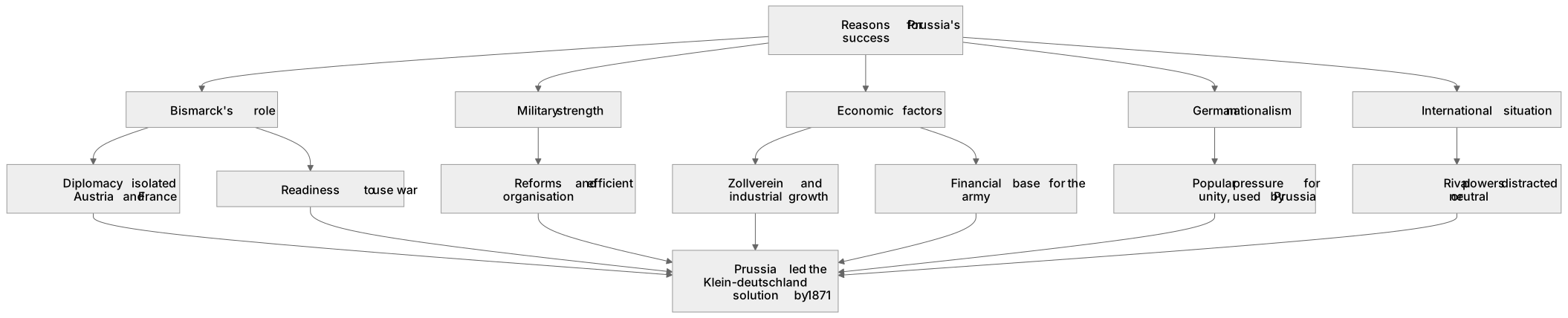
Prussia’s success in unifying Germany rested on several interlocking reasons. Bismarck’s role was central: his diplomacy isolated Austria and France, and his willingness to use war served Prussian interests. Military strength mattered: reforms and efficient organisation gave Prussia battlefield advantages. Economic factors were also important: the Zollverein and industrial growth tied German states to Prussia and funded its army. German nationalism provided popular pressure for unity, though it was often used by Prussia rather than controlled by it. The international situation helped: rival powers were distracted or neutral, allowing Prussia to act without a major coalition against it. Together, these reasons explain why Prussia, not Austria, led the Klein-deutschland solution by 1871.
What earns the marks
- Explains Bismarck’s role, for example through diplomacy, manipulation of international crises, and readiness to use war.
- Explains military strength, for example through army reforms, organisation, and technological or tactical advantages.
- Explains economic factors, for example the Zollverein, industrial growth, and the financial base for military power.
- Explains German nationalism, for example popular support for unity and its use by Prussia to justify leadership.
- Explains the international situation, for example the neutrality or distraction of other powers and the isolation of Austria and France.
Common mistakes and how to put them right
Treating Bismarck as the only reason for success.
Put it right: Explain how military, economic, nationalist and international factors also contributed.
Assuming German nationalism was always controlled by Bismarck.
Put it right: Recognise popular nationalist pressure as a factor that Prussia could use but not fully control.
Ignoring the international situation.
Put it right: Explain how the attitudes of other powers allowed Prussia to act.
Exam tips
- Organise your answer around the named reasons, but show how they connected to each other.
- Use specific examples, such as the Zollverein, army reforms, or diplomatic isolation of Austria and France.
- Explain why each reason mattered for Prussia’s success, not just what happened.
Try the lesson
The start of the Paper 2, Option 2D.2: The unification of Germany, c1840–71 - 4 Prussia and the Klein- deutschland solution, 1866–71: Reasons for Prussia’s success, including the role of Bismarck, military strength, economic factors, German nationalism and the international situation. lesson, made from checked teaching notes for this specification point.
Have a go first
Which economic development most helped Prussia to fund and equip its army before 1871?
Listen
Prussia’s success in unifying Germany rested on several interlocking reasons. Bismarck’s role was central: his diplomacy isolated Austria and France, and his willingness to use war served Prussian interests. Military strength mattered: reforms and efficient organisation gave Prussia battlefield advantages. Economic factors were also important: the Zollverein and industrial growth tied German states to Prussia and funded its army. German nationalism provided popular pressure for unity, though it was often used by Prussia rather than controlled by it. The international situation helped: rival powers were distracted or neutral, allowing Prussia to act without a major coalition against it. Together, these reasons explain why Prussia, not Austria, led the Klein-deutschland solution by 1871. A strong answer earns marks for these points. Explains Bismarck’s role, for example through diplomacy, manipulation of international crises, and readiness to use war. Explains military strength, for example through army reforms, organisation, and technological or tactical advantages. Explains economic factors, for example the Zollverein, industrial growth, and the financial base for military power. Explains German nationalism, for example popular support for unity and its use by Prussia to justify leadership. A common slip: Treating Bismarck as the only reason for success. Instead, explain how military, economic, nationalist and international factors also contributed. Exam tip: Organise your answer around the named reasons, but show how they connected to each other.
See it
Key words
Say what each word means before you turn the card.
Leadership and diplomacy
Try answering aloud or in your head before turning the card.
Military power
Try answering aloud or in your head before turning the card.
Economic strength
Try answering aloud or in your head before turning the card.
Nationalism and international context
Try answering aloud or in your head before turning the card.
See every definition
- Leadership and diplomacy
- Bismarck’s role was central, as his diplomacy isolated Austria and France and his willingness to use war served Prussian interests.
- Military power
- Reforms and efficient organisation gave Prussia battlefield advantages, including technological or tactical advantages.
- Economic strength
- The Zollverein and industrial growth tied German states to Prussia and funded its army, providing a financial base for military power.
- Nationalism and international context
- German nationalism provided popular pressure for unity, often used by Prussia rather than controlled by it, while rival powers were distracted or neutral, allowing Prussia to act without a major coalition against it.
Label the diagram
Some boxes have lost their names. Pick the right name for each number.
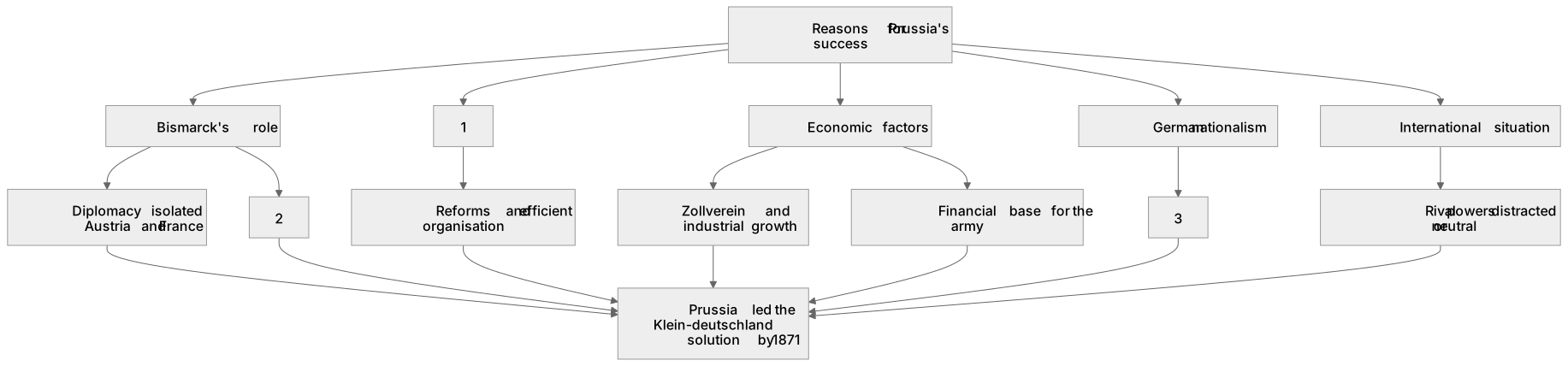
1Box 1
2Box 2
3Box 3
There is more to this lesson
The full lesson goes on to check your understanding and help you earn the marks. Create a free account to carry on, with your progress saved.
A week of Premium from your first lesson · Then the free plan continues · No card, no charge
Test your understanding of Paper 2, Option 2D.2: The unification of Germany, c1840–71 - 4 Prussia and the Klein- deutschland solution, 1866–71: Reasons for Prussia’s success, including the role of Bismarck, military strength, economic factors, German nationalism and the international situation.
Active recall beats re-reading. Take an instant quiz now to test what you’ve learned and lock it into long-term memory.
A week of Premium from your first lesson · Then the free plan continues · No card, no charge