Pearson Edexcel · A-Level · History
Course version: 9HI0 · Version from Sept 2015
The unification of Germany, c1840–71 - 4 Prussia and the Klein-…
Full specification wording
Paper 2, Option 2D.2: The unification of Germany, c1840–71 - 4 Prussia and the Klein- deutschland solution, 1866–71: The significance of the Franco-Prussian War, including increased support for German nationalism, strengthening of Bismarck’s position and the creation of a German Empire; the significance of the Treaty of Frankfurt 1871.
The Franco-Prussian War (1870–71) was the final stage of German unification.
Checked against the Pearson Edexcel 9HI0 specification (opens in a new tab) on .
- Point 3 of 4
- 4 key terms
Study notes
From the checked teaching notes for this specification point.
The idea
The Franco-Prussian War (1870–71) was the final stage of German unification. Its significance lies in three linked outcomes. First, it increased support for German nationalism: the war against a foreign enemy rallied the south German states to Prussia’s side, overcoming earlier reluctance and making unity popular. Second, it strengthened Bismarck’s position: his diplomacy isolated France, and victory made him indispensable to the new order. Third, it created a German Empire: the defeat of France allowed the proclamation of the Empire at Versailles in January 1871, with Wilhelm I as Kaiser. The Treaty of Frankfurt (May 1871) confirmed this new balance: France ceded Alsace-Lorraine, paid an indemnity, and accepted German unification. Together, these outcomes show how war and treaty turned Prussian leadership into a German Empire.
What earns the marks
- Explains how the war increased support for German nationalism, for example by provoking a patriotic response in the south German states and overcoming particularist resistance.
- Explains how the war strengthened Bismarck’s position, for example by allowing him to control diplomacy, isolate France, and present himself as the architect of victory.
- Explains how the war led to the creation of a German Empire, for example through the proclamation at Versailles in January 1871 and the acceptance of Wilhelm I as Kaiser.
- Explains the significance of the Treaty of Frankfurt 1871, for example the cession of Alsace-Lorraine, the payment of an indemnity, and the confirmation of German unification.
- Links the three outcomes together, showing how military victory, political leadership and territorial settlement reinforced each other.
Common mistakes and how to put them right
Treating the war as only a military event and ignoring its political consequences.
Put it right: Explain how it changed nationalist sentiment, Bismarck’s authority and the creation of the Empire.
Assuming the Treaty of Frankfurt simply ended the war without lasting significance.
Put it right: Explain how its terms affected France, Germany and future relations.
Confusing the proclamation of the German Empire with the Treaty of Frankfurt.
Put it right: Distinguish the political creation of the Empire in January 1871 from the formal peace settlement in May 1871.
Exam tips
- Use the three outcomes as a structure: nationalism, Bismarck’s position, and the Empire, then add the Treaty of Frankfurt as the settlement that confirmed them.
- Support each point with specific evidence, such as the proclamation at Versailles or the terms of the Treaty of Frankfurt.
- Explain significance rather than just describing events: say why each outcome mattered for unification and for the future.
Try the lesson
The start of the Paper 2, Option 2D.2: The unification of Germany, c1840–71 - 4 Prussia and the Klein- deutschland solution, 1866–71: The significance of the Franco-Prussian War, including increased support for German nationalism, strengthening of Bismarck’s position and the creation of a German Empire; the significance of the Treaty of Frankfurt 1871. lesson, made from checked teaching notes for this specification point.
Have a go first
Which territory was transferred from France to the new German Empire under the terms of the Treaty of Frankfurt in 1871?
Listen
The Franco-Prussian War (1870–71) was the final stage of German unification. Its significance lies in three linked outcomes. First, it increased support for German nationalism: the war against a foreign enemy rallied the south German states to Prussia’s side, overcoming earlier reluctance and making unity popular. Second, it strengthened Bismarck’s position: his diplomacy isolated France, and victory made him indispensable to the new order. Third, it created a German Empire: the defeat of France allowed the proclamation of the Empire at Versailles in January 1871, with Wilhelm I as Kaiser. The Treaty of Frankfurt (May 1871) confirmed this new balance: France ceded Alsace-Lorraine, paid an indemnity, and accepted German unification. Together, these outcomes show how war and treaty turned Prussian leadership into a German Empire. A strong answer earns marks for these points. Explains how the war increased support for German nationalism, for example by provoking a patriotic response in the south German states and overcoming particularist resistance. Explains how the war strengthened Bismarck’s position, for example by allowing him to control diplomacy, isolate France, and present himself as the architect of victory. Explains how the war led to the creation of a German Empire, for example through the proclamation at Versailles in January 1871 and the acceptance of Wilhelm I as Kaiser. Explains the significance of the Treaty of Frankfurt 1871, for example the cession of Alsace-Lorraine, the payment of an indemnity, and the confirmation of German unification. A common slip: Treating the war as only a military event and ignoring its political consequences. Instead, explain how it changed nationalist sentiment, Bismarck’s authority and the creation of the Empire. Exam tip: Use the three outcomes as a structure: nationalism, Bismarck’s position, and the Empire, then add the Treaty of Frankfurt as the settlement that confirmed them.
See it
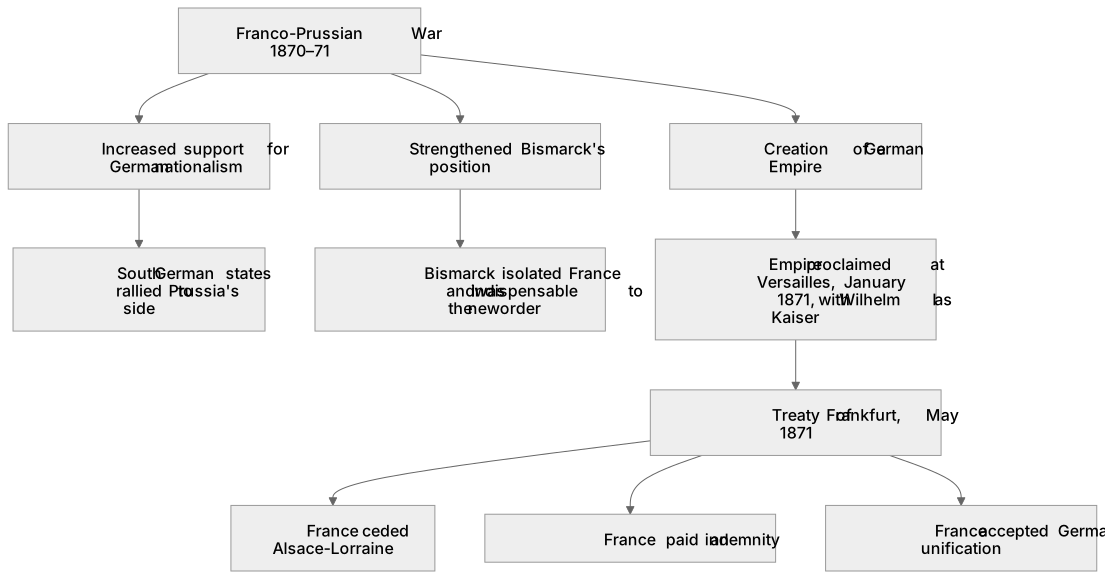
Key words
Say what each word means before you turn the card.
Nationalism and popular support
Try answering aloud or in your head before turning the card.
Political leadership and diplomacy
Try answering aloud or in your head before turning the card.
War and state creation
Try answering aloud or in your head before turning the card.
Peace settlements and their consequences
Try answering aloud or in your head before turning the card.
See every definition
- Nationalism and popular support
- The war against a foreign enemy rallied the south German states to Prussia's side, overcoming earlier reluctance and making unity popular.
- Political leadership and diplomacy
- His diplomacy isolated France, and victory made him indispensable to the new order.
- War and state creation
- The defeat of France allowed the proclamation of the Empire at Versailles in January 1871, with Wilhelm I as Kaiser.
- Peace settlements and their consequences
- The Treaty of Frankfurt confirmed the new balance: France ceded Alsace-Lorraine, paid an indemnity, and accepted German unification.
Label the diagram
Some boxes have lost their names. Pick the right name for each number.
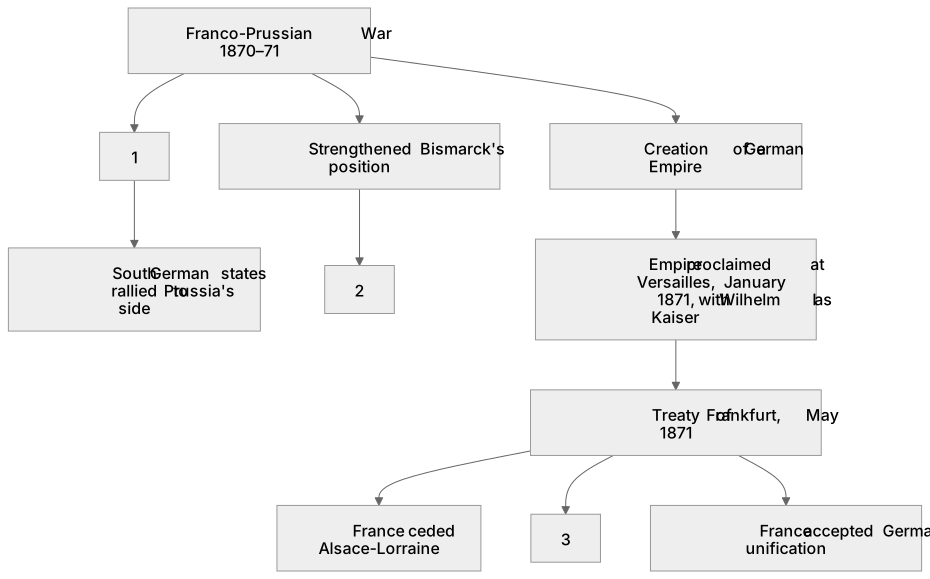
1Box 1
2Box 2
3Box 3
There is more to this lesson
The full lesson goes on to check your understanding and help you earn the marks. Create a free account to carry on, with your progress saved.
A week of Premium from your first lesson · Then the free plan continues · No card, no charge
Test your understanding of Paper 2, Option 2D.2: The unification of Germany, c1840–71 - 4 Prussia and the Klein- deutschland solution, 1866–71: The significance of the Franco-Prussian War, including increased support for German nationalism, strengthening of Bismarck’s position and the creation of a German Empire; the significance of the Treaty of Frankfurt 1871.
Active recall beats re-reading. Take an instant quiz now to test what you’ve learned and lock it into long-term memory.
A week of Premium from your first lesson · Then the free plan continues · No card, no charge