Pearson Edexcel · A-Level · History
Course version: 9HI0 · Version from Sept 2015
South Africa, 1948–94: from apartheid state to ‘rainbow nation’ - 2…
Full specification wording
Paper 2, Option 2F.2: South Africa, 1948–94: from apartheid state to ‘rainbow nation’ - 2 Radicalisation of resistance and the consolidation of National Party power, 1960–68: Resistance to apartheid and government reaction, 1960– 61: peaceful protest; the Sharpeville Massacre and its significance; the banning of political parties and the state of emergency.
In 1960–61, resistance to apartheid shifted from peaceful protest to state repression.
Checked against the Pearson Edexcel 9HI0 specification (opens in a new tab) on .
- Point 1 of 4
- 4 key terms
Study notes
From the checked teaching notes for this specification point.
The idea
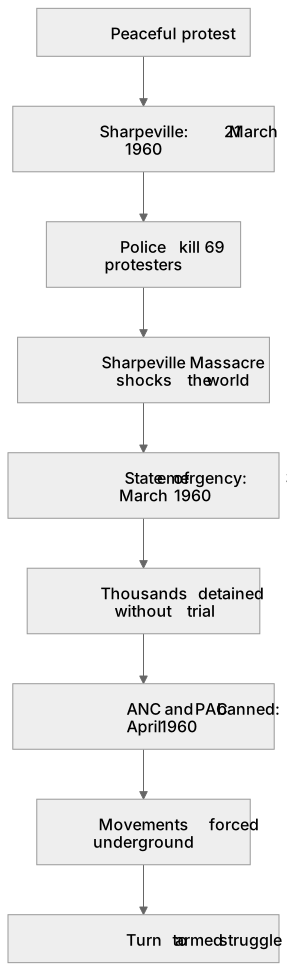
In 1960–61, resistance to apartheid shifted from peaceful protest to state repression. The PAC’s anti-pass campaign began on 21 March 1960 at Sharpeville, where police killed 69 protesters. The Sharpeville Massacre shocked the world and exposed apartheid’s violence. In response, the government declared a state of emergency on 30 March 1960, detaining thousands without trial. On 8 April 1960, it banned the ANC and PAC under the Unlawful Organisations Act. Peaceful protest had failed; both movements turned to armed struggle. The events radicalised resistance and consolidated National Party power.
What earns the marks
- Explains that peaceful protest before 1960 included the 1952 Defiance Campaign, the 1955 Freedom Charter, and the 1959 anti-pass campaign, showing mass mobilisation but limited concessions.
- Describes the Sharpeville Massacre: on 21 March 1960, PAC protesters gathered at Sharpeville police station against pass laws; police opened fire, killing 69 and wounding 180, many shot in the back.
- Analyses the significance of Sharpeville: it exposed apartheid brutality, provoked international condemnation, led to a state of emergency, and prompted the banning of the ANC and PAC.
- Explains the government reaction: a state of emergency declared on 30 March 1960, mass detentions without trial, and the banning of political parties on 8 April 1960 under the Unlawful Organisations Act.
- Evaluates the consequences: the ANC and PAC were forced underground, leading to the formation of Umkhonto we Sizwe (MK) in 1961 and Poqo, marking a turn to armed struggle.
Common mistakes and how to put them right
Confusing the Sharpeville Massacre with the Soweto Uprising of 1976.
Put it right: Sharpeville occurred on 21 March 1960 and involved pass-law protests, while Soweto was a 1976 student protest against Afrikaans-medium instruction.
Stating that the ANC was banned before Sharpeville.
Put it right: The ANC and PAC were banned on 8 April 1960, after the massacre and the declaration of the state of emergency.
Claiming that peaceful protest continued unchanged after 1960.
Put it right: The bans and state repression pushed the ANC and PAC towards armed struggle, with MK formed in 1961.
Exam tips
- Use precise dates and casualty figures to support your arguments, such as 21 March 1960, 69 killed, and 8 April 1960 for the banning of parties.
- Link each event to the theme of radicalisation and consolidation of National Party power, explaining how repression led to a shift in resistance tactics.
- When analysing significance, consider short-term and long-term impacts, including international reaction, internal repression, and the move to armed struggle.
Try the lesson
The start of the Paper 2, Option 2F.2: South Africa, 1948–94: from apartheid state to ‘rainbow nation’ - 2 Radicalisation of resistance and the consolidation of National Party power, 1960–68: Resistance to apartheid and government reaction, 1960– 61: peaceful protest; the Sharpeville Massacre and its significance; the banning of political parties and the state of emergency. lesson, made from checked teaching notes for this specification point.
Have a go first
Which organisation called the peaceful anti-pass campaign that began in Sharpeville in March 1960?
Listen
In 1960–61, resistance to apartheid shifted from peaceful protest to state repression. The PAC’s anti-pass campaign began on 21 March 1960 at Sharpeville, where police killed 69 protesters. The Sharpeville Massacre shocked the world and exposed apartheid’s violence. In response, the government declared a state of emergency on 30 March 1960, detaining thousands without trial. On 8 April 1960, it banned the ANC and PAC under the Unlawful Organisations Act. Peaceful protest had failed; both movements turned to armed struggle. The events radicalised resistance and consolidated National Party power. A strong answer earns marks for these points. Explains that peaceful protest before 1960 included the 1952 Defiance Campaign, the 1955 Freedom Charter, and the 1959 anti-pass campaign, showing mass mobilisation but limited concessions. Describes the Sharpeville Massacre: on 21 March 1960, PAC protesters gathered at Sharpeville police station against pass laws; police opened fire, killing 69 and wounding 180, many shot in the back. Analyses the significance of Sharpeville: it exposed apartheid brutality, provoked international condemnation, led to a state of emergency, and prompted the banning of the ANC and PAC. Explains the government reaction: a state of emergency declared on 30 March 1960, mass detentions without trial, and the banning of political parties on 8 April 1960 under the Unlawful Organisations Act. A common slip: Confusing the Sharpeville Massacre with the Soweto Uprising of 1976. Instead, Sharpeville occurred on 21 March 1960 and involved pass-law protests, while Soweto was a 1976 student protest against Afrikaans-medium instruction. Exam tip: Use precise dates and casualty figures to support your arguments, such as 21 March 1960, 69 killed, and 8 April 1960 for the banning of parties.
See it
Key words
Say what each word means before you turn the card.
Peaceful protest and its limitations
Try answering aloud or in your head before turning the card.
State repression and the banning of political parties
Try answering aloud or in your head before turning the card.
The significance of the Sharpeville Massacre
Try answering aloud or in your head before turning the card.
Radicalisation of resistance and the turn to armed struggle
Try answering aloud or in your head before turning the card.
See every definition
- Peaceful protest and its limitations
- Mass mobilisation through methods such as the Defiance Campaign and the Freedom Charter produced only limited concessions, and after 1960 peaceful protest had failed.
- State repression and the banning of political parties
- The government declared a state of emergency on 30 March 1960, detaining thousands without trial, and banned the ANC and PAC on 8 April 1960 under the Unlawful Organisations Act.
- The significance of the Sharpeville Massacre
- It exposed apartheid brutality, provoked international condemnation, led to a state of emergency, and prompted the banning of the ANC and PAC.
- Radicalisation of resistance and the turn to armed struggle
- With the ANC and PAC forced underground, Umkhonto we Sizwe was formed in 1961 and Poqo emerged, marking a turn to armed struggle.
Label the diagram
Some boxes have lost their names. Pick the right name for each number.
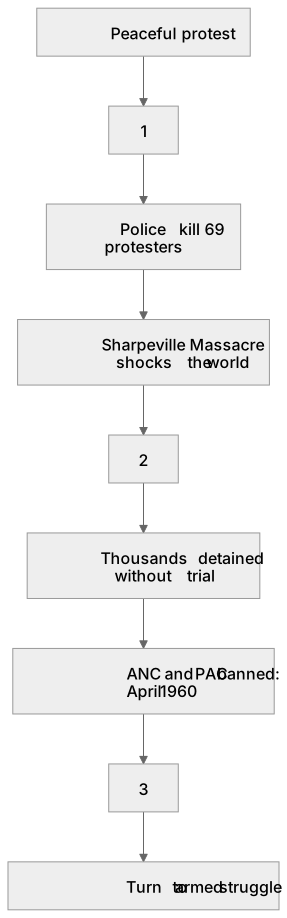
1Box 1
2Box 2
3Box 3
There is more to this lesson
The full lesson goes on to check your understanding and help you earn the marks. Create a free account to carry on, with your progress saved.
A week of Premium from your first lesson · Then the free plan continues · No card, no charge
Test your understanding of Paper 2, Option 2F.2: South Africa, 1948–94: from apartheid state to ‘rainbow nation’ - 2 Radicalisation of resistance and the consolidation of National Party power, 1960–68: Resistance to apartheid and government reaction, 1960– 61: peaceful protest; the Sharpeville Massacre and its significance; the banning of political parties and the state of emergency.
Active recall beats re-reading. Take an instant quiz now to test what you’ve learned and lock it into long-term memory.
A week of Premium from your first lesson · Then the free plan continues · No card, no charge