Pearson Edexcel · A-Level · History
Course version: 9HI0 · Version from Sept 2015
South Africa, 1948–94: from apartheid state to ‘rainbow nation’ - 4 The…
Full specification wording
Paper 2, Option 2F.2: South Africa, 1948–94: from apartheid state to ‘rainbow nation’ - 4 The end of apartheid and the creation of the ‘rainbow nation’, 1984–94: A new political settlement, 1992–94: CODESA negotiations; nationalist divisions and communal violence; constitutional agreement and elections; the Government of National Unity; international recognition.
This topic covers the transition from apartheid to democracy between 1992 and 1994.
Checked against the Pearson Edexcel 9HI0 specification (opens in a new tab) on .
- Point 4 of 4
- 4 key terms
Study notes
From the checked teaching notes for this specification point.
The idea
This topic covers the transition from apartheid to democracy between 1992 and 1994. CODESA negotiations were undermined by nationalist divisions, including white right-wing resistance, and by communal violence such as ANC–IFP clashes and the Boipatong massacre. Homeland violence, like the Bisho massacre, further strained talks. Despite breakdowns, a constitutional agreement emerged in 1993 through the Multi-Party Negotiating Process, setting a date for elections and interim power-sharing. The April 1994 elections brought the ANC to power under Mandela, with a Government of National Unity including the NP and IFP. International recognition followed through the lifting of sanctions and South Africa’s return to global bodies.
What earns the marks
- Explains the course of CODESA negotiations, including the breakdown in 1992 and the later Multi-Party Negotiating Process that produced the 1993 interim constitution.
- Analyses nationalist divisions, such as white right-wing opposition and Bantustan leaders’ resistance, as obstacles to a unified settlement.
- Assesses communal violence, including ANC–IFP clashes and the Boipatong massacre, alongside homeland violence like the Bisho massacre, as factors that shaped negotiation strategies and concessions.
- Explains the constitutional agreement and the April 1994 elections as a compromise settlement involving power-sharing, a bill of rights and a five-year Government of National Unity.
- Evaluates the Government of National Unity as a mechanism to reassure minorities and include rival parties, while noting its temporary and contested nature.
- Examines international recognition through the lifting of sanctions, South Africa’s re-admission to the Commonwealth and the UN, and global acceptance of the 1994 election.
Common mistakes and how to put them right
Treating CODESA as a single successful event.
Put it right: Distinguish CODESA I, its breakdown, and the later Multi-Party Negotiating Process that achieved agreement.
Misclassifying the Bisho massacre as communal violence.
Put it right: Bisho involved Ciskei homeland security forces firing on ANC marchers, whereas communal violence typically involved ANC–IFP clashes.
Assuming the Government of National Unity was a permanent solution.
Put it right: Explain it was a five-year transitional arrangement designed to share power and reduce fear.
Confusing international recognition with the end of all sanctions.
Put it right: Note that sanctions were lifted progressively as reforms became irreversible, not all at once.
Exam tips
- Use specific dates and agreements, such as the 1993 interim constitution and the 27 April 1994 election, to demonstrate precise knowledge.
- When discussing divisions, distinguish between different nationalist groups and their aims, avoiding generalisations about ‘black’ or ‘white’ politics.
- Link international recognition to domestic developments, explaining how external acceptance depended on credible negotiations and elections.
Try the lesson
The start of the Paper 2, Option 2F.2: South Africa, 1948–94: from apartheid state to ‘rainbow nation’ - 4 The end of apartheid and the creation of the ‘rainbow nation’, 1984–94: A new political settlement, 1992–94: CODESA negotiations; nationalist divisions and communal violence; constitutional agreement and elections; the Government of National Unity; international recognition. lesson, made from checked teaching notes for this specification point.
Have a go first
What was the name of the multiparty negotiation forum that first met in South Africa in December 1991?
Listen
This topic covers the transition from apartheid to democracy between 1992 and 1994. CODESA negotiations were undermined by nationalist divisions, including white right-wing resistance, and by communal violence such as ANC–IFP clashes and the Boipatong massacre. Homeland violence, like the Bisho massacre, further strained talks. Despite breakdowns, a constitutional agreement emerged in 1993 through the Multi-Party Negotiating Process, setting a date for elections and interim power-sharing. The April 1994 elections brought the ANC to power under Mandela, with a Government of National Unity including the NP and IFP. International recognition followed through the lifting of sanctions and South Africa’s return to global bodies. A strong answer earns marks for these points. Explains the course of CODESA negotiations, including the breakdown in 1992 and the later Multi-Party Negotiating Process that produced the 1993 interim constitution. Analyses nationalist divisions, such as white right-wing opposition and Bantustan leaders’ resistance, as obstacles to a unified settlement. Assesses communal violence, including ANC–IFP clashes and the Boipatong massacre, alongside homeland violence like the Bisho massacre, as factors that shaped negotiation strategies and concessions. Explains the constitutional agreement and the April 1994 elections as a compromise settlement involving power-sharing, a bill of rights and a five-year Government of National Unity. A common slip: Treating CODESA as a single successful event. Instead, distinguish CODESA I, its breakdown, and the later Multi-Party Negotiating Process that achieved agreement. Exam tip: Use specific dates and agreements, such as the 1993 interim constitution and the 27 April 1994 election, to demonstrate precise knowledge.
See it
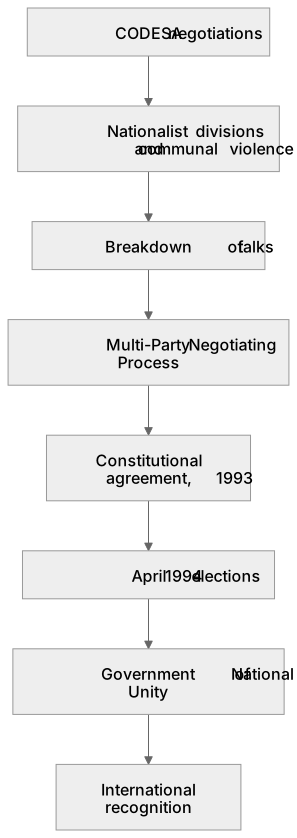
Put it in order
Put these steps in the order they happen.
- 1. Constitutional agreement, 1993
- 2. International recognition
- 3. April 1994 elections
- 4. CODESA negotiations
- 5. Nationalist divisions and communal violence
- 6. Government of National Unity
- 7. Breakdown of talks
- 8. Multi-Party Negotiating Process
Put the events in order
Put these events in the order they happened, earliest first.
- 1. CODESA negotiations broke down
- 2. April elections brought the ANC to power under Mandela
- 3. Multi-Party Negotiating Process produced interim constitution
Key words
Say what each word means before you turn the card.
Constitutional negotiation
Try answering aloud or in your head before turning the card.
Nationalist and communal conflict
Try answering aloud or in your head before turning the card.
Power-sharing and compromise
Try answering aloud or in your head before turning the card.
International legitimacy
Try answering aloud or in your head before turning the card.
See every definition
- Constitutional negotiation
- The CODESA negotiations and the later Multi-Party Negotiating Process that produced the 1993 interim constitution and a constitutional agreement.
- Nationalist and communal conflict
- Nationalist divisions such as white right-wing resistance and Bantustan leaders' resistance, alongside communal violence such as ANC–IFP clashes and the Boipatong massacre.
- Power-sharing and compromise
- A compromise settlement involving power-sharing, a bill of rights and a five-year Government of National Unity including the NP and IFP.
- International legitimacy
- International recognition through the lifting of sanctions and South Africa's return to global bodies, including re-admission to the Commonwealth and the UN.
Label the diagram
Some boxes have lost their names. Pick the right name for each number.
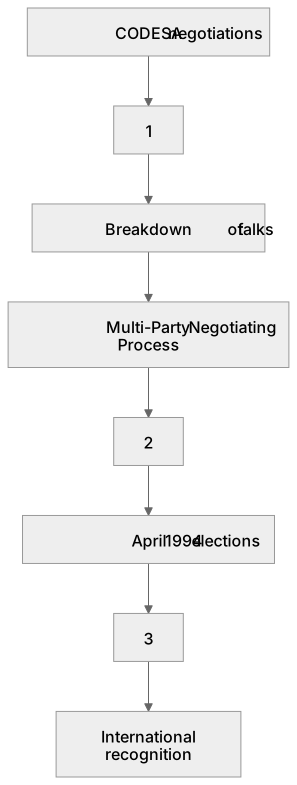
1Box 1
2Box 2
3Box 3
There is more to this lesson
The full lesson goes on to check your understanding and help you earn the marks. Create a free account to carry on, with your progress saved.
A week of Premium from your first lesson · Then the free plan continues · No card, no charge
Test your understanding of Paper 2, Option 2F.2: South Africa, 1948–94: from apartheid state to ‘rainbow nation’ - 4 The end of apartheid and the creation of the ‘rainbow nation’, 1984–94: A new political settlement, 1992–94: CODESA negotiations; nationalist divisions and communal violence; constitutional agreement and elections; the Government of National Unity; international recognition.
Active recall beats re-reading. Take an instant quiz now to test what you’ve learned and lock it into long-term memory.
A week of Premium from your first lesson · Then the free plan continues · No card, no charge