Pearson Edexcel · A-Level · History
Course version: 9HI0 · Version from Sept 2015
South Africa, 1948–94: from apartheid state to ‘rainbow nation’ - 4 The…
Full specification wording
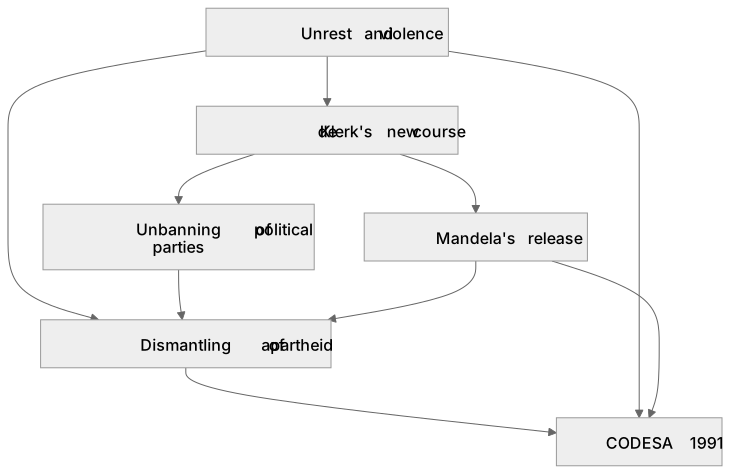
Paper 2, Option 2F.2: South Africa, 1948–94: from apartheid state to ‘rainbow nation’ - 4 The end of apartheid and the creation of the ‘rainbow nation’, 1984–94: Negotiation and compromise, 1989–91: de Klerk’s new course; the significance of Mandela’s release; the unbanning of political parties; the impact of unrest and violence; the dismantling of apartheid; CODESA 1991.
This topic examines how apartheid was negotiated away between 1989 and 1991.
Checked against the Pearson Edexcel 9HI0 specification (opens in a new tab) on .
- Point 3 of 4
- 4 key terms
Study notes
From the checked teaching notes for this specification point.
The idea
This topic examines how apartheid was negotiated away between 1989 and 1991. F. W. de Klerk’s new course began with freeing Mandela in 1990 and unbanning the ANC, PAC and SACP, signalling a shift from repression to negotiation. Mandela’s release gave the ANC a legitimate leader and global symbol, but also exposed divisions. Unrest and violence, notably in Natal and townships, threatened talks and showed the state’s loss of control. The dismantling of apartheid laws, such as the Group Areas Act and Population Registration Act, removed legal pillars but did not end inequality. CODESA 1991 opened formal multi-party negotiations, though its structure and the IFP’s role remained contested.
What earns the marks
- Explains de Klerk’s new course as a calculated response to economic sanctions, international isolation and domestic unrest, not simply a moral conversion.
- Assesses Mandela’s release as significant because it legitimised the ANC, boosted its international standing and created a focal point for negotiation, while also revealing tensions with the UDF and PAC.
- Analyses the unbanning of political parties as a precondition for talks that shifted the political centre and allowed the ANC to operate legally after decades underground.
- Evaluates the impact of unrest and violence, including Inkatha–ANC clashes and township conflict, as both a pressure for and a threat to negotiation.
- Explains the dismantling of apartheid through the repeal of key laws and the removal of legal segregation, while noting that social and economic apartheid persisted.
- Examines CODESA 1991 as the first formal multi-party negotiation, considering its participants, aims and early disagreements over federalism and minority rights.
Common mistakes and how to put them right
Treating de Klerk’s reforms as sudden and idealistic.
Put it right: Link them to mounting sanctions, economic pressure and the need to regain control.
Assuming Mandela’s release immediately ended apartheid.
Put it right: Explain that it began a negotiation process and that apartheid laws were repealed over time.
Describing violence as background noise.
Put it right: Show how unrest and violence shaped the timing, trust and outcomes of negotiations.
Confusing CODESA 1991 with the later 1992 talks.
Put it right: Date CODESA as opening in December 1991 and distinguish it from CODESA II and the 1993 settlement.
Exam tips
- Use precise dates and names, such as 2 February 1990 for the unbanning speech and 11 February 1990 for Mandela’s release, to anchor analysis.
- Link each factor to the central question of negotiation and compromise, explaining causation and consequence rather than narrating events.
- When discussing violence, distinguish between different arenas and actors, such as Natal, the Witwatersrand and state-sponsored violence, to show analytical range.
Try the lesson
The start of the Paper 2, Option 2F.2: South Africa, 1948–94: from apartheid state to ‘rainbow nation’ - 4 The end of apartheid and the creation of the ‘rainbow nation’, 1984–94: Negotiation and compromise, 1989–91: de Klerk’s new course; the significance of Mandela’s release; the unbanning of political parties; the impact of unrest and violence; the dismantling of apartheid; CODESA 1991. lesson, made from checked teaching notes for this specification point.
Have a go first
Which political party did President F. W. de Klerk unban in 1990 as part of his new course towards negotiation?
Listen
This topic examines how apartheid was negotiated away between 1989 and 1991. F. W. de Klerk’s new course began with freeing Mandela in 1990 and unbanning the ANC, PAC and SACP, signalling a shift from repression to negotiation. Mandela’s release gave the ANC a legitimate leader and global symbol, but also exposed divisions. Unrest and violence, notably in Natal and townships, threatened talks and showed the state’s loss of control. The dismantling of apartheid laws, such as the Group Areas Act and Population Registration Act, removed legal pillars but did not end inequality. CODESA 1991 opened formal multi-party negotiations, though its structure and the IFP’s role remained contested. A strong answer earns marks for these points. Explains de Klerk’s new course as a calculated response to economic sanctions, international isolation and domestic unrest, not simply a moral conversion. Assesses Mandela’s release as significant because it legitimised the ANC, boosted its international standing and created a focal point for negotiation, while also revealing tensions with the UDF and PAC. Analyses the unbanning of political parties as a precondition for talks that shifted the political centre and allowed the ANC to operate legally after decades underground. Evaluates the impact of unrest and violence, including Inkatha–ANC clashes and township conflict, as both a pressure for and a threat to negotiation. A common slip: Treating de Klerk’s reforms as sudden and idealistic. Instead, link them to mounting sanctions, economic pressure and the need to regain control. Exam tip: Use precise dates and names, such as 2 February 1990 for the unbanning speech and 11 February 1990 for Mandela’s release, to anchor analysis.
See it
Key words
Say what each word means before you turn the card.
Negotiation and compromise
Try answering aloud or in your head before turning the card.
Leadership and legitimacy
Try answering aloud or in your head before turning the card.
Political violence and instability
Try answering aloud or in your head before turning the card.
Legal dismantling of apartheid
Try answering aloud or in your head before turning the card.
See every definition
- Negotiation and compromise
- The shift from repression to talks between 1989 and 1991, in which apartheid was negotiated away.
- Leadership and legitimacy
- Mandela's release gave the ANC a legitimate leader and global symbol, while also exposing divisions.
- Political violence and instability
- Unrest and violence, notably in Natal and townships, threatened talks and showed the state's loss of control.
- Legal dismantling of apartheid
- The removal of apartheid laws such as the Group Areas Act and Population Registration Act, which removed legal pillars but did not end inequality.
Label the diagram
Some boxes have lost their names. Pick the right name for each number.
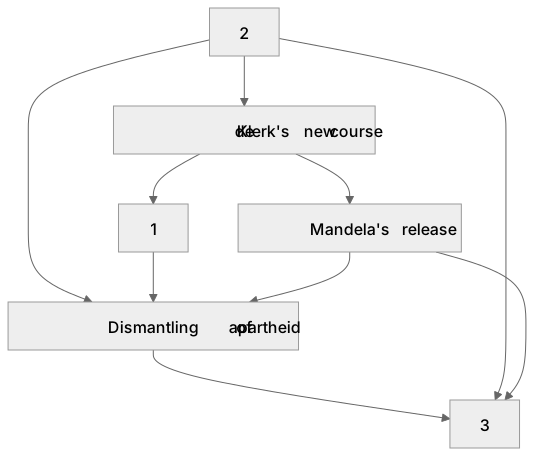
1Box 1
2Box 2
3Box 3
There is more to this lesson
The full lesson goes on to check your understanding and help you earn the marks. Create a free account to carry on, with your progress saved.
A week of Premium from your first lesson · Then the free plan continues · No card, no charge
Test your understanding of Paper 2, Option 2F.2: South Africa, 1948–94: from apartheid state to ‘rainbow nation’ - 4 The end of apartheid and the creation of the ‘rainbow nation’, 1984–94: Negotiation and compromise, 1989–91: de Klerk’s new course; the significance of Mandela’s release; the unbanning of political parties; the impact of unrest and violence; the dismantling of apartheid; CODESA 1991.
Active recall beats re-reading. Take an instant quiz now to test what you’ve learned and lock it into long-term memory.
A week of Premium from your first lesson · Then the free plan continues · No card, no charge