Pearson Edexcel · A-Level · History
Course version: 9HI0 · Version from Sept 2015
South Africa, 1948–94: from apartheid state to ‘rainbow nation’ - 4 The…
Full specification wording
Paper 2, Option 2F.2: South Africa, 1948–94: from apartheid state to ‘rainbow nation’ - 4 The end of apartheid and the creation of the ‘rainbow nation’, 1984–94: Reasons for Botha’s decision to negotiate, 1985–89, including the failure of Botha’s ‘total strategy’, economic problems and the impact of international isolation, the effect of the state of emergency.
Between 1985 and 1989 Botha moved towards negotiation because his 'total strategy' failed to defeat township revolt and regional instability.
Checked against the Pearson Edexcel 9HI0 specification (opens in a new tab) on .
- Point 2 of 4
- 4 key terms
Study notes
From the checked teaching notes for this specification point.
The idea
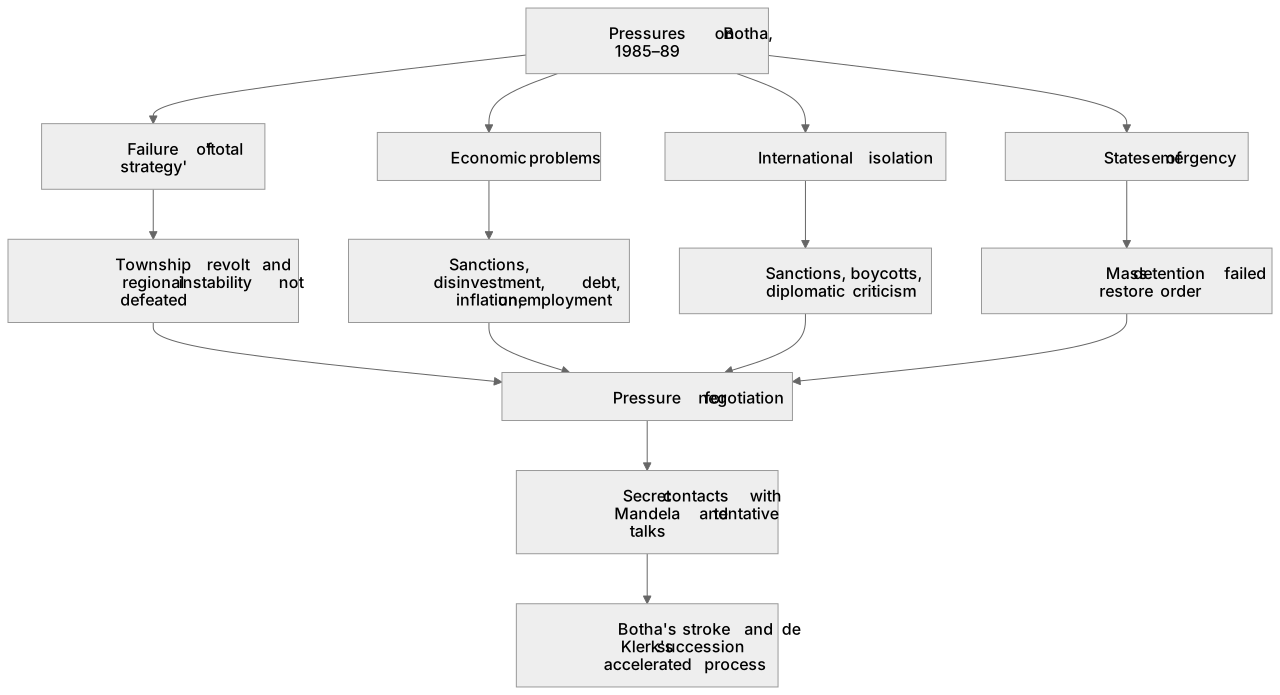
Between 1985 and 1989 Botha moved towards negotiation because his 'total strategy' failed to defeat township revolt and regional instability. Economic problems deepened as sanctions, disinvestment and debt repayment pressures squeezed growth and raised inflation and unemployment. International isolation grew through sanctions, sporting and cultural boycotts and diplomatic criticism, while the 1985 and 1986 states of emergency detained thousands yet failed to restore order. These pressures split the National Party and business opinion, encouraging secret contacts with Nelson Mandela and tentative talks, though Botha's stroke in 1989 and de Klerk's succession accelerated the process.
What earns the marks
- Explains that 'total strategy' combined military, political and economic measures to defend apartheid, and assesses why it failed to end township unrest or regional conflict.
- Analyses economic problems, including sanctions, disinvestment, debt and inflation, and how these eroded business confidence and state capacity.
- Evaluates international isolation through sanctions, boycotts and diplomatic pressure, and its role in pushing Botha towards contact with the ANC.
- Assesses the effect of the states of emergency, including mass detention and repression, in failing to restore order and in prompting debate about negotiation.
- Weighs the relative importance of these pressures against leadership factors, such as Botha's illness and the rise of de Klerk, in explaining the timing of negotiation.
Common mistakes and how to put them right
Presenting 'total strategy' as purely military.
Put it right: Include its political, economic and regional dimensions.
Treating international isolation as a single event.
Put it right: Distinguish sanctions, disinvestment, boycotts and diplomatic pressure and their different effects.
Assuming the states of emergency ended unrest.
Put it right: Explain that repression failed to restore order and contributed to pressure for negotiation.
Exam tips
- Group reasons into military-strategic, economic, international and domestic-repressive categories, then rank their relative weight.
- Support each reason with a specific example, such as a sanction, a debt crisis or an emergency regulation, and explain its consequence.
- Conclude by judging how far these pressures, rather than individual leadership, explain Botha's decision to negotiate.
Try the lesson
The start of the Paper 2, Option 2F.2: South Africa, 1948–94: from apartheid state to ‘rainbow nation’ - 4 The end of apartheid and the creation of the ‘rainbow nation’, 1984–94: Reasons for Botha’s decision to negotiate, 1985–89, including the failure of Botha’s ‘total strategy’, economic problems and the impact of international isolation, the effect of the state of emergency. lesson, made from checked teaching notes for this specification point.
Have a go first
What was the name of P. W. Botha's security policy that aimed to defend the apartheid state against internal and external threats in the 1980s?
Listen
Between 1985 and 1989 Botha moved towards negotiation because his 'total strategy' failed to defeat township revolt and regional instability. Economic problems deepened as sanctions, disinvestment and debt repayment pressures squeezed growth and raised inflation and unemployment. International isolation grew through sanctions, sporting and cultural boycotts and diplomatic criticism, while the 1985 and 1986 states of emergency detained thousands yet failed to restore order. These pressures split the National Party and business opinion, encouraging secret contacts with Nelson Mandela and tentative talks, though Botha's stroke in 1989 and de Klerk's succession accelerated the process. A strong answer earns marks for these points. Explains that 'total strategy' combined military, political and economic measures to defend apartheid, and assesses why it failed to end township unrest or regional conflict. Analyses economic problems, including sanctions, disinvestment, debt and inflation, and how these eroded business confidence and state capacity. Evaluates international isolation through sanctions, boycotts and diplomatic pressure, and its role in pushing Botha towards contact with the ANC. Assesses the effect of the states of emergency, including mass detention and repression, in failing to restore order and in prompting debate about negotiation. A common slip: Presenting 'total strategy' as purely military. Instead, include its political, economic and regional dimensions. Exam tip: Group reasons into military-strategic, economic, international and domestic-repressive categories, then rank their relative weight.
See it
Put the events in order
Put these events in the order they happened, earliest first.
- 1. States of emergency detained thousands but failed to restore order
- 2. Botha's stroke and de Klerk's succession accelerated negotiation
- 3. Further state of emergency used mass detention and repression
Key words
Say what each word means before you turn the card.
Failure of 'total strategy'
Try answering aloud or in your head before turning the card.
Economic crisis and sanctions
Try answering aloud or in your head before turning the card.
International isolation and boycotts
Try answering aloud or in your head before turning the card.
States of emergency and pressure for negotiation
Try answering aloud or in your head before turning the card.
See every definition
- Failure of 'total strategy'
- A strategy combining military, political and economic measures to defend apartheid that failed to defeat township revolt or regional instability.
- Economic crisis and sanctions
- Deepening problems as sanctions, disinvestment and debt repayment pressures squeezed growth and raised inflation and unemployment.
- International isolation and boycotts
- Growing isolation through sanctions, sporting and cultural boycotts and diplomatic criticism.
- States of emergency and pressure for negotiation
- The 1985 and 1986 states of emergency detained thousands yet failed to restore order, prompting debate about negotiation.
Label the diagram
Some boxes have lost their names. Pick the right name for each number.
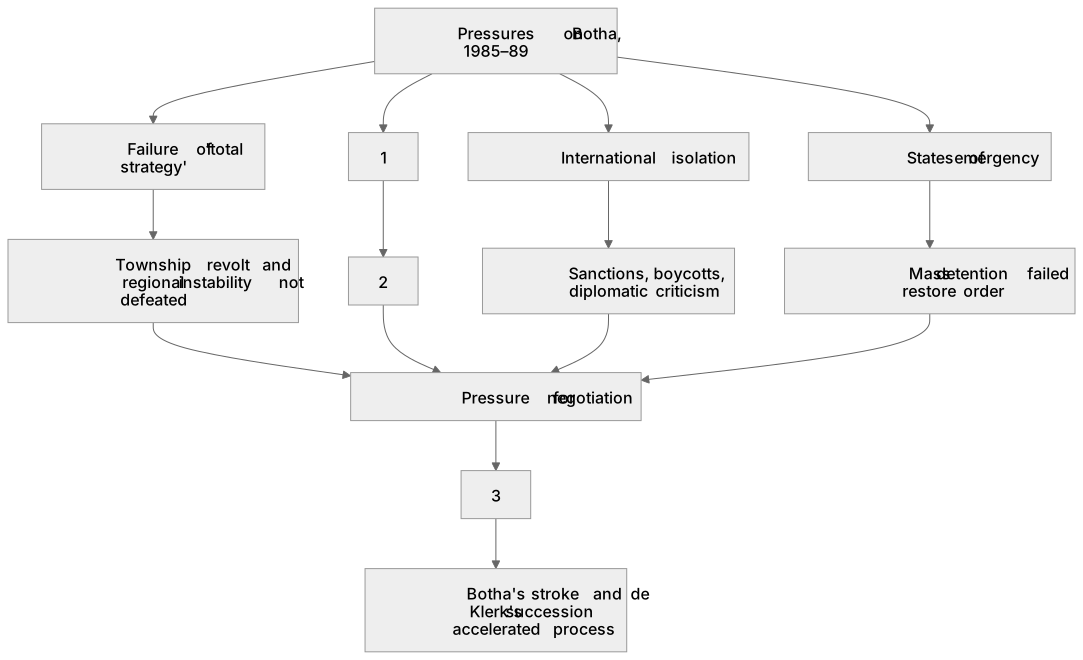
1Box 1
2Box 2
3Box 3
There is more to this lesson
The full lesson goes on to check your understanding and help you earn the marks. Create a free account to carry on, with your progress saved.
A week of Premium from your first lesson · Then the free plan continues · No card, no charge
Test your understanding of Paper 2, Option 2F.2: South Africa, 1948–94: from apartheid state to ‘rainbow nation’ - 4 The end of apartheid and the creation of the ‘rainbow nation’, 1984–94: Reasons for Botha’s decision to negotiate, 1985–89, including the failure of Botha’s ‘total strategy’, economic problems and the impact of international isolation, the effect of the state of emergency.
Active recall beats re-reading. Take an instant quiz now to test what you’ve learned and lock it into long-term memory.
A week of Premium from your first lesson · Then the free plan continues · No card, no charge