Pearson Edexcel · A-Level · History
Course version: 9HI0 · Version from Sept 2015
The rise and fall of fascism in Italy, c1911–46 - 2 The rise of Mussolini…
Full specification wording
Paper 2, Option 2G.1: The rise and fall of fascism in Italy, c1911–46 - 2 The rise of Mussolini and the creation of a fascist dictatorship, 1919–26: Challenges to the Liberal State: ‘mutilated victory’; occupation of Fiume; post-war economic crisis; social discontent; political reforms; growth of a Socialist Party and Catholic Party; result and impact of elections 1919.
Italy's victory in 1918 bred the myth of the 'mutilated victory': nationalists claimed the Treaty of London promises were betrayed at Versailles, and D'Annunzio seized Fiume in September 1919,…
Checked against the Pearson Edexcel 9HI0 specification (opens in a new tab) on .
- Point 1 of 4
- 3 key terms
Study notes
From the checked teaching notes for this specification point.
The idea
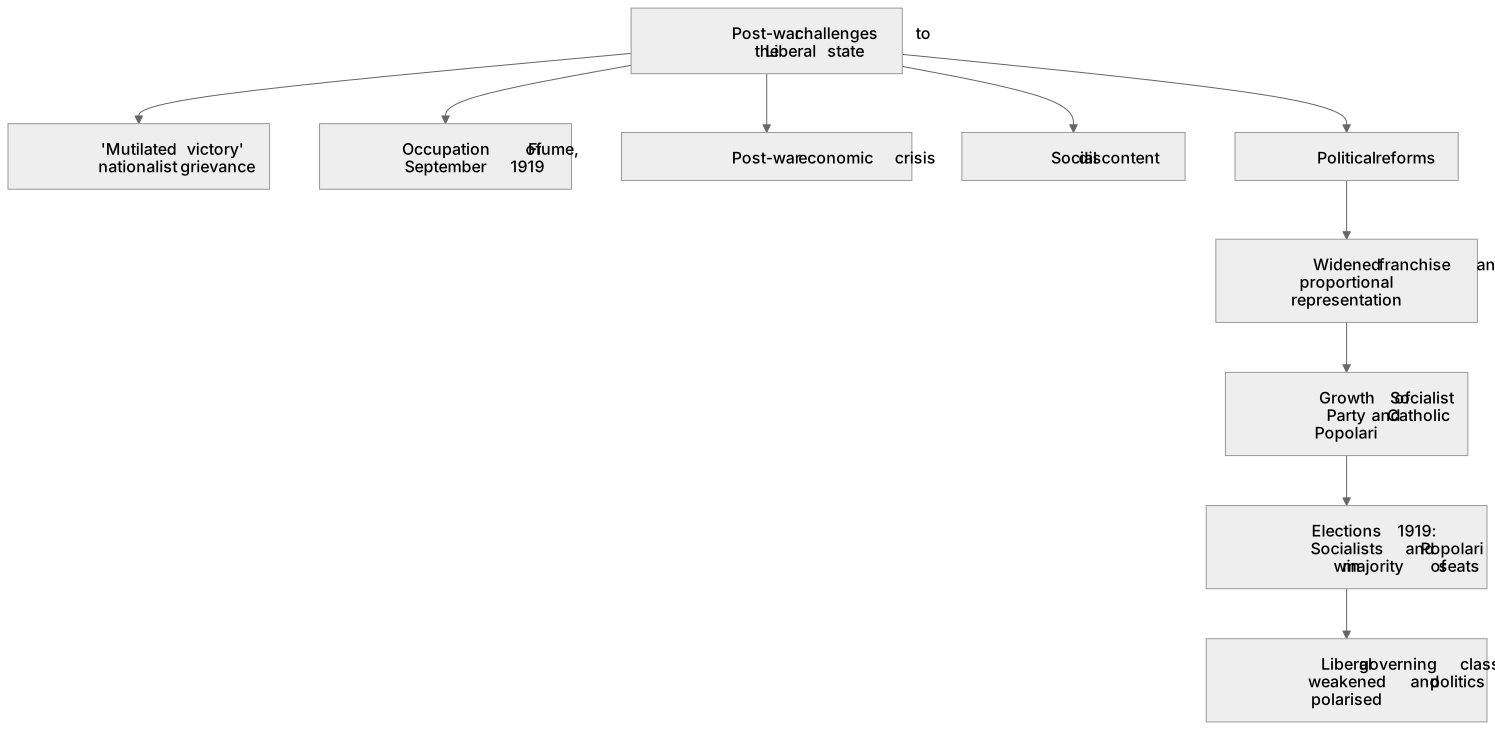
Italy's victory in 1918 bred the myth of the 'mutilated victory': nationalists claimed the Treaty of London promises were betrayed at Versailles, and D'Annunzio seized Fiume in September 1919, holding it for over a year. Economic crisis followed: war debt, inflation, unemployment and land hunger. Social discontent erupted in strikes, land occupations and factory unrest. Political reforms widened the franchise and introduced proportional representation. A mass Socialist Party and the new Catholic Popolari grew rapidly. In the November 1919 elections the Socialists and Popolari together won a majority of seats, weakening the Liberal governing class and polarising politics.
What earns the marks
- Explains the 'mutilated victory' myth as nationalist grievance over unredeemed lands such as Dalmatia and Fiume, and its role in discrediting the Liberal government.
- Describes D'Annunzio's occupation of Fiume from September 1919 and its impact in showing the state's weakness and inspiring fascist style.
- Analyses post-war economic crisis: war debt, inflation, rising prices, unemployment and the failure of land reform promises.
- Explains social discontent through strikes, land occupations and factory unrest, and the fear this generated among the middle and propertied classes.
- Assesses political reforms, including the widened franchise and proportional representation, and how they changed party competition.
- Evaluates the growth of the Socialist Party and the Catholic Popolari, and the significance of the 1919 election result for the Liberal state.
Common mistakes and how to put them right
Treating the 'mutilated victory' as a purely economic grievance.
Put it right: It was primarily a nationalist and diplomatic grievance about territory and prestige.
Assuming the 1919 election strengthened the Liberals.
Put it right: The Socialists and Popolari made large gains and the Liberal governing class was weakened.
Confusing D'Annunzio's Fiume occupation with a fascist action.
Put it right: It was a nationalist venture that fascists later imitated, not a Fascist Party operation.
Exam tips
- Link each challenge to the weakening of the Liberal state rather than listing events separately.
- Use precise dates and terms such as September 1919 for Fiume and proportional representation for the electoral reform.
- When discussing the 1919 election, refer to the gains of the Socialists and Popolari and the consequences for coalition politics.
Try the lesson
The start of the Paper 2, Option 2G.1: The rise and fall of fascism in Italy, c1911–46 - 2 The rise of Mussolini and the creation of a fascist dictatorship, 1919–26: Challenges to the Liberal State: ‘mutilated victory’; occupation of Fiume; post-war economic crisis; social discontent; political reforms; growth of a Socialist Party and Catholic Party; result and impact of elections 1919. lesson, made from checked teaching notes for this specification point.
Have a go first
Which term did Italian nationalists use to describe the peace settlement of 1919, which they claimed denied Italy the territorial gains promised in the Treaty of London?
Listen
Italy's victory in 1918 bred the myth of the 'mutilated victory': nationalists claimed the Treaty of London promises were betrayed at Versailles, and D'Annunzio seized Fiume in September 1919, holding it for over a year. Economic crisis followed: war debt, inflation, unemployment and land hunger. Social discontent erupted in strikes, land occupations and factory unrest. Political reforms widened the franchise and introduced proportional representation. A mass Socialist Party and the new Catholic Popolari grew rapidly. In the November 1919 elections the Socialists and Popolari together won a majority of seats, weakening the Liberal governing class and polarising politics. A strong answer earns marks for these points. Explains the 'mutilated victory' myth as nationalist grievance over unredeemed lands such as Dalmatia and Fiume, and its role in discrediting the Liberal government. Describes D'Annunzio's occupation of Fiume from September 1919 and its impact in showing the state's weakness and inspiring fascist style. Analyses post-war economic crisis: war debt, inflation, rising prices, unemployment and the failure of land reform promises. Explains social discontent through strikes, land occupations and factory unrest, and the fear this generated among the middle and propertied classes. A common slip: Treating the 'mutilated victory' as a purely economic grievance. Instead, it was primarily a nationalist and diplomatic grievance about territory and prestige. Exam tip: Link each challenge to the weakening of the Liberal state rather than listing events separately.
See it
Key words
Say what each word means before you turn the card.
mutilated victory
Try answering aloud or in your head before turning the card.
Fiume
Try answering aloud or in your head before turning the card.
Catholic Popolari
Try answering aloud or in your head before turning the card.
See every definition
- mutilated victory
- The myth that Italy's victory in 1918 was betrayed, as nationalists claimed the Treaty of London promises were betrayed at Versailles.
- Fiume
- The city seized by D'Annunzio in September 1919, which he held for over a year.
- Catholic Popolari
- A new Catholic party that grew rapidly and, with the Socialists, won a majority of seats in the November 1919 elections.
Label the diagram
Some boxes have lost their names. Pick the right name for each number.
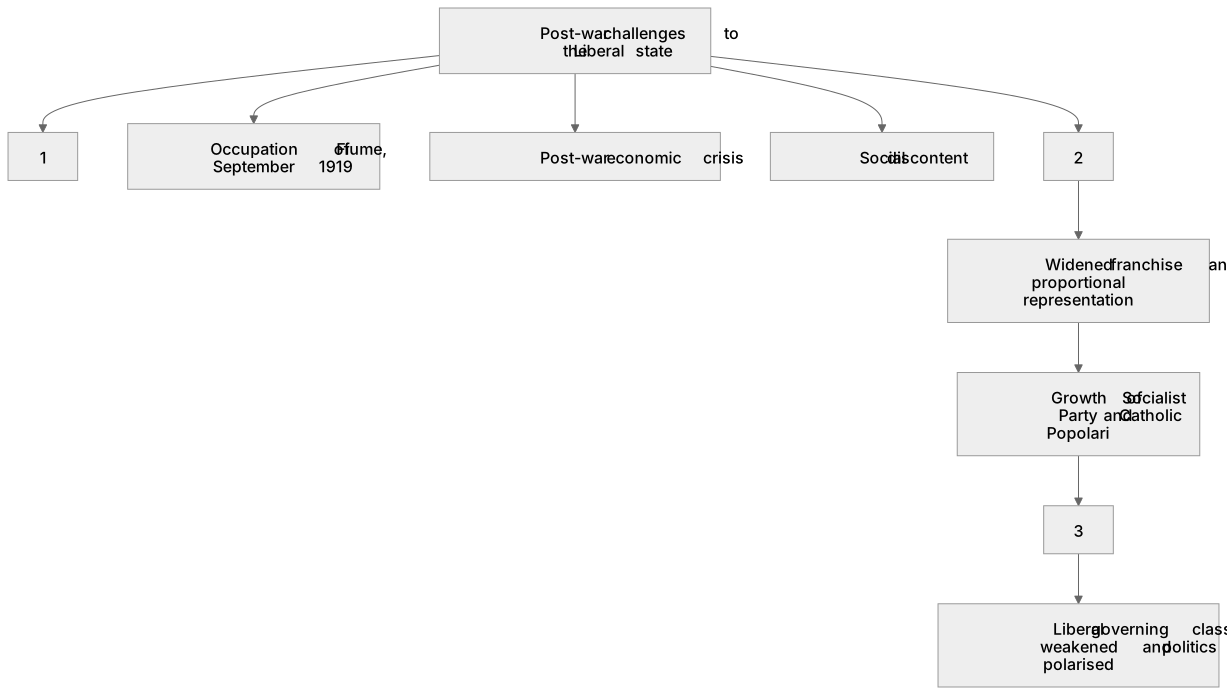
1Box 1
2Box 2
3Box 3
There is more to this lesson
The full lesson goes on to check your understanding and help you earn the marks. Create a free account to carry on, with your progress saved.
A week of Premium from your first lesson · Then the free plan continues · No card, no charge
Test your understanding of Paper 2, Option 2G.1: The rise and fall of fascism in Italy, c1911–46 - 2 The rise of Mussolini and the creation of a fascist dictatorship, 1919–26: Challenges to the Liberal State: ‘mutilated victory’; occupation of Fiume; post-war economic crisis; social discontent; political reforms; growth of a Socialist Party and Catholic Party; result and impact of elections 1919.
Active recall beats re-reading. Take an instant quiz now to test what you’ve learned and lock it into long-term memory.
A week of Premium from your first lesson · Then the free plan continues · No card, no charge