Pearson Edexcel · A-Level · History
Course version: 9HI0 · Version from Sept 2015
The rise and fall of fascism in Italy, c1911–46 - 2 The rise of Mussolini…
Full specification wording
Paper 2, Option 2G.1: The rise and fall of fascism in Italy, c1911–46 - 2 The rise of Mussolini and the creation of a fascist dictatorship, 1919–26: Mussolini and the development of fascism, 1919–22: foundation of Fasci di Combattimento and party programme; squadrismo and the move to the right; political legitimacy, the PNF and the ‘New Programme’; nature and extent of fascist support.
In March 1919 Mussolini founded the Fasci di Combattimento in Milan, with a radical programme including republicanism, workers' rights and anti-clericalism.
Checked against the Pearson Edexcel 9HI0 specification (opens in a new tab) on .
- Point 2 of 4
- 4 key terms
Study notes
From the checked teaching notes for this specification point.
The idea
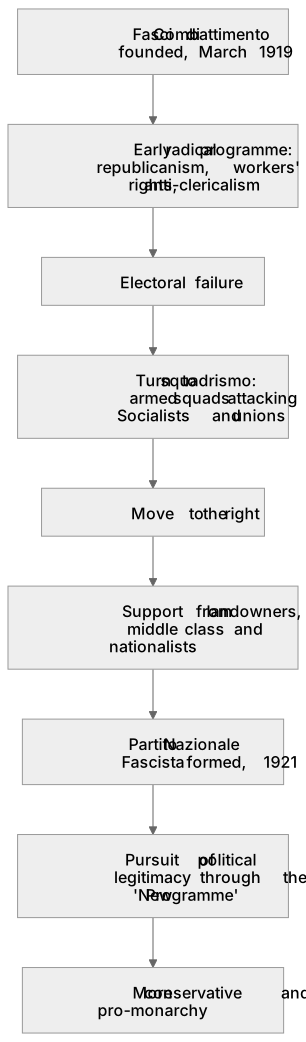
In March 1919 Mussolini founded the Fasci di Combattimento in Milan, with a radical programme including republicanism, workers' rights and anti-clericalism. Failing electorally, the movement turned to squadrismo: armed squads attacking Socialists and unions, especially in the Po Valley. This violence and the move to the right attracted landowners, middle-class and nationalist support. In 1921 the movement became the Partito Nazionale Fascista (PNF), and Mussolini sought political legitimacy, presenting a 'New Programme' that was more conservative and pro-monarchy. Fascist support remained limited but grew through anti-Socialist violence, patronage and the weakness of the Liberal state.
What earns the marks
- Explains the foundation of the Fasci di Combattimento in March 1919 and its early radical programme.
- Analyses squadrismo as organised violence against Socialists and unions, and its role in attracting support and undermining the state's monopoly of force.
- Explains the move to the right, including the abandonment of early radicalism and the appeal to landowners, nationalists and the middle classes.
- Assesses the creation of the PNF in 1921 and Mussolini's pursuit of political legitimacy through the 'New Programme'.
- Evaluates the nature and extent of fascist support, including its regional strengths and limits, and the role of Liberal weakness.
Common mistakes and how to put them right
Assuming fascism had mass support from the start.
Put it right: Early support was limited and grew through violence, patronage and fear of Socialism.
Treating the 'New Programme' as a return to the original 1919 radicalism.
Put it right: It was more conservative and designed to win respectability.
Confusing the Fasci di Combattimento with the PNF.
Put it right: The PNF was formed in 1921 as a more organised party.
Exam tips
- Trace the shift from radicalism to the right using specific events such as the 1919 programme and the 1921 PNF formation.
- Use squadrismo as evidence of both fascist tactics and the weakness of the Liberal state.
- When assessing support, distinguish between active membership, electoral support and passive acceptance.
Try the lesson
The start of the Paper 2, Option 2G.1: The rise and fall of fascism in Italy, c1911–46 - 2 The rise of Mussolini and the creation of a fascist dictatorship, 1919–26: Mussolini and the development of fascism, 1919–22: foundation of Fasci di Combattimento and party programme; squadrismo and the move to the right; political legitimacy, the PNF and the ‘New Programme’; nature and extent of fascist support. lesson, made from checked teaching notes for this specification point.
Have a go first
In which city did Mussolini found the Fasci di Combattimento in March 1919?
Listen
In March 1919 Mussolini founded the Fasci di Combattimento in Milan, with a radical programme including republicanism, workers' rights and anti-clericalism. Failing electorally, the movement turned to squadrismo: armed squads attacking Socialists and unions, especially in the Po Valley. This violence and the move to the right attracted landowners, middle-class and nationalist support. In 1921 the movement became the Partito Nazionale Fascista (PNF), and Mussolini sought political legitimacy, presenting a 'New Programme' that was more conservative and pro-monarchy. Fascist support remained limited but grew through anti-Socialist violence, patronage and the weakness of the Liberal state. A strong answer earns marks for these points. Explains the foundation of the Fasci di Combattimento in March 1919 and its early radical programme. Analyses squadrismo as organised violence against Socialists and unions, and its role in attracting support and undermining the state's monopoly of force. Explains the move to the right, including the abandonment of early radicalism and the appeal to landowners, nationalists and the middle classes. Assesses the creation of the PNF in 1921 and Mussolini's pursuit of political legitimacy through the 'New Programme'. A common slip: Assuming fascism had mass support from the start. Instead, early support was limited and grew through violence, patronage and fear of Socialism. Exam tip: Trace the shift from radicalism to the right using specific events such as the 1919 programme and the 1921 PNF formation.
See it
Key words
Say what each word means before you turn the card.
Foundation and early programme of fascism
Try answering aloud or in your head before turning the card.
Squadrismo and political violence
Try answering aloud or in your head before turning the card.
The move to the right and the PNF
Try answering aloud or in your head before turning the card.
Nature and extent of fascist support
Try answering aloud or in your head before turning the card.
See every definition
- Foundation and early programme of fascism
- In March 1919 Mussolini founded the Fasci di Combattimento in Milan, with a radical programme including republicanism, workers' rights and anti-clericalism.
- Squadrismo and political violence
- Armed squads attacking Socialists and unions, especially in the Po Valley, which attracted support and undermined the state's monopoly of force.
- The move to the right and the PNF
- The abandonment of early radicalism and the appeal to landowners, nationalists and the middle classes, with the movement becoming the Partito Nazionale Fascista in 1921.
- Nature and extent of fascist support
- Support that remained limited but grew through anti-Socialist violence, patronage and the weakness of the Liberal state.
Label the diagram
Some boxes have lost their names. Pick the right name for each number.
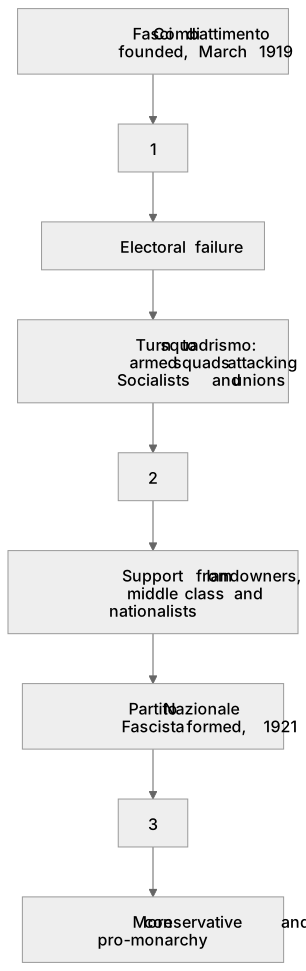
1Box 1
2Box 2
3Box 3
There is more to this lesson
The full lesson goes on to check your understanding and help you earn the marks. Create a free account to carry on, with your progress saved.
A week of Premium from your first lesson · Then the free plan continues · No card, no charge
Test your understanding of Paper 2, Option 2G.1: The rise and fall of fascism in Italy, c1911–46 - 2 The rise of Mussolini and the creation of a fascist dictatorship, 1919–26: Mussolini and the development of fascism, 1919–22: foundation of Fasci di Combattimento and party programme; squadrismo and the move to the right; political legitimacy, the PNF and the ‘New Programme’; nature and extent of fascist support.
Active recall beats re-reading. Take an instant quiz now to test what you’ve learned and lock it into long-term memory.
A week of Premium from your first lesson · Then the free plan continues · No card, no charge