Pearson Edexcel · A-Level · History
Course version: 9HI0 · Version from Sept 2015
The rise and fall of fascism in Italy, c1911–46 - 2 The rise of Mussolini…
Full specification wording
Paper 2, Option 2G.1: The rise and fall of fascism in Italy, c1911–46 - 2 The rise of Mussolini and the creation of a fascist dictatorship, 1919–26: The creation of a fascist dictatorship, 1922–26: parliamentary compromise and coercion; controlling the PNF; the Acerbo Law and the Matteotti crisis; repression in 1925 and constitutional amendments, 1925–26.
From 1922 Mussolini combined parliamentary compromise with coercion.
Checked against the Pearson Edexcel 9HI0 specification (opens in a new tab) on .
- Point 4 of 4
- 4 key terms
Study notes
From the checked teaching notes for this specification point.
The idea
From 1922 Mussolini combined parliamentary compromise with coercion. He led a coalition, reassured conservatives, and used emergency powers, while Fascist violence continued and the PNF was brought under tighter control through the Fascist Grand Council and the militia. The Acerbo Law of 1923 gave the largest party two-thirds of seats if it won over a quarter of votes, helping Fascists dominate the 1924 election. The Matteotti crisis followed the socialist deputy's murder in 1924; after initial uncertainty Mussolini claimed responsibility in his 1925 speech and moved to repression. Laws of 1925–26 banned opposition parties, censored the press and extended executive power, creating the legal framework of dictatorship.
What earns the marks
- Explains parliamentary compromise: coalition government, conservative support and the use of emergency powers after 1922.
- Shows how coercion continued through squadristi violence and pressure on opponents alongside constitutional forms.
- Describes control of the PNF, including the Fascist Grand Council and the militia, and the taming of local squadristi.
- Explains the Acerbo Law's electoral mechanism and its effect on the 1924 election result.
- Analyses the Matteotti crisis: the murder, the political fallout, and Mussolini's 1925 speech as a turning point.
- Explains the 1925–26 repression and constitutional amendments that ended parliamentary opposition and strengthened the executive.
Common mistakes and how to put them right
Presenting the Acerbo Law as simply abolishing elections.
Put it right by explaining its two-thirds bonus for the largest party above a quarter of the vote.
Treating the Matteotti crisis as the immediate end of democracy.
Put it right by showing the delay before Mussolini's 1925 speech and the subsequent repression.
Confusing control of the PNF with control of the state.
Put it right by distinguishing party reorganisation from constitutional and legal changes.
Exam tips
- Use the sequence compromise, crisis, repression to structure answers within 1922–26.
- Link each measure to the growth of dictatorship rather than listing events.
- Refer precisely to the Acerbo Law, the Matteotti crisis and the 1925–26 laws to show secure knowledge.
Try the lesson
The start of the Paper 2, Option 2G.1: The rise and fall of fascism in Italy, c1911–46 - 2 The rise of Mussolini and the creation of a fascist dictatorship, 1919–26: The creation of a fascist dictatorship, 1922–26: parliamentary compromise and coercion; controlling the PNF; the Acerbo Law and the Matteotti crisis; repression in 1925 and constitutional amendments, 1925–26. lesson, made from checked teaching notes for this specification point.
Have a go first
What did the Acerbo Law of 1923 provide for in Italian elections?
Listen
From 1922 Mussolini combined parliamentary compromise with coercion. He led a coalition, reassured conservatives, and used emergency powers, while Fascist violence continued and the PNF was brought under tighter control through the Fascist Grand Council and the militia. The Acerbo Law of 1923 gave the largest party two-thirds of seats if it won over a quarter of votes, helping Fascists dominate the 1924 election. The Matteotti crisis followed the socialist deputy's murder in 1924; after initial uncertainty Mussolini claimed responsibility in his 1925 speech and moved to repression. Laws of 1925–26 banned opposition parties, censored the press and extended executive power, creating the legal framework of dictatorship. A strong answer earns marks for these points. Explains parliamentary compromise: coalition government, conservative support and the use of emergency powers after 1922. Shows how coercion continued through squadristi violence and pressure on opponents alongside constitutional forms. Describes control of the PNF, including the Fascist Grand Council and the militia, and the taming of local squadristi. Explains the Acerbo Law's electoral mechanism and its effect on the 1924 election result. A common slip: Presenting the Acerbo Law as simply abolishing elections. Instead, explaining its two-thirds bonus for the largest party above a quarter of the vote. Exam tip: Use the sequence compromise, crisis, repression to structure answers within 1922–26.
See it
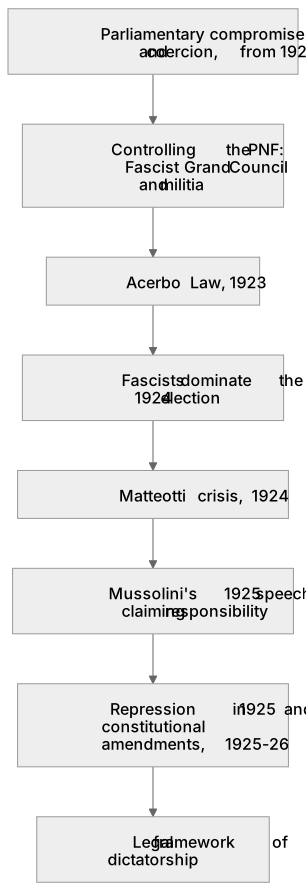
Put it in order
Put these steps in the order they happen.
- 1. Matteotti crisis, 1924
- 2. Legal framework of dictatorship
- 3. Mussolini's 1925 speech claiming responsibility
- 4. Parliamentary compromise and coercion, from 1922
- 5. Controlling the PNF: Fascist Grand Council and militia
- 6. Repression in 1925 and constitutional amendments, 1925-26
- 7. Acerbo Law, 1923
- 8. Fascists dominate the 1924 election
Put the events in order
Put these events in the order they happened, earliest first.
- 1. Mussolini claimed responsibility in his speech and moved to repression
- 2. Mussolini led a coalition government after parliamentary compromise and coercion
- 3. The Matteotti crisis followed the socialist deputy's murder
- 4. The Acerbo Law gave the largest party a two-thirds bonus
Key words
Say what each word means before you turn the card.
Parliamentary compromise and coercion
Try answering aloud or in your head before turning the card.
Party control and the PNF
Try answering aloud or in your head before turning the card.
Electoral manipulation and the Acerbo Law
Try answering aloud or in your head before turning the card.
The Matteotti crisis and the transition to dictatorship
Try answering aloud or in your head before turning the card.
See every definition
- Parliamentary compromise and coercion
- Mussolini combined parliamentary compromise with coercion, leading a coalition, reassuring conservatives and using emergency powers while Fascist violence continued.
- Party control and the PNF
- The PNF was brought under tighter control through the Fascist Grand Council and the militia, taming local squadristi.
- Electoral manipulation and the Acerbo Law
- The Acerbo Law of 1923 gave the largest party two-thirds of seats if it won over a quarter of votes, helping Fascists dominate the 1924 election.
- The Matteotti crisis and the transition to dictatorship
- After the socialist deputy's murder in 1924, Mussolini claimed responsibility in his 1925 speech and moved to repression, creating the legal framework of dictatorship.
Label the diagram
Some boxes have lost their names. Pick the right name for each number.
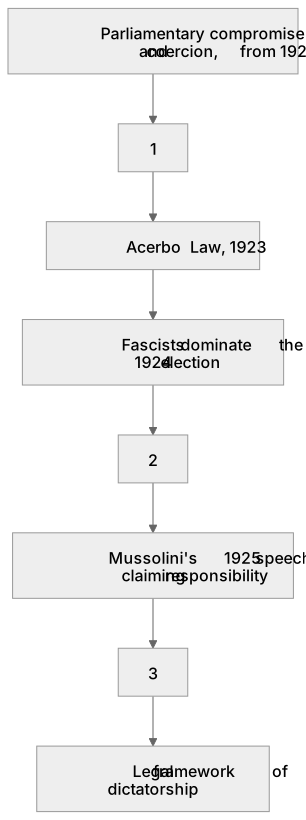
1Box 1
2Box 2
3Box 3
There is more to this lesson
The full lesson goes on to check your understanding and help you earn the marks. Create a free account to carry on, with your progress saved.
A week of Premium from your first lesson · Then the free plan continues · No card, no charge
Test your understanding of Paper 2, Option 2G.1: The rise and fall of fascism in Italy, c1911–46 - 2 The rise of Mussolini and the creation of a fascist dictatorship, 1919–26: The creation of a fascist dictatorship, 1922–26: parliamentary compromise and coercion; controlling the PNF; the Acerbo Law and the Matteotti crisis; repression in 1925 and constitutional amendments, 1925–26.
Active recall beats re-reading. Take an instant quiz now to test what you’ve learned and lock it into long-term memory.
A week of Premium from your first lesson · Then the free plan continues · No card, no charge