Pearson Edexcel · A-Level · History
Course version: 9HI0 · Version from Sept 2015
The rise and fall of fascism in Italy, c1911–46 - 2 The rise of Mussolini…
Full specification wording
Paper 2, Option 2G.1: The rise and fall of fascism in Italy, c1911–46 - 2 The rise of Mussolini and the creation of a fascist dictatorship, 1919–26: Mussolini gains power, 1920–22: taking advantage of political unrest; establishing a dual policy; the March on Rome and its significance; the role of Victor Emmanuel III; Mussolini’s appointment as prime minister.
After 1920 Fascism exploited Italy's post-war crisis: strikes, land occupations, socialist gains and a weak Liberal state.
Checked against the Pearson Edexcel 9HI0 specification (opens in a new tab) on .
- Point 3 of 4
- 4 key terms
Study notes
From the checked teaching notes for this specification point.
The idea
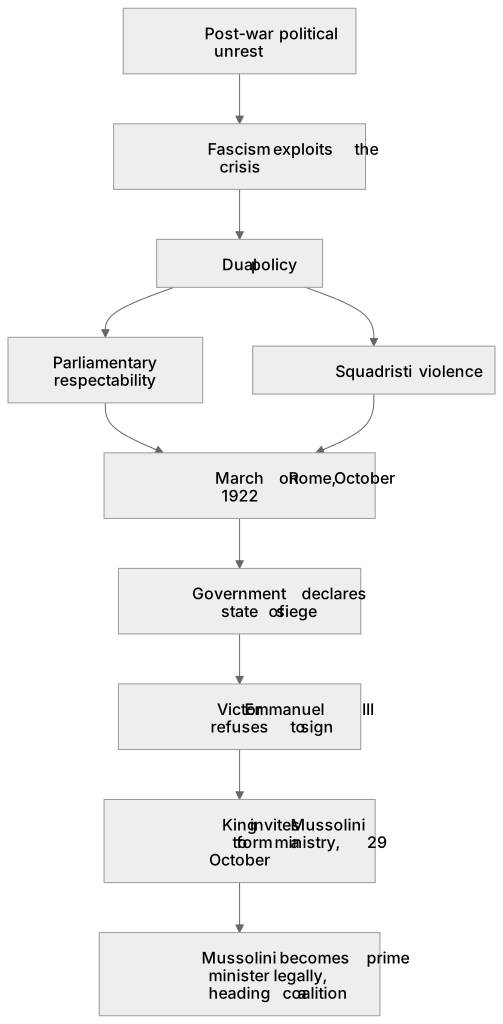
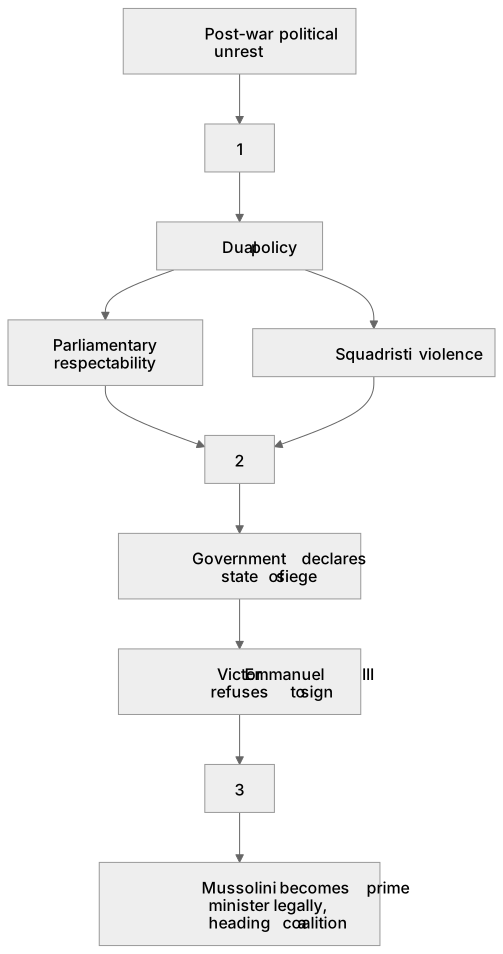
After 1920 Fascism exploited Italy's post-war crisis: strikes, land occupations, socialist gains and a weak Liberal state. Mussolini ran a dual policy: public respectability and parliamentary ambition alongside squadristi violence that destroyed left-wing and union organisation, especially in the Po Valley. In October 1922 the Fascists staged the March on Rome; the government declared a state of siege, but Victor Emmanuel III refused to sign it and instead invited Mussolini to form a ministry on 29 October. Mussolini thus became prime minister legally, heading a coalition, yet backed by the threat of force. Historians debate how far the March itself forced the King's hand and how far the King chose Mussolini to avoid civil conflict and preserve the monarchy.
What earns the marks
- Explains how post-war unrest (strikes, factory occupations, socialist and Catholic organisation, fear of revolution) created the conditions Fascism exploited.
- Distinguishes the two faces of the dual policy: parliamentary respectability and violent squadrismo, and shows how each served the other.
- Narrates the March on Rome accurately: the mobilisation, Facta's proposed state of siege, the King's refusal, and the invitation to Mussolini.
- Analyses the significance of the March as a show of strength and a myth of seizure of power rather than a military coup.
- Assesses Victor Emmanuel III's role and motives, including fear of civil war, distrust of the left and concern for the monarchy.
- Evaluates Mussolini's appointment as a legal, constitutional outcome that nonetheless rested on intimidation and violence.
Common mistakes and how to put them right
Treating the March on Rome as a successful armed coup.
Put it right by explaining that the King's decision, not the marchers, installed Mussolini.
Assuming Mussolini seized power by force alone.
Put it right by showing the legal appointment and the coalition ministry alongside the threat of violence.
Ignoring the dual policy and presenting Fascism as only violent or only respectable.
Put it right by showing both strands working together.
Exam tips
- Anchor answers in the stated date range 1920–22 and use precise events rather than general claims about 'chaos'.
- When discussing significance, weigh the March's symbolic and political impact against the constitutional route to office.
- Bring in Victor Emmanuel III explicitly, since his decision is central to explaining the outcome.
Try the lesson
The start of the Paper 2, Option 2G.1: The rise and fall of fascism in Italy, c1911–46 - 2 The rise of Mussolini and the creation of a fascist dictatorship, 1919–26: Mussolini gains power, 1920–22: taking advantage of political unrest; establishing a dual policy; the March on Rome and its significance; the role of Victor Emmanuel III; Mussolini’s appointment as prime minister. lesson, made from checked teaching notes for this specification point.
Have a go first
Which group carried out the March on Rome in October 1922?
Listen
After 1920 Fascism exploited Italy's post-war crisis: strikes, land occupations, socialist gains and a weak Liberal state. Mussolini ran a dual policy: public respectability and parliamentary ambition alongside squadristi violence that destroyed left-wing and union organisation, especially in the Po Valley. In October 1922 the Fascists staged the March on Rome; the government declared a state of siege, but Victor Emmanuel III refused to sign it and instead invited Mussolini to form a ministry on 29 October. Mussolini thus became prime minister legally, heading a coalition, yet backed by the threat of force. Historians debate how far the March itself forced the King's hand and how far the King chose Mussolini to avoid civil conflict and preserve the monarchy. A strong answer earns marks for these points. Explains how post-war unrest (strikes, factory occupations, socialist and Catholic organisation, fear of revolution) created the conditions Fascism exploited. Distinguishes the two faces of the dual policy: parliamentary respectability and violent squadrismo, and shows how each served the other. Narrates the March on Rome accurately: the mobilisation, Facta's proposed state of siege, the King's refusal, and the invitation to Mussolini. Analyses the significance of the March as a show of strength and a myth of seizure of power rather than a military coup. A common slip: Treating the March on Rome as a successful armed coup. Instead, explaining that the King's decision, not the marchers, installed Mussolini. Exam tip: Anchor answers in the stated date range 1920–22 and use precise events rather than general claims about 'chaos'.
See it
Key words
Say what each word means before you turn the card.
Political unrest and the crisis of the Liberal state
Try answering aloud or in your head before turning the card.
Dual policy of respectability and violence
Try answering aloud or in your head before turning the card.
The March on Rome as symbol and myth
Try answering aloud or in your head before turning the card.
The monarchy's role in Mussolini's appointment
Try answering aloud or in your head before turning the card.
See every definition
- Political unrest and the crisis of the Liberal state
- Post-war strikes, land occupations, socialist gains and a weak Liberal state created conditions that Fascism exploited after 1920.
- Dual policy of respectability and violence
- Public respectability and parliamentary ambition alongside squadristi violence that destroyed left-wing and union organisation, especially in the Po Valley.
- The March on Rome as symbol and myth
- An October 1922 show of strength and a myth of seizure of power rather than a military coup.
- The monarchy's role in Mussolini's appointment
- Victor Emmanuel III refused to sign the state of siege and instead invited Mussolini to form a ministry on 29 October.
Label the diagram
Some boxes have lost their names. Pick the right name for each number.
1Box 1
2Box 2
3Box 3
There is more to this lesson
The full lesson goes on to check your understanding and help you earn the marks. Create a free account to carry on, with your progress saved.
A week of Premium from your first lesson · Then the free plan continues · No card, no charge
Test your understanding of Paper 2, Option 2G.1: The rise and fall of fascism in Italy, c1911–46 - 2 The rise of Mussolini and the creation of a fascist dictatorship, 1919–26: Mussolini gains power, 1920–22: taking advantage of political unrest; establishing a dual policy; the March on Rome and its significance; the role of Victor Emmanuel III; Mussolini’s appointment as prime minister.
Active recall beats re-reading. Take an instant quiz now to test what you’ve learned and lock it into long-term memory.
A week of Premium from your first lesson · Then the free plan continues · No card, no charge