Pearson Edexcel · A-Level · History
Course version: 9HI0 · Version from Sept 2015
The USA, c1920–55: boom, bust and recovery - 3 Impact of the New Deal and…
Full specification wording
Paper 2, Option 2H.1: The USA, c1920–55: boom, bust and recovery - 3 Impact of the New Deal and the Second World War on the USA to 1945: The impact of the New Deal and the war on ethnic minorities: New Deal policies and black Americans; the Indian Reorganisation Act 1934; change for hispanic Americans; the contribution of ethnic minorities to the war effort; the race riots of 1943; the Double V campaign.
The New Deal and WWII affected ethnic minorities unevenly.
Checked against the Pearson Edexcel 9HI0 specification (opens in a new tab) on .
- Point 2 of 4
Study notes
From the checked teaching notes for this specification point.
The idea
The New Deal and WWII affected ethnic minorities unevenly. New Deal programmes often discriminated against black Americans, with lower wages and exclusion from skilled jobs, though some gains came through agencies like the CCC and NYA. The Indian Reorganisation Act 1934 reversed assimilation policies, promoting tribal self-government and cultural preservation. Hispanic Americans saw limited change, with some New Deal aid but continued discrimination. During WWII, ethnic minorities contributed significantly: black Americans served in segregated units, Hispanic Americans fought, and Native Americans served as code talkers. The 1943 race riots in Detroit and Los Angeles exposed racial tensions. The Double V campaign linked victory abroad with victory against racism at home, raising expectations for civil rights.
What earns the marks
- New Deal policies often discriminated against black Americans, but some agencies provided limited opportunities.
- The Indian Reorganisation Act 1934 ended allotment and encouraged tribal self-government and cultural renewal.
- Hispanic Americans received some New Deal assistance but faced ongoing discrimination and limited change.
- Ethnic minorities contributed to WWII through military service and wartime industries, despite segregation and prejudice.
- The 1943 race riots highlighted deep racial tensions in cities like Detroit and Los Angeles.
- The Double V campaign connected military victory with the fight for racial equality at home.
Common mistakes and how to put them right
Assuming the New Deal benefited all ethnic minorities equally.
Put it right: Black Americans and Hispanic Americans often faced discrimination in New Deal programmes.
Confusing the Indian Reorganisation Act 1934 with earlier assimilation policies.
Put it right: The Act reversed assimilation and promoted tribal self-government.
Overlooking the Double V campaign's role in linking war aims to civil rights.
Put it right: It was a key black American response to wartime racism.
Exam tips
- Use specific examples, such as the Detroit race riot of 1943, to illustrate tensions.
- Compare the experiences of different ethnic minority groups to show nuance.
- Link the Double V campaign to broader civil rights developments.
Try the lesson
The start of the Paper 2, Option 2H.1: The USA, c1920–55: boom, bust and recovery - 3 Impact of the New Deal and the Second World War on the USA to 1945: The impact of the New Deal and the war on ethnic minorities: New Deal policies and black Americans; the Indian Reorganisation Act 1934; change for hispanic Americans; the contribution of ethnic minorities to the war effort; the race riots of 1943; the Double V campaign. lesson, made from checked teaching notes for this specification point.
Have a go first
What was the main aim of the Indian Reorganisation Act of 1934?
Listen
The New Deal and WWII affected ethnic minorities unevenly. New Deal programmes often discriminated against black Americans, with lower wages and exclusion from skilled jobs, though some gains came through agencies like the CCC and NYA. The Indian Reorganisation Act 1934 reversed assimilation policies, promoting tribal self-government and cultural preservation. Hispanic Americans saw limited change, with some New Deal aid but continued discrimination. During WWII, ethnic minorities contributed significantly: black Americans served in segregated units, Hispanic Americans fought, and Native Americans served as code talkers. The 1943 race riots in Detroit and Los Angeles exposed racial tensions. The Double V campaign linked victory abroad with victory against racism at home, raising expectations for civil rights. A strong answer earns marks for these points. New Deal policies often discriminated against black Americans, but some agencies provided limited opportunities. The Indian Reorganisation Act 1934 ended allotment and encouraged tribal self-government and cultural renewal. Hispanic Americans received some New Deal assistance but faced ongoing discrimination and limited change. Ethnic minorities contributed to WWII through military service and wartime industries, despite segregation and prejudice. A common slip: assuming the New Deal benefited all ethnic minorities equally. Instead, black Americans and Hispanic Americans often faced discrimination in New Deal programmes. Exam tip: Use specific examples, such as the Detroit race riot of 1943, to illustrate tensions.
See it

Label the diagram
Some boxes have lost their names. Pick the right name for each number.
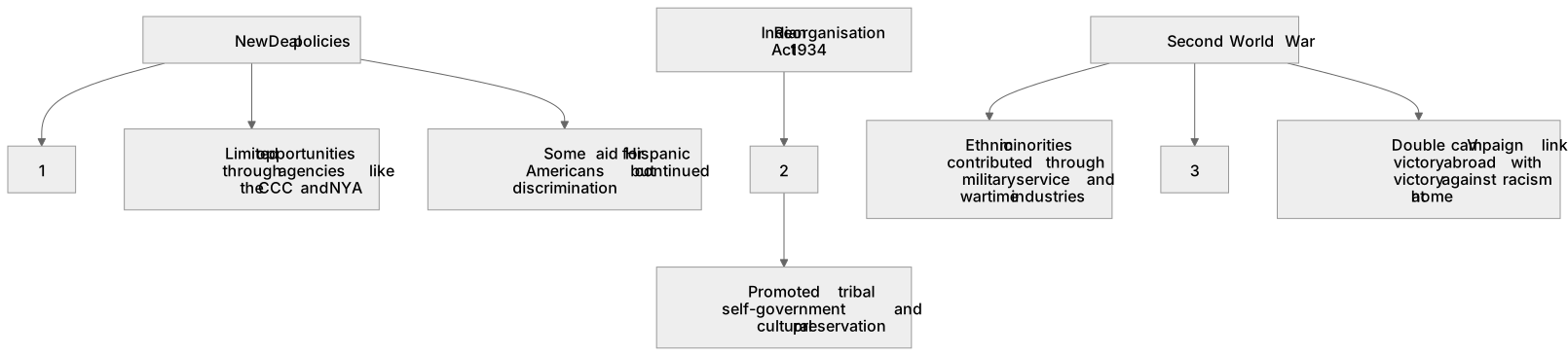
1Box 1
2Box 2
3Box 3
There is more to this lesson
The full lesson goes on to check your understanding and help you earn the marks. Create a free account to carry on, with your progress saved.
A week of Premium from your first lesson · Then the free plan continues · No card, no charge
Test your understanding of Paper 2, Option 2H.1: The USA, c1920–55: boom, bust and recovery - 3 Impact of the New Deal and the Second World War on the USA to 1945: The impact of the New Deal and the war on ethnic minorities: New Deal policies and black Americans; the Indian Reorganisation Act 1934; change for hispanic Americans; the contribution of ethnic minorities to the war effort; the race riots of 1943; the Double V campaign.
Active recall beats re-reading. Take an instant quiz now to test what you’ve learned and lock it into long-term memory.
A week of Premium from your first lesson · Then the free plan continues · No card, no charge