Pearson Edexcel · A-Level · History
Course version: 9HI0 · Version from Sept 2015
The USA, c1920–55: boom, bust and recovery - 3 Impact of the New Deal and…
Full specification wording
Paper 2, Option 2H.1: The USA, c1920–55: boom, bust and recovery - 3 Impact of the New Deal and the Second World War on the USA to 1945: The New Deal and the economy: the impact of New Deal policies on unemployment and national infrastructure; women and the New Deal, including the role of Eleanor Roosevelt; the state of the US economy in 1940.
The New Deal aimed to tackle unemployment and rebuild infrastructure.
Checked against the Pearson Edexcel 9HI0 specification (opens in a new tab) on .
- Point 1 of 4
Study notes
From the checked teaching notes for this specification point.
The idea
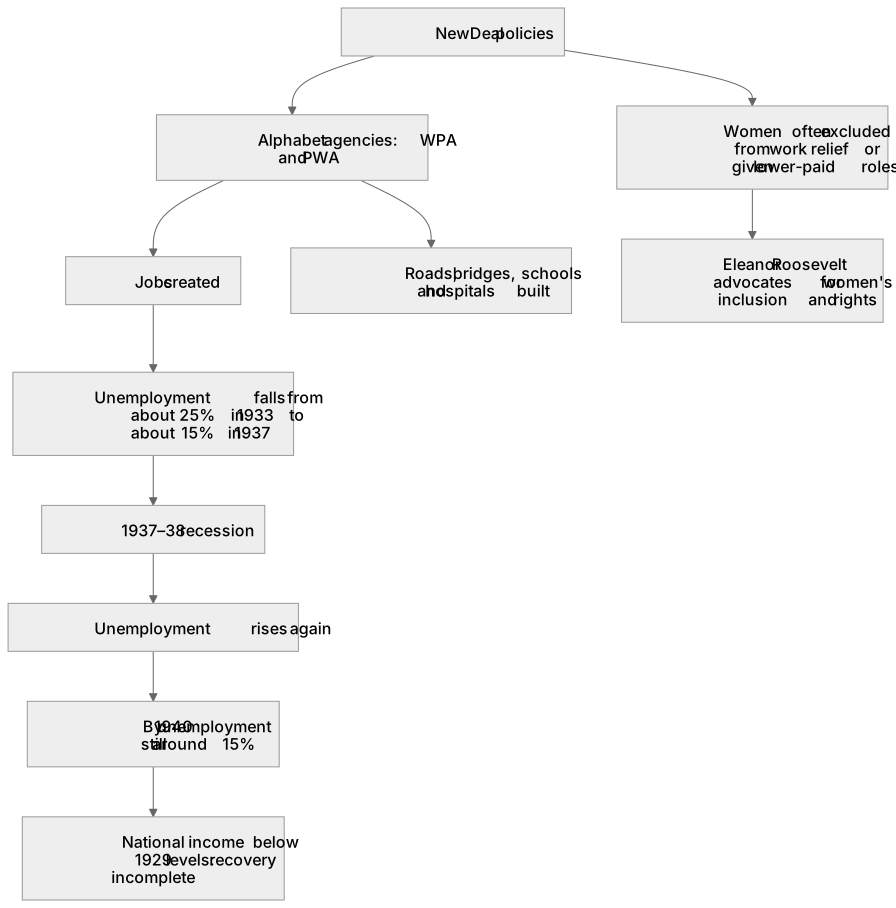
The New Deal aimed to tackle unemployment and rebuild infrastructure. Alphabet agencies like the WPA and PWA created jobs, reducing unemployment from roughly 25% in 1933 to about 15% by 1937, though a recession in 1937–38 pushed it up again. By 1940, unemployment remained around 15%, and the economy was still recovering, with national income below 1929 levels. Women benefited less: many New Deal programmes excluded women or paid them less. Eleanor Roosevelt championed women's and civil rights, pressing for female appointments and better conditions. The economy in 1940 was still not fully recovered, but war production soon transformed it.
What earns the marks
- Unemployment fell from about 25% in 1933 to about 15% in 1937, but rose again in the 1937–38 recession.
- The WPA and PWA built roads, bridges, schools and hospitals, improving national infrastructure.
- Women were often excluded from New Deal work relief or given lower-paid roles; Eleanor Roosevelt advocated for women's inclusion and rights.
- By 1940, unemployment was still around 15% and national income had not returned to 1929 levels, showing incomplete recovery.
Common mistakes and how to put them right
Claiming the New Deal ended the Great Depression by 1940.
Put it right: Unemployment remained high and full recovery came with wartime production.
Stating that women benefited equally from New Deal jobs.
Put it right: Many programmes discriminated against women, and Eleanor Roosevelt worked to improve their position.
Saying the New Deal only helped farmers.
Put it right: It also created urban infrastructure and employment through agencies like the WPA and PWA.
Exam tips
- Use specific figures, such as unemployment percentages, to support your arguments.
- Link each New Deal agency to its impact on unemployment or infrastructure.
- When discussing women, refer to both limitations and Eleanor Roosevelt's role.
Try the lesson
The start of the Paper 2, Option 2H.1: The USA, c1920–55: boom, bust and recovery - 3 Impact of the New Deal and the Second World War on the USA to 1945: The New Deal and the economy: the impact of New Deal policies on unemployment and national infrastructure; women and the New Deal, including the role of Eleanor Roosevelt; the state of the US economy in 1940. lesson, made from checked teaching notes for this specification point.
Have a go first
Which New Deal agency was created in 1933 to build dams and generate electricity in the Tennessee Valley?
Listen
The New Deal aimed to tackle unemployment and rebuild infrastructure. Alphabet agencies like the WPA and PWA created jobs, reducing unemployment from roughly 25% in 1933 to about 15% by 1937, though a recession in 1937–38 pushed it up again. By 1940, unemployment remained around 15%, and the economy was still recovering, with national income below 1929 levels. Women benefited less: many New Deal programmes excluded women or paid them less. Eleanor Roosevelt championed women's and civil rights, pressing for female appointments and better conditions. The economy in 1940 was still not fully recovered, but war production soon transformed it. A strong answer earns marks for these points. Unemployment fell from about 25% in 1933 to about 15% in 1937, but rose again in the 1937–38 recession. The WPA and PWA built roads, bridges, schools and hospitals, improving national infrastructure. Women were often excluded from New Deal work relief or given lower-paid roles; Eleanor Roosevelt advocated for women's inclusion and rights. By 1940, unemployment was still around 15% and national income had not returned to 1929 levels, showing incomplete recovery. A common slip: claiming the New Deal ended the Great Depression by 1940. Instead, unemployment remained high and full recovery came with wartime production. Exam tip: Use specific figures, such as unemployment percentages, to support your arguments.
See it
Put the events in order
Put these events in the order they happened, earliest first.
- 1. Unemployment at roughly twenty-five per cent
- 2. Unemployment still around fifteen per cent
- 3. Unemployment fell to about fifteen per cent
Label the diagram
Some boxes have lost their names. Pick the right name for each number.
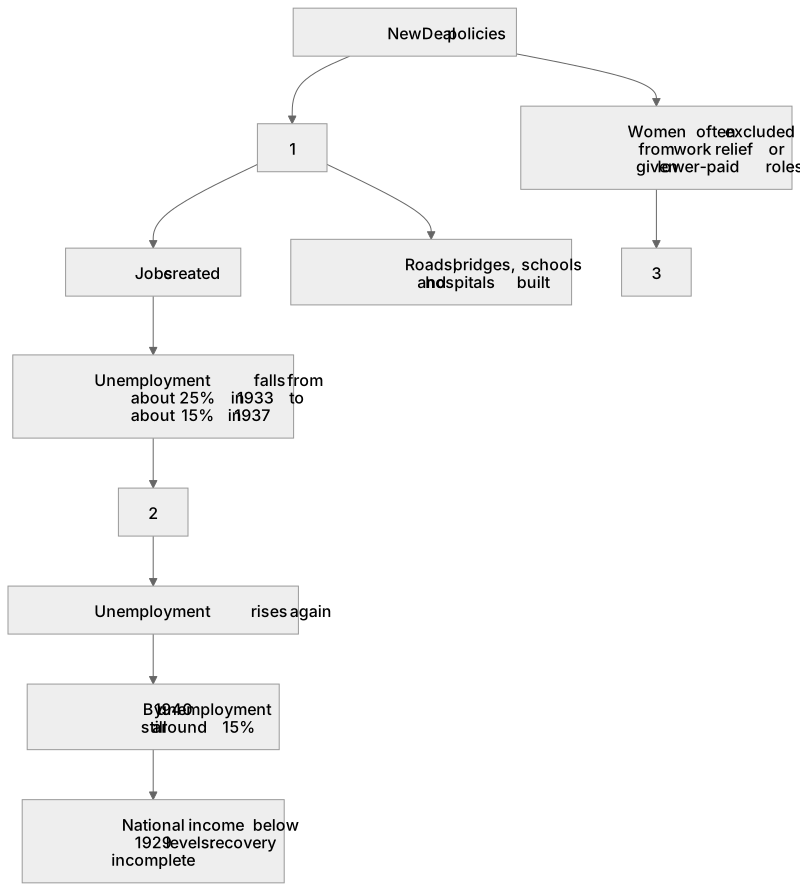
1Box 1
2Box 2
3Box 3
There is more to this lesson
The full lesson goes on to check your understanding and help you earn the marks. Create a free account to carry on, with your progress saved.
A week of Premium from your first lesson · Then the free plan continues · No card, no charge
Test your understanding of Paper 2, Option 2H.1: The USA, c1920–55: boom, bust and recovery - 3 Impact of the New Deal and the Second World War on the USA to 1945: The New Deal and the economy: the impact of New Deal policies on unemployment and national infrastructure; women and the New Deal, including the role of Eleanor Roosevelt; the state of the US economy in 1940.
Active recall beats re-reading. Take an instant quiz now to test what you’ve learned and lock it into long-term memory.
A week of Premium from your first lesson · Then the free plan continues · No card, no charge