Pearson Edexcel · A-Level · History
Course version: 9HI0 · Version from Sept 2015
Rebellion and disorder under the Tudors, 1485–1603 - 2 Gaining the…
Full specification wording
Paper 3, Option 31: Rebellion and disorder under the Tudors, 1485–1603 - 2 Gaining the cooperation of the localities: Involving the localities in governance, 1485–1603: relations with localities (key developments: re-establishing the Council of the North 1537, the Law in Wales Acts 1535 and 1542); increasing borough representation in the Commons over the period; impact of increasing literacy in the yeoman class; the changing role of justices of the peace (key developments: the Tudor subsidy of 1513, the Statute of Artificers 1563, the Act for the Relief of the Poor 1598).
Tudor government depended on cooperation from the localities.
Checked against the Pearson Edexcel 9HI0 specification (opens in a new tab) on .
- Point 1 of 2
- 4 key terms
Study notes
From the checked teaching notes for this specification point.
The idea
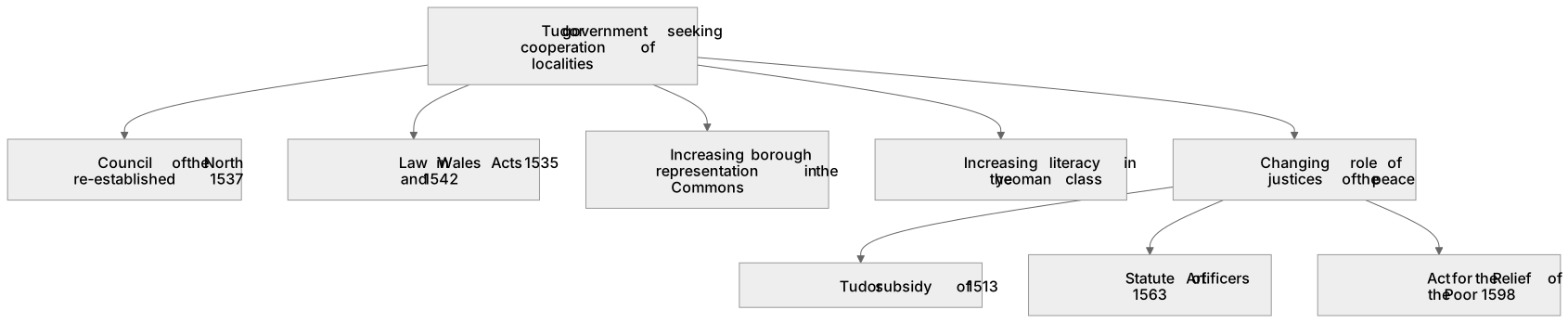
Tudor government depended on cooperation from the localities. After the Pilgrimage of Grace, the Council of the North was re-established in 1537 to strengthen royal authority and supervise justice in the north. The Law in Wales Acts of 1535 and 1542 integrated Wales into English-style shire government, extending royal law and representation. Borough representation in the Commons grew as more towns received the right to return MPs, linking local interests to central politics. Increasing literacy among the yeoman class produced more capable local officeholders, petitioners and jurors. Justices of the peace became the key agents of local governance, enforcing the Tudor subsidy of 1513, the Statute of Artificers 1563 and the Act for the Relief of the Poor 1598. Cooperation was therefore negotiated rather than simply imposed.
What earns the marks
- Explains how the re-established Council of the North in 1537 extended royal authority and judicial oversight in the north after rebellion.
- Analyses the Law in Wales Acts of 1535 and 1542 as instruments that reshaped Welsh local government, law and parliamentary representation.
- Assesses the significance of increasing borough representation in the Commons for relations between centre and localities.
- Evaluates the impact of rising literacy in the yeoman class on the supply of local officials, jurors and petitioners.
- Judges the changing role of justices of the peace through enforcement of the Tudor subsidy of 1513, the Statute of Artificers 1563 and the Act for the Relief of the Poor 1598.
Common mistakes and how to put them right
Confusing the two Law in Wales Acts.
Put it right: Treat 1535 as the main administrative and legal union measure and 1542 as completing and refining it.
Assuming the Council of the North was a new Tudor invention.
Put it right: Note it was re-established in 1537, building on earlier medieval and Henrician arrangements.
Treating justices of the peace as paid central officials.
Put it right: Explain that they were local gentry acting unpaid under royal commission.
Exam tips
- Connect each key development to the theme of gaining cooperation, showing how it made local elites partners in governance.
- Use specific statutes and dates to demonstrate depth, for example the Tudor subsidy of 1513 or the Act for the Relief of the Poor 1598.
- When discussing literacy, avoid vague claims and instead link it to the practical tasks of local officeholders and petitioners.
Try the lesson
The start of the Paper 3, Option 31: Rebellion and disorder under the Tudors, 1485–1603 - 2 Gaining the cooperation of the localities: Involving the localities in governance, 1485–1603: relations with localities (key developments: re-establishing the Council of the North 1537, the Law in Wales Acts 1535 and 1542); increasing borough representation in the Commons over the period; impact of increasing literacy in the yeoman class; the changing role of justices of the peace (key developments: the Tudor subsidy of 1513, the Statute of Artificers 1563, the Act for the Relief of the Poor 1598). lesson, made from checked teaching notes for this specification point.
Have a go first
Which royal council was re-established in 1537 to strengthen crown authority in the north of England?
Listen
Tudor government depended on cooperation from the localities. After the Pilgrimage of Grace, the Council of the North was re-established in 1537 to strengthen royal authority and supervise justice in the north. The Law in Wales Acts of 1535 and 1542 integrated Wales into English-style shire government, extending royal law and representation. Borough representation in the Commons grew as more towns received the right to return MPs, linking local interests to central politics. Increasing literacy among the yeoman class produced more capable local officeholders, petitioners and jurors. Justices of the peace became the key agents of local governance, enforcing the Tudor subsidy of 1513, the Statute of Artificers 1563 and the Act for the Relief of the Poor 1598. Cooperation was therefore negotiated rather than simply imposed. A strong answer earns marks for these points. Explains how the re-established Council of the North in 1537 extended royal authority and judicial oversight in the north after rebellion. Analyses the Law in Wales Acts of 1535 and 1542 as instruments that reshaped Welsh local government, law and parliamentary representation. Assesses the significance of increasing borough representation in the Commons for relations between centre and localities. Evaluates the impact of rising literacy in the yeoman class on the supply of local officials, jurors and petitioners. A common slip: Confusing the two Law in Wales Acts. Instead, treat 1535 as the main administrative and legal union measure and 1542 as completing and refining it. Exam tip: Connect each key development to the theme of gaining cooperation, showing how it made local elites partners in governance.
See it
Key words
Say what each word means before you turn the card.
Royal authority in the north and Wales
Try answering aloud or in your head before turning the card.
Borough representation and the Commons
Try answering aloud or in your head before turning the card.
Literacy and the yeoman class
Try answering aloud or in your head before turning the card.
Justices of the peace and local enforcement
Try answering aloud or in your head before turning the card.
See every definition
- Royal authority in the north and Wales
- Extended through the Council of the North, re-established in 1537 to supervise justice in the north, and the Law in Wales Acts of 1535 and 1542, which integrated Wales into English-style shire government.
- Borough representation and the Commons
- Grew over the period as more towns received the right to return MPs, linking local interests to central politics.
- Literacy and the yeoman class
- Increasing literacy among this class produced more capable local officeholders, petitioners and jurors.
- Justices of the peace and local enforcement
- Became the key agents of local governance, enforcing the Tudor subsidy of 1513, the Statute of Artificers 1563 and the Act for the Relief of the Poor 1598.
Label the diagram
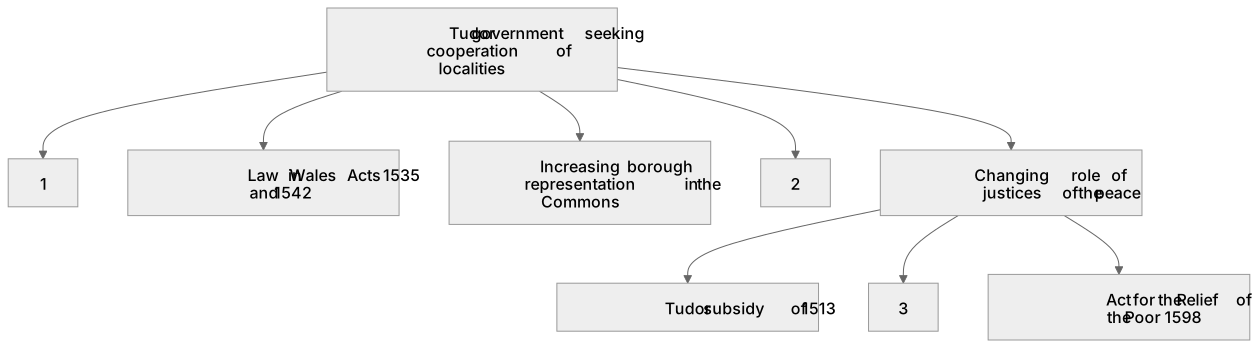
Some boxes have lost their names. Pick the right name for each number.
1Box 1
2Box 2
3Box 3
There is more to this lesson
The full lesson goes on to check your understanding and help you earn the marks. Create a free account to carry on, with your progress saved.
A week of Premium from your first lesson · Then the free plan continues · No card, no charge
Test your understanding of Paper 3, Option 31: Rebellion and disorder under the Tudors, 1485–1603 - 2 Gaining the cooperation of the localities: Involving the localities in governance, 1485–1603: relations with localities (key developments: re-establishing the Council of the North 1537, the Law in Wales Acts 1535 and 1542); increasing borough representation in the Commons over the period; impact of increasing literacy in the yeoman class; the changing role of justices of the peace (key developments: the Tudor subsidy of 1513, the Statute of Artificers 1563, the Act for the Relief of the Poor 1598).
Active recall beats re-reading. Take an instant quiz now to test what you’ve learned and lock it into long-term memory.
A week of Premium from your first lesson · Then the free plan continues · No card, no charge