Pearson Edexcel · A-Level · History
Course version: 9HI0 · Version from Sept 2015
Rebellion and disorder under the Tudors, 1485–1603 - 2 Gaining the…
Full specification wording
Paper 3, Option 31: Rebellion and disorder under the Tudors, 1485–1603 - 2 Gaining the cooperation of the localities: The crown and the country, 1485–1603: the development of a network of personal relationships by patronage, the granting of lands, titles and positions at court; the increasing use of royal progresses beyond London and the Home Counties.
Tudor rule depended on personal bonds, not a standing army or bureaucracy.
Checked against the Pearson Edexcel 9HI0 specification (opens in a new tab) on .
- Point 2 of 2
- 4 key terms
Study notes
From the checked teaching notes for this specification point.
The idea
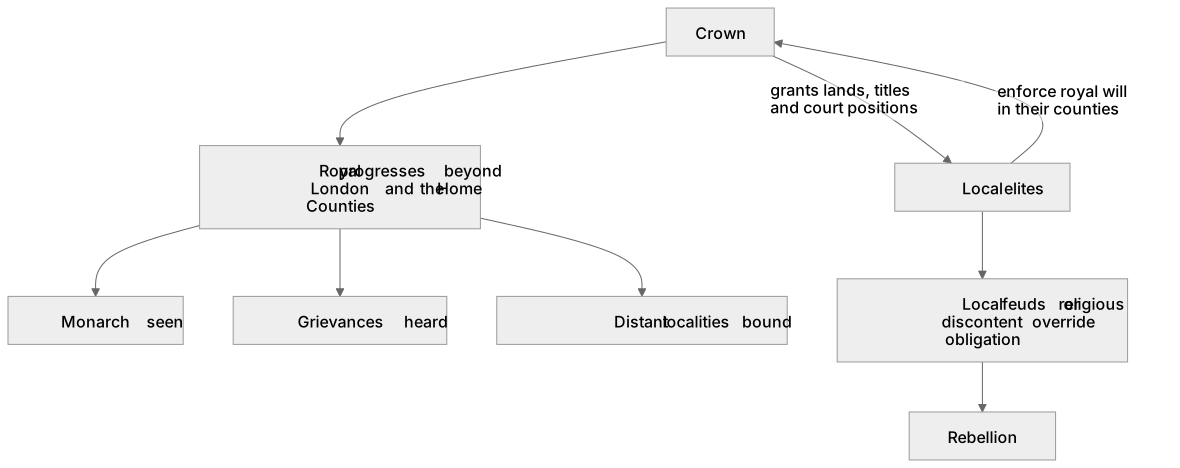
Tudor rule depended on personal bonds, not a standing army or bureaucracy. Patronage bound local elites to the crown: the monarch granted lands, titles such as peerages and knighthoods, and court positions like household offices or places on the royal council. In return, recipients enforced royal will in their counties. Royal progresses extended this network beyond London and the Home Counties, letting the monarch be seen, hear grievances and bind distant localities. Assess how far these methods secured cooperation and where they failed, for example when local feuds or religious discontent overrode obligation.
What earns the marks
- Explains patronage as a reciprocal relationship: crown grants lands, titles and court positions; recipients provide local enforcement, military service and information.
- Gives specific examples of grants, such as peerages, knighthoods, stewardships, wardships or household offices, and links them to political loyalty.
- Analyses how court positions created access to the monarch and thus competition among local families, which could stabilise or destabilise regions.
- Assesses the increasing use of royal progresses beyond London and the Home Counties as a tool to display majesty, gather intelligence and settle disputes in person.
- Evaluates limits: cost of progresses, absence from the capital, and cases where patronage failed to prevent rebellion, such as the Pilgrimage of Grace or the Northern Earls' revolt.
Common mistakes and how to put them right
Treating patronage as one-way generosity rather than a reciprocal bond.
Put it right by stating what the crown received in return.
Assuming progresses were merely holidays.
Put it right by explaining their political functions, including justice, intelligence and local negotiation.
Listing grants without linking them to cooperation or disorder.
Put it right by explaining the consequence of each grant for local stability.
Exam tips
- Plan around the twin mechanisms of patronage and progresses, then weigh their effectiveness across the whole period.
- Use named examples of individuals or regions to show how personal relationships worked in practice.
- In judgements, distinguish between short-term management of elites and long-term structural weaknesses such as finance or religion.
Try the lesson
The start of the Paper 3, Option 31: Rebellion and disorder under the Tudors, 1485–1603 - 2 Gaining the cooperation of the localities: The crown and the country, 1485–1603: the development of a network of personal relationships by patronage, the granting of lands, titles and positions at court; the increasing use of royal progresses beyond London and the Home Counties. lesson, made from checked teaching notes for this specification point.
Have a go first
How did Tudor monarchs primarily use patronage to secure the cooperation of leading families in the localities?
Listen
Tudor rule depended on personal bonds, not a standing army or bureaucracy. Patronage bound local elites to the crown: the monarch granted lands, titles such as peerages and knighthoods, and court positions like household offices or places on the royal council. In return, recipients enforced royal will in their counties. Royal progresses extended this network beyond London and the Home Counties, letting the monarch be seen, hear grievances and bind distant localities. Assess how far these methods secured cooperation and where they failed, for example when local feuds or religious discontent overrode obligation. A strong answer earns marks for these points. Explains patronage as a reciprocal relationship: crown grants lands, titles and court positions; recipients provide local enforcement, military service and information. Gives specific examples of grants, such as peerages, knighthoods, stewardships, wardships or household offices, and links them to political loyalty. Analyses how court positions created access to the monarch and thus competition among local families, which could stabilise or destabilise regions. Assesses the increasing use of royal progresses beyond London and the Home Counties as a tool to display majesty, gather intelligence and settle disputes in person. A common slip: Treating patronage as one-way generosity rather than a reciprocal bond. Instead, stating what the crown received in return. Exam tip: Plan around the twin mechanisms of patronage and progresses, then weigh their effectiveness across the whole period.
See it
Key words
Say what each word means before you turn the card.
Patronage and clientage
Try answering aloud or in your head before turning the card.
Royal authority and local elites
Try answering aloud or in your head before turning the card.
Court politics and access
Try answering aloud or in your head before turning the card.
Royal progresses and regional control
Try answering aloud or in your head before turning the card.
See every definition
- Patronage and clientage
- A network of personal relationships in which the crown granted lands, titles and court positions, and recipients enforced royal will in their counties.
- Royal authority and local elites
- Tudor rule bound local elites to the crown through personal bonds rather than a standing army or bureaucracy, in return for local enforcement.
- Court politics and access
- Court positions created access to the monarch and thus competition among local families, which could stabilise or destabilise regions.
- Royal progresses and regional control
- The increasing use of journeys beyond London and the Home Counties let the monarch be seen, hear grievances and bind distant localities.
Label the diagram
Some boxes have lost their names. Pick the right name for each number.
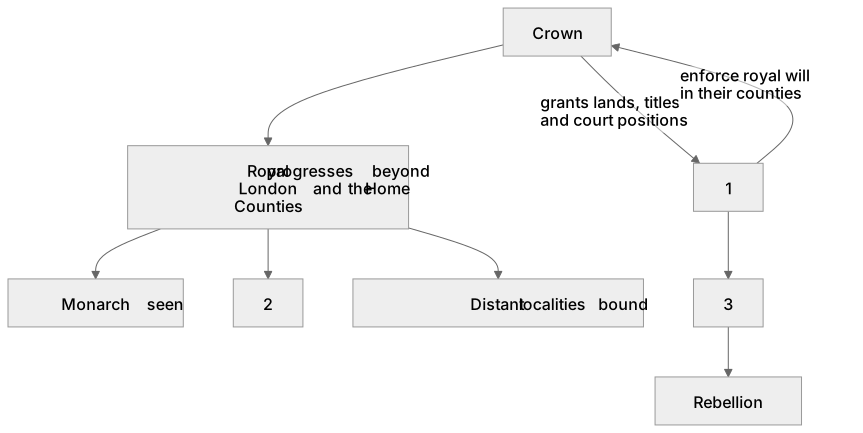
1Box 1
2Box 2
3Box 3
There is more to this lesson
The full lesson goes on to check your understanding and help you earn the marks. Create a free account to carry on, with your progress saved.
A week of Premium from your first lesson · Then the free plan continues · No card, no charge
Test your understanding of Paper 3, Option 31: Rebellion and disorder under the Tudors, 1485–1603 - 2 Gaining the cooperation of the localities: The crown and the country, 1485–1603: the development of a network of personal relationships by patronage, the granting of lands, titles and positions at court; the increasing use of royal progresses beyond London and the Home Counties.
Active recall beats re-reading. Take an instant quiz now to test what you’ve learned and lock it into long-term memory.
A week of Premium from your first lesson · Then the free plan continues · No card, no charge