Pearson Edexcel · A-Level · History
Course version: 9HI0 · Version from Sept 2015
Rebellion and disorder under the Tudors, 1485–1603 - 3 Agrarian…
Full specification wording
Paper 3, Option 31: Rebellion and disorder under the Tudors, 1485–1603 - 3 Agrarian discontent: Kett’s rebellion 1549: The role of leaders in challenge and suppression: Kett; Somerset and the Earl of Warwick; the extent of repression.
Leadership shaped both the challenge and its suppression.
Checked against the Pearson Edexcel 9HI0 specification (opens in a new tab) on .
- Point 3 of 3
- 3 key terms
Study notes
From the checked teaching notes for this specification point.
The idea
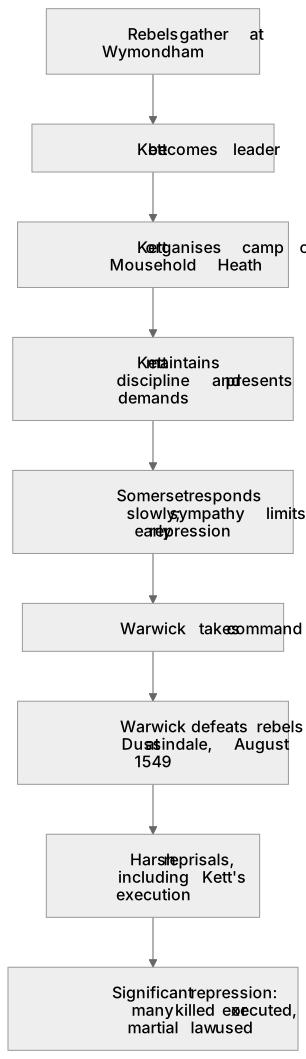
Leadership shaped both the challenge and its suppression. Robert Kett, a local gentleman, became leader after rebels gathered at Wymondham; he organised the camp on Mousehold Heath, maintained discipline and presented the rebels’ demands. The Duke of Somerset, Lord Protector, was slow to respond and his sympathy for the poor limited early repression. The Earl of Warwick took command, defeated the rebels at Dussindale in August 1549 and oversaw harsh reprisals, including Kett’s execution. The extent of repression was significant: many rebels were killed or executed, and the government used martial law.
What earns the marks
- Explains Kett’s role in organising the rebel camp, maintaining discipline and articulating demands.
- Assesses Somerset’s response, including his initial reluctance to use force and the impact of his sympathy for the rebels.
- Evaluates Warwick’s military leadership at Dussindale and his role in crushing the rebellion.
- Analyses the extent of repression, including executions, martial law and the message sent to future rebels.
- Compares the effectiveness of different leaders in challenge and suppression.
Common mistakes and how to put them right
Overstating Somerset’s support for the rebels.
Put it right: Note that he was cautious but ultimately authorised force.
Assuming Warwick acted alone.
Put it right: Recognise that he worked with royal forces and local gentry.
Ignoring the scale of repression.
Put it right: Include executions and the use of martial law as evidence of severity.
Exam tips
- Use specific dates and events, such as the Battle of Dussindale in August 1549, to support arguments about leadership.
- Compare the approaches of Somerset and Warwick to show change in government response.
- Discuss the extent of repression by referring to both immediate punishments and longer-term consequences.
Try the lesson
The start of the Paper 3, Option 31: Rebellion and disorder under the Tudors, 1485–1603 - 3 Agrarian discontent: Kett’s rebellion 1549: The role of leaders in challenge and suppression: Kett; Somerset and the Earl of Warwick; the extent of repression. lesson, made from checked teaching notes for this specification point.
Have a go first
Who led the royal army that finally defeated Kett's rebels at Dussindale in 1549?
Listen
Leadership shaped both the challenge and its suppression. Robert Kett, a local gentleman, became leader after rebels gathered at Wymondham; he organised the camp on Mousehold Heath, maintained discipline and presented the rebels’ demands. The Duke of Somerset, Lord Protector, was slow to respond and his sympathy for the poor limited early repression. The Earl of Warwick took command, defeated the rebels at Dussindale in August 1549 and oversaw harsh reprisals, including Kett’s execution. The extent of repression was significant: many rebels were killed or executed, and the government used martial law. A strong answer earns marks for these points. Explains Kett’s role in organising the rebel camp, maintaining discipline and articulating demands. Assesses Somerset’s response, including his initial reluctance to use force and the impact of his sympathy for the rebels. Evaluates Warwick’s military leadership at Dussindale and his role in crushing the rebellion. Analyses the extent of repression, including executions, martial law and the message sent to future rebels. A common slip: Overstating Somerset’s support for the rebels. Instead, note that he was cautious but ultimately authorised force. Exam tip: Use specific dates and events, such as the Battle of Dussindale in August 1549, to support arguments about leadership.
See it
Key words
Say what each word means before you turn the card.
Leadership and rebellion
Try answering aloud or in your head before turning the card.
Government suppression
Try answering aloud or in your head before turning the card.
Repression and punishment
Try answering aloud or in your head before turning the card.
See every definition
- Leadership and rebellion
- Robert Kett, a local gentleman, became leader after rebels gathered at Wymondham, organising the camp on Mousehold Heath, maintaining discipline and presenting the rebels' demands.
- Government suppression
- Somerset was slow to respond and his sympathy for the poor limited early repression, while Warwick took command, defeated the rebels at Dussindale in August 1549 and oversaw harsh reprisals.
- Repression and punishment
- The extent of repression was significant, with many rebels killed or executed and the government using martial law, including Kett's execution.
Label the diagram
Some boxes have lost their names. Pick the right name for each number.
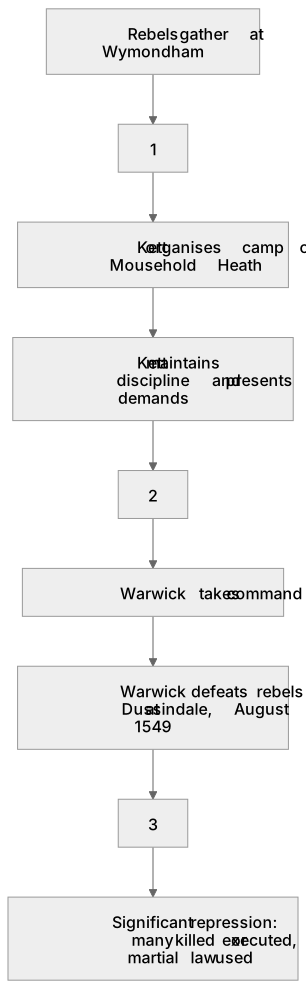
1Box 1
2Box 2
3Box 3
There is more to this lesson
The full lesson goes on to check your understanding and help you earn the marks. Create a free account to carry on, with your progress saved.
A week of Premium from your first lesson · Then the free plan continues · No card, no charge
Test your understanding of Paper 3, Option 31: Rebellion and disorder under the Tudors, 1485–1603 - 3 Agrarian discontent: Kett’s rebellion 1549: The role of leaders in challenge and suppression: Kett; Somerset and the Earl of Warwick; the extent of repression.
Active recall beats re-reading. Take an instant quiz now to test what you’ve learned and lock it into long-term memory.
A week of Premium from your first lesson · Then the free plan continues · No card, no charge