Pearson Edexcel · A-Level · History
Course version: 9HI0 · Version from Sept 2015
Rebellion and disorder under the Tudors, 1485–1603 - 3 Agrarian…
Full specification wording
Paper 3, Option 31: Rebellion and disorder under the Tudors, 1485–1603 - 3 Agrarian discontent: Kett’s rebellion 1549: The challenge posed by Kett’s rebellion: its demands; extent of the threat posed.
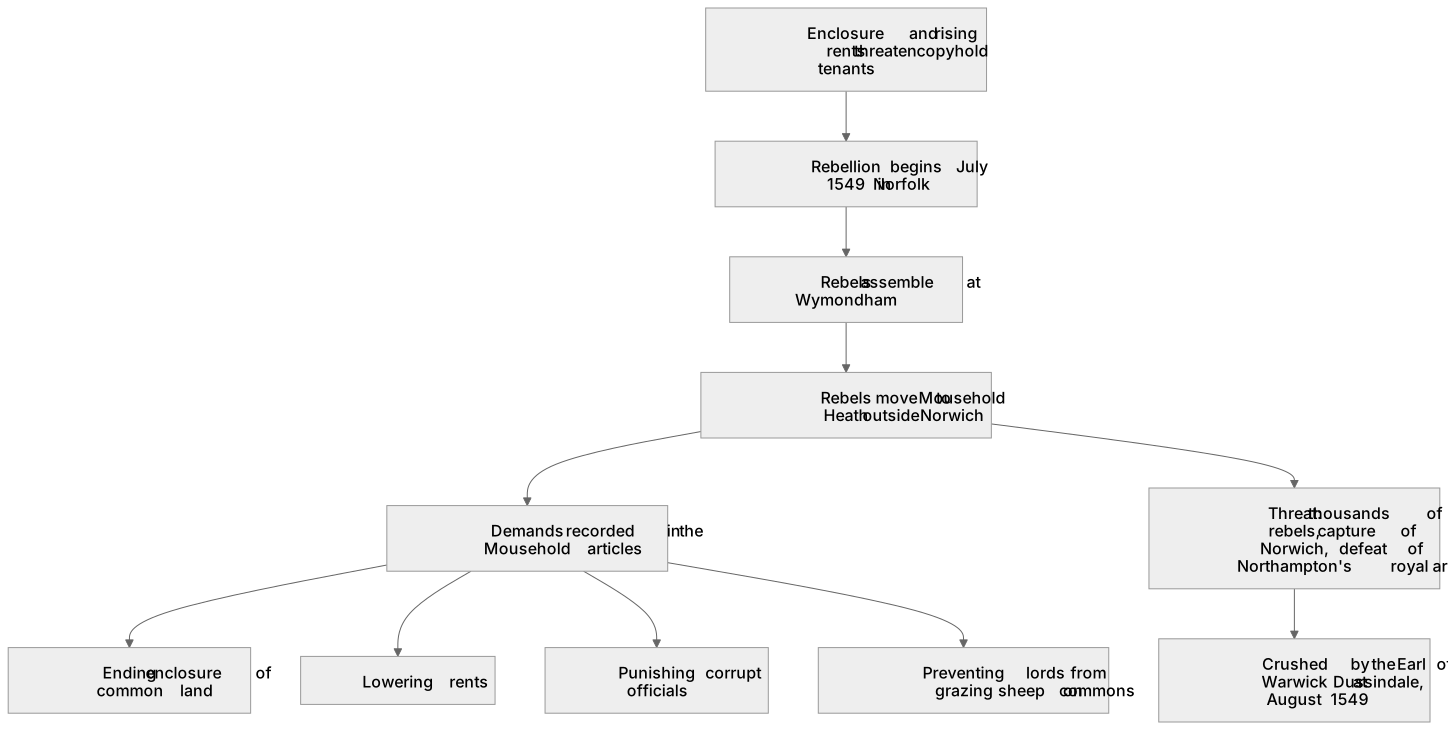
Kett’s rebellion began in July 1549 in Norfolk, where enclosure and rising rents threatened copyhold tenants.
Checked against the Pearson Edexcel 9HI0 specification (opens in a new tab) on .
- Point 2 of 3
Study notes
From the checked teaching notes for this specification point.
The idea
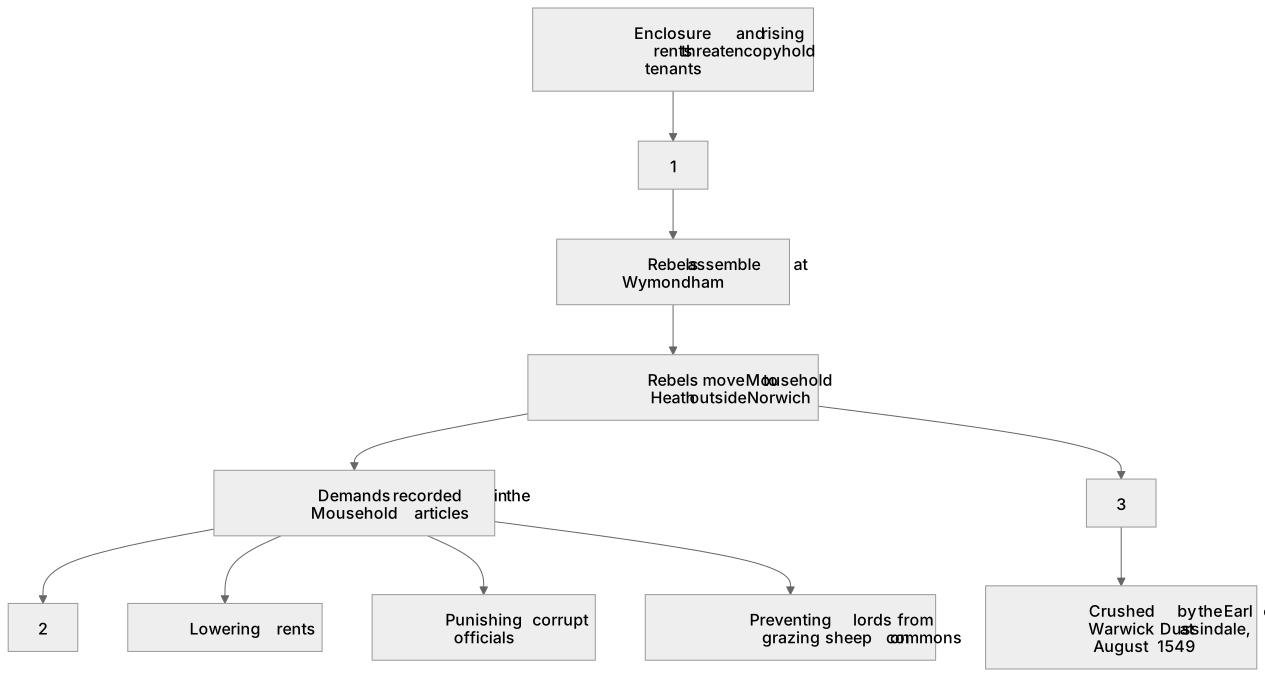
Kett’s rebellion began in July 1549 in Norfolk, where enclosure and rising rents threatened copyhold tenants. Rebels assembled at Wymondham and moved to Mousehold Heath outside Norwich. Their demands, recorded in the Mousehold articles, included ending enclosure of common land, lowering rents, punishing corrupt officials and preventing lords from grazing sheep on commons. The rebellion posed a serious threat because it drew thousands of rebels, captured Norwich, defeated a royal army under the Marquess of Northampton, and coincided with other risings in 1549. However, it lacked noble leadership, remained regional and was crushed by the Earl of Warwick at Dussindale in August 1549.
What earns the marks
- Explains the specific demands of the rebels, such as ending enclosure, reducing rents and punishing local officials, using the Mousehold articles as evidence.
- Assesses the scale of the rebellion, including the number of rebels, the capture of Norwich and the defeat of Northampton’s force.
- Evaluates the geographical spread and duration, noting that the rebellion remained largely confined to Norfolk and East Anglia.
- Weighs the threat against government responses, including the role of Warwick and the eventual defeat at Dussindale.
- Compares Kett’s rebellion with other 1549 risings to judge whether it was part of a wider crisis or a regional disturbance.
Common mistakes and how to put them right
Treating the rebellion as a purely class war.
Put it right: Recognise that rebels included local gentry and clergy and that demands mixed economic and religious grievances.
Assuming the rebellion threatened London directly.
Put it right: Note that it remained in Norfolk and was suppressed before any march on London.
Confusing Kett’s rebellion with the Pilgrimage of Grace.
Put it right: Keep the 1549 Norfolk context distinct from the 1536–37 northern risings.
Exam tips
- Use the Mousehold articles as specific evidence when discussing demands, rather than generalising about enclosure.
- Balance the extent of the threat by discussing both rebel successes and the reasons for their ultimate failure.
- Link the rebellion to the wider context of 1549, including agrarian and religious tensions, to show understanding of significance.
Try the lesson
The start of the Paper 3, Option 31: Rebellion and disorder under the Tudors, 1485–1603 - 3 Agrarian discontent: Kett’s rebellion 1549: The challenge posed by Kett’s rebellion: its demands; extent of the threat posed. lesson, made from checked teaching notes for this specification point.
Have a go first
Which of the following was a demand made by the rebels at Mousehold Heath in 1549?
Listen
Kett’s rebellion began in July 1549 in Norfolk, where enclosure and rising rents threatened copyhold tenants. Rebels assembled at Wymondham and moved to Mousehold Heath outside Norwich. Their demands, recorded in the Mousehold articles, included ending enclosure of common land, lowering rents, punishing corrupt officials and preventing lords from grazing sheep on commons. The rebellion posed a serious threat because it drew thousands of rebels, captured Norwich, defeated a royal army under the Marquess of Northampton, and coincided with other risings in 1549. However, it lacked noble leadership, remained regional and was crushed by the Earl of Warwick at Dussindale in August 1549. A strong answer earns marks for these points. Explains the specific demands of the rebels, such as ending enclosure, reducing rents and punishing local officials, using the Mousehold articles as evidence. Assesses the scale of the rebellion, including the number of rebels, the capture of Norwich and the defeat of Northampton’s force. Evaluates the geographical spread and duration, noting that the rebellion remained largely confined to Norfolk and East Anglia. Weighs the threat against government responses, including the role of Warwick and the eventual defeat at Dussindale. A common slip: Treating the rebellion as a purely class war. Instead, recognise that rebels included local gentry and clergy and that demands mixed economic and religious grievances. Exam tip: Use the Mousehold articles as specific evidence when discussing demands, rather than generalising about enclosure.
See it
Label the diagram
Some boxes have lost their names. Pick the right name for each number.
1Box 1
2Box 2
3Box 3
There is more to this lesson
The full lesson goes on to check your understanding and help you earn the marks. Create a free account to carry on, with your progress saved.
A week of Premium from your first lesson · Then the free plan continues · No card, no charge
Test your understanding of Paper 3, Option 31: Rebellion and disorder under the Tudors, 1485–1603 - 3 Agrarian discontent: Kett’s rebellion 1549: The challenge posed by Kett’s rebellion: its demands; extent of the threat posed.
Active recall beats re-reading. Take an instant quiz now to test what you’ve learned and lock it into long-term memory.
A week of Premium from your first lesson · Then the free plan continues · No card, no charge