Pearson Edexcel · A-Level · History
Course version: 9HI0 · Version from Sept 2015
Rebellion and disorder under the Tudors, 1485–1603 - 3 Agrarian…
Full specification wording
Paper 3, Option 31: Rebellion and disorder under the Tudors, 1485–1603 - 3 Agrarian discontent: Kett’s rebellion 1549: The social and economic reasons for rebellion: the impact of enclosures; rural discontent; the impact of the Duke of Somerset’s commission on enclosures.
Kett's rebellion in 1549 grew from social and economic pressures in East Anglia.
Checked against the Pearson Edexcel 9HI0 specification (opens in a new tab) on .
- Point 1 of 3
- 4 key terms
Study notes
From the checked teaching notes for this specification point.
The idea
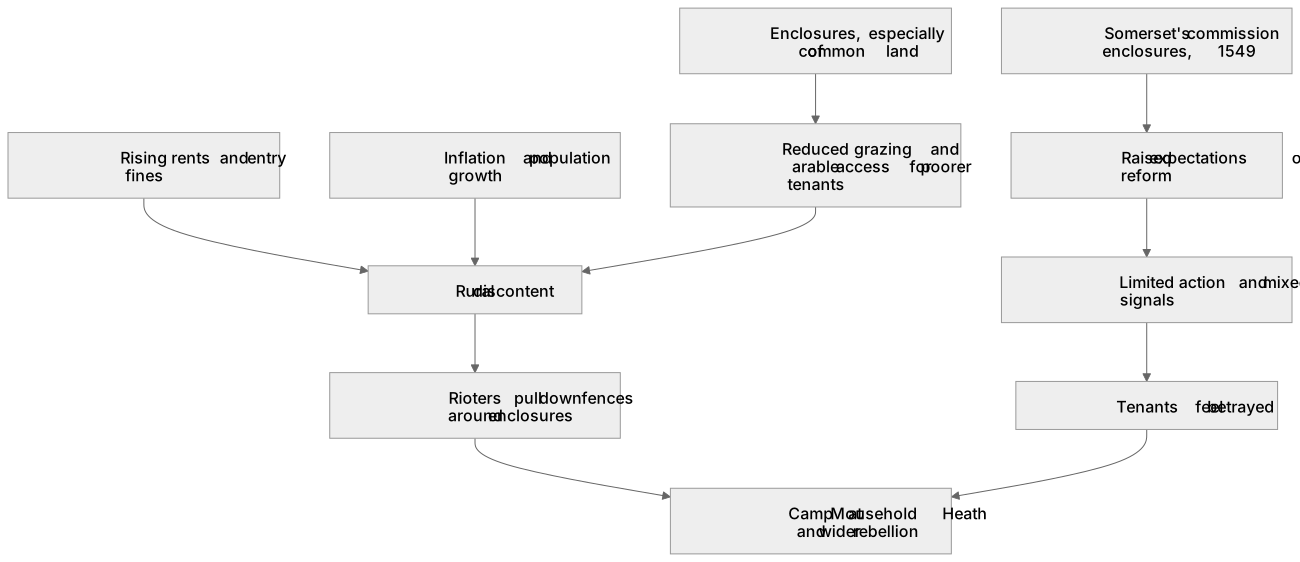
Kett's rebellion in 1549 grew from social and economic pressures in East Anglia. Enclosures, especially of common land, reduced grazing and arable access for poorer tenants, while rising rents, entry fines, inflation and population growth deepened rural discontent. Many rioters first pulled down fences around enclosures before the rising widened into a camp at Mousehold Heath. The Duke of Somerset, Lord Protector, had encouraged complaints against enclosures and sent a commission to investigate illegal ones in 1549. Its limited action and the perception that it offered hope without remedy fuelled expectations and anger, helping turn local grievances into a major rebellion.
What earns the marks
- Explains how enclosures, particularly of common land, harmed smallholders and labourers by reducing access to grazing and arable land, creating a direct grievance that rioters expressed by destroying fences.
- Explains wider rural discontent: rising rents and entry fines, price inflation, population growth and insecure employment increased poverty and resentment among copyholders and wage labourers.
- Explains how these social and economic grievances interacted with religious and political complaints to produce the camp at Mousehold Heath and the scale of Kett's rebellion.
- Assesses the relative importance of enclosure compared with other rural grievances, recognising that enclosure was often a symbol of wider economic hardship rather than the sole cause.
Common mistakes and how to put them right
Claiming Kett's rebellion was purely about enclosure.
Put it right by explaining that enclosure was one grievance among wider rural discontent such as rents, fines and inflation.
Assuming Somerset's commission solved the problem.
Put it right by noting it investigated complaints but achieved little, so expectations were raised and then disappointed.
Confusing the 1549 enclosure commission with later Tudor poor laws.
Put it right by keeping the focus on its immediate role in the events leading to Kett's rebellion.
Exam tips
- Link each economic cause to a specific rebel action or demand, such as fence destruction or articles drawn up at Mousehold Heath, to show causation rather than listing grievances.
- Weigh social and economic factors against religious and political ones when the question asks for the most important cause, and state a clear judgement.
- Use precise terms such as common land, entry fine and copyholder correctly to demonstrate secure contextual knowledge.
Try the lesson
The start of the Paper 3, Option 31: Rebellion and disorder under the Tudors, 1485–1603 - 3 Agrarian discontent: Kett’s rebellion 1549: The social and economic reasons for rebellion: the impact of enclosures; rural discontent; the impact of the Duke of Somerset’s commission on enclosures. lesson, made from checked teaching notes for this specification point.
Have a go first
How did the Duke of Somerset's enclosure commissions contribute to the outbreak of Kett's Rebellion in 1549?
Listen
Kett's rebellion in 1549 grew from social and economic pressures in East Anglia. Enclosures, especially of common land, reduced grazing and arable access for poorer tenants, while rising rents, entry fines, inflation and population growth deepened rural discontent. Many rioters first pulled down fences around enclosures before the rising widened into a camp at Mousehold Heath. The Duke of Somerset, Lord Protector, had encouraged complaints against enclosures and sent a commission to investigate illegal ones in 1549. Its limited action and the perception that it offered hope without remedy fuelled expectations and anger, helping turn local grievances into a major rebellion. A strong answer earns marks for these points. Explains how enclosures, particularly of common land, harmed smallholders and labourers by reducing access to grazing and arable land, creating a direct grievance that rioters expressed by destroying fences. Explains wider rural discontent: rising rents and entry fines, price inflation, population growth and insecure employment increased poverty and resentment among copyholders and wage labourers. Explains the role of Somerset's enclosure commission of 1549: it investigated illegal enclosures and raised expectations of reform, but its limited results and the government's mixed signals left tenants feeling betrayed. Explains how these social and economic grievances interacted with religious and political complaints to produce the camp at Mousehold Heath and the scale of Kett's rebellion. A common slip: Claiming Kett's rebellion was purely about enclosure. Instead, explaining that enclosure was one grievance among wider rural discontent such as rents, fines and inflation. Exam tip: Link each economic cause to a specific rebel action or demand, such as fence destruction or articles drawn up at Mousehold Heath, to show causation rather than listing grievances.
See it
Key words
Say what each word means before you turn the card.
Enclosure and access to land
Try answering aloud or in your head before turning the card.
Rural poverty and economic change
Try answering aloud or in your head before turning the card.
Government commissions and expectations
Try answering aloud or in your head before turning the card.
Causes of popular rebellion
Try answering aloud or in your head before turning the card.
See every definition
- Enclosure and access to land
- Enclosures, especially of common land, reduced grazing and arable access for poorer tenants, creating a direct grievance that rioters expressed by destroying fences.
- Rural poverty and economic change
- Rising rents, entry fines, inflation and population growth deepened rural discontent and increased poverty and resentment among copyholders and wage labourers.
- Government commissions and expectations
- Somerset sent a commission to investigate illegal enclosures in 1549, but its limited action and the perception that it offered hope without remedy fuelled expectations and anger.
- Causes of popular rebellion
- Social and economic grievances interacted with religious and political complaints to produce the camp at Mousehold Heath and the scale of Kett's rebellion.
Label the diagram
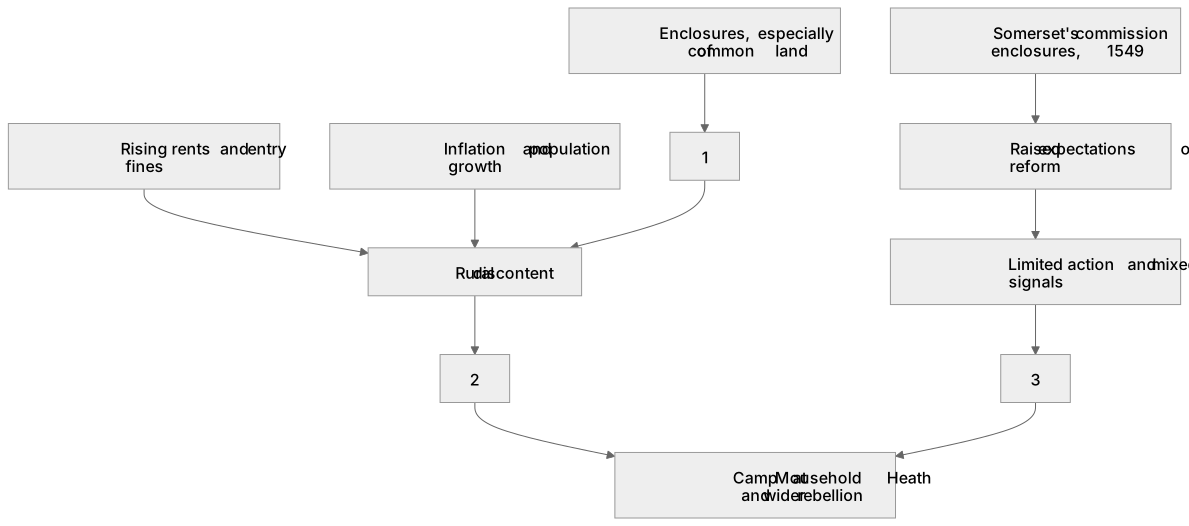
Some boxes have lost their names. Pick the right name for each number.
1Box 1
2Box 2
3Box 3
There is more to this lesson
The full lesson goes on to check your understanding and help you earn the marks. Create a free account to carry on, with your progress saved.
A week of Premium from your first lesson · Then the free plan continues · No card, no charge
Test your understanding of Paper 3, Option 31: Rebellion and disorder under the Tudors, 1485–1603 - 3 Agrarian discontent: Kett’s rebellion 1549: The social and economic reasons for rebellion: the impact of enclosures; rural discontent; the impact of the Duke of Somerset’s commission on enclosures.
Active recall beats re-reading. Take an instant quiz now to test what you’ve learned and lock it into long-term memory.
A week of Premium from your first lesson · Then the free plan continues · No card, no charge