Pearson Edexcel · A-Level · History
Course version: 9HI0 · Version from Sept 2015
Rebellion and disorder under the Tudors, 1485–1603 - 4 Queen takes Queen?…
Full specification wording
Paper 3, Option 31: Rebellion and disorder under the Tudors, 1485–1603 - 4 Queen takes Queen? The revolt of the northern earls, 1569–70: The causes of and development of the challenge: problem posed by Mary, Queen of Scots; court politics and faction; the role of the Duke of Norfolk; economic and religious insecurities of the northern nobility; Mary’s arrival in 1568.
This topic explains why the northern earls rose in 1569.
Checked against the Pearson Edexcel 9HI0 specification (opens in a new tab) on .
- Point 1 of 3
- 4 key terms
Study notes
From the checked teaching notes for this specification point.
The idea
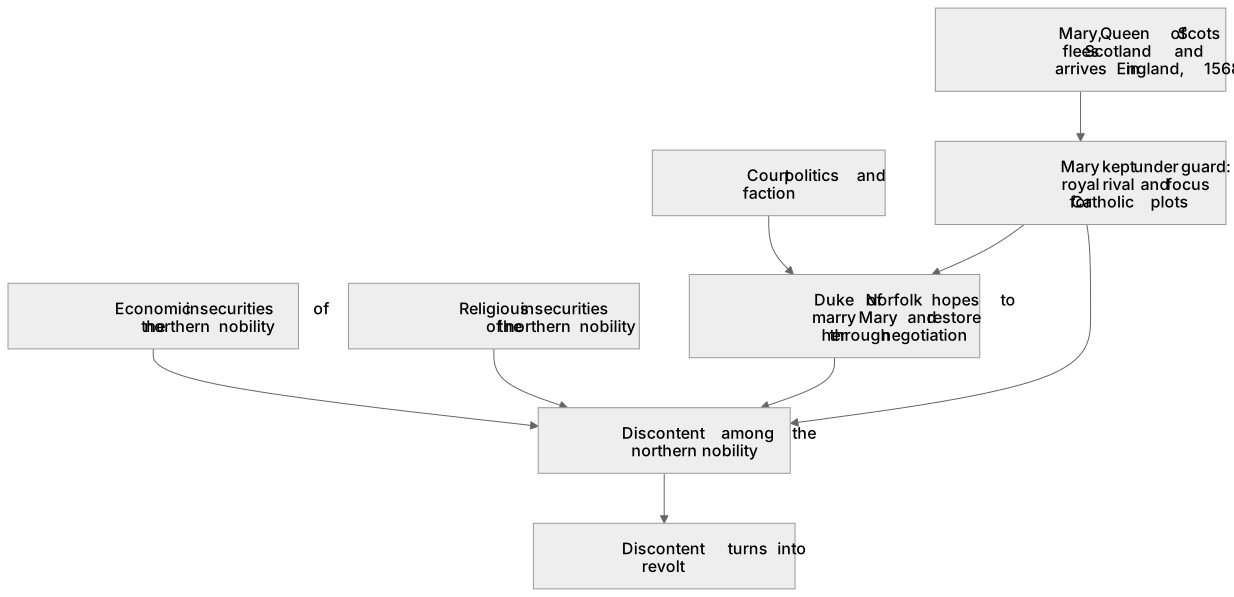
This topic explains why the northern earls rose in 1569. Mary, Queen of Scots fled Scotland and crossed into England in May 1568, creating a royal rival with a claim to the throne. Elizabeth kept her under guard, so Mary became a focus for Catholic plots. At court, factional rivalry between William Cecil and conservative nobles such as the Duke of Norfolk deepened suspicion. Norfolk hoped to marry Mary and restore her through negotiation, linking court politics to the northern grievance. The northern nobility also feared economic loss from Elizabeth's policies and resented Protestant reform, which threatened their local power and religious traditions. These causes combined to turn discontent into revolt.
What earns the marks
- Explains how Mary's arrival in 1568 gave disaffected Catholics a credible alternative monarch and made her a permanent focus of plots.
- Analyses how court faction between Cecil's Protestant circle and conservative peers such as Norfolk created instability and pushed some nobles towards conspiracy.
- Assesses Norfolk's role in proposing marriage to Mary as a political solution that alarmed Elizabeth and hardened the government's stance.
- Explains the economic insecurities of northern nobles, including fears over royal policies, land, and local authority.
- Explains the religious insecurities of northern nobles, including resentment of Protestant reform and the loss of traditional Catholic practices.
- Links the separate causes together, showing how Mary's presence, faction, Norfolk's ambition, and northern grievances interacted to produce the revolt.
Common mistakes and how to put them right
Treating Mary's arrival as the sole cause.
Put it right: Present it as a catalyst that intensified existing court and northern grievances.
Assuming all northern nobles rebelled for purely religious reasons.
Put it right: Balance religious resentment with economic and political motives.
Describing Norfolk as a committed rebel from the start.
Put it right: Explain his role as a conspirator whose marriage plan and indecision contributed to the crisis.
Exam tips
- Plan answers around the named causes so every clause of the specification is addressed.
- Use precise dates and names, such as Mary's arrival in 1568 and Norfolk's marriage scheme, to support analysis.
- When judging significance, compare causes and explain which one did most to turn discontent into open revolt.
Try the lesson
The start of the Paper 3, Option 31: Rebellion and disorder under the Tudors, 1485–1603 - 4 Queen takes Queen? The revolt of the northern earls, 1569–70: The causes of and development of the challenge: problem posed by Mary, Queen of Scots; court politics and faction; the role of the Duke of Norfolk; economic and religious insecurities of the northern nobility; Mary’s arrival in 1568. lesson, made from checked teaching notes for this specification point.
Have a go first
In which year did Mary, Queen of Scots arrive in England after fleeing Scotland?
Listen
This topic explains why the northern earls rose in 1569. Mary, Queen of Scots fled Scotland and crossed into England in May 1568, creating a royal rival with a claim to the throne. Elizabeth kept her under guard, so Mary became a focus for Catholic plots. At court, factional rivalry between William Cecil and conservative nobles such as the Duke of Norfolk deepened suspicion. Norfolk hoped to marry Mary and restore her through negotiation, linking court politics to the northern grievance. The northern nobility also feared economic loss from Elizabeth's policies and resented Protestant reform, which threatened their local power and religious traditions. These causes combined to turn discontent into revolt. A strong answer earns marks for these points. Explains how Mary's arrival in 1568 gave disaffected Catholics a credible alternative monarch and made her a permanent focus of plots. Analyses how court faction between Cecil's Protestant circle and conservative peers such as Norfolk created instability and pushed some nobles towards conspiracy. Assesses Norfolk's role in proposing marriage to Mary as a political solution that alarmed Elizabeth and hardened the government's stance. Explains the economic insecurities of northern nobles, including fears over royal policies, land, and local authority. A common slip: Treating Mary's arrival as the sole cause. Instead, present it as a catalyst that intensified existing court and northern grievances. Exam tip: Plan answers around the named causes so every clause of the specification is addressed.
See it
Key words
Say what each word means before you turn the card.
Dynastic challenge
Try answering aloud or in your head before turning the card.
Court faction
Try answering aloud or in your head before turning the card.
Noble grievance
Try answering aloud or in your head before turning the card.
Religion and rebellion
Try answering aloud or in your head before turning the card.
See every definition
- Dynastic challenge
- The problem posed by Mary, Queen of Scots, who created a royal rival with a claim to the throne after her arrival in 1568.
- Court faction
- Factional rivalry at court between William Cecil and conservative nobles such as the Duke of Norfolk, which deepened suspicion.
- Noble grievance
- The economic and religious insecurities of the northern nobility, who feared economic loss and resented Protestant reform.
- Religion and rebellion
- Resentment of Protestant reform, which threatened the local power and religious traditions of the northern nobility.
Label the diagram
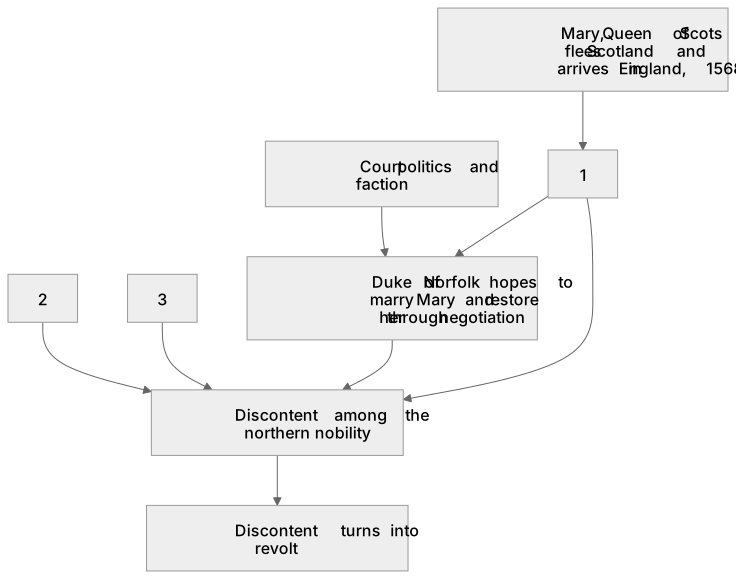
Some boxes have lost their names. Pick the right name for each number.
1Box 1
2Box 2
3Box 3
There is more to this lesson
The full lesson goes on to check your understanding and help you earn the marks. Create a free account to carry on, with your progress saved.
A week of Premium from your first lesson · Then the free plan continues · No card, no charge
Test your understanding of Paper 3, Option 31: Rebellion and disorder under the Tudors, 1485–1603 - 4 Queen takes Queen? The revolt of the northern earls, 1569–70: The causes of and development of the challenge: problem posed by Mary, Queen of Scots; court politics and faction; the role of the Duke of Norfolk; economic and religious insecurities of the northern nobility; Mary’s arrival in 1568.
Active recall beats re-reading. Take an instant quiz now to test what you’ve learned and lock it into long-term memory.
A week of Premium from your first lesson · Then the free plan continues · No card, no charge