Pearson Edexcel · A-Level · History
Course version: 9HI0 · Version from Sept 2015
Rebellion and disorder under the Tudors, 1485–1603 - 4 Queen takes Queen?…
Full specification wording
Paper 3, Option 31: Rebellion and disorder under the Tudors, 1485–1603 - 4 Queen takes Queen? The revolt of the northern earls, 1569–70: The main events of the revolt: the significance of the capture of Durham and the siege of Barnard Castle; the role of the northern earls; the extent of the threat to Elizabeth.
This topic covers the revolt's main events and asks how serious it was.
Checked against the Pearson Edexcel 9HI0 specification (opens in a new tab) on .
- Point 2 of 3
Study notes
From the checked teaching notes for this specification point.
The idea
This topic covers the revolt's main events and asks how serious it was. In November 1569 the northern earls, led by the Earls of Northumberland and Westmorland, marched into Durham and captured the city, restoring Catholic worship in the cathedral. This public act gave the rebellion a religious character and attracted support. The rebels then moved south and besieged Barnard Castle, a key stronghold, but the siege exposed their limited military strength and slow progress. Elizabeth responded by moving a large royal army north under the Earl of Sussex, and the rebels dispersed without a major battle. The earls fled into Scotland, and the government punished participants harshly. The revolt therefore posed a real but limited threat to Elizabeth, revealing both the depth of northern discontent and the crown's ability to suppress it.
What earns the marks
- Explains why the capture of Durham was significant, including its symbolic restoration of Catholic worship and its role in attracting support.
- Analyses the siege of Barnard Castle as a test of rebel organisation and military capability.
- Assesses the leadership and role of the northern earls, including Northumberland and Westmorland, in directing the revolt.
- Evaluates the extent of the threat to Elizabeth, considering rebel numbers, speed of government response, and lack of foreign support.
- Uses the revolt's outcome to judge whether it was a serious challenge or a contained regional rising.
Common mistakes and how to put them right
Narrating events without judging significance.
Put it right: Explain what Durham and Barnard Castle reveal about rebel aims and strength.
Claiming the revolt nearly overthrew Elizabeth.
Put it right: Show that the royal army's advance and the rebels' dispersal limited the threat.
Ignoring the role of individual earls.
Put it right: Distinguish the leadership and motives of Northumberland and Westmorland.
Exam tips
- Structure answers around significance, role, and extent of threat rather than a simple story.
- Use the capture of Durham and the siege of Barnard Castle as evidence for rebel strengths and weaknesses.
- Reach a clear judgement on how far the revolt threatened Elizabeth, supported by specific events.
Try the lesson
The start of the Paper 3, Option 31: Rebellion and disorder under the Tudors, 1485–1603 - 4 Queen takes Queen? The revolt of the northern earls, 1569–70: The main events of the revolt: the significance of the capture of Durham and the siege of Barnard Castle; the role of the northern earls; the extent of the threat to Elizabeth. lesson, made from checked teaching notes for this specification point.
Have a go first
Which northern cathedral city was captured by the rebel earls in November 1569?
Listen
This topic covers the revolt's main events and asks how serious it was. In November 1569 the northern earls, led by the Earls of Northumberland and Westmorland, marched into Durham and captured the city, restoring Catholic worship in the cathedral. This public act gave the rebellion a religious character and attracted support. The rebels then moved south and besieged Barnard Castle, a key stronghold, but the siege exposed their limited military strength and slow progress. Elizabeth responded by moving a large royal army north under the Earl of Sussex, and the rebels dispersed without a major battle. The earls fled into Scotland, and the government punished participants harshly. The revolt therefore posed a real but limited threat to Elizabeth, revealing both the depth of northern discontent and the crown's ability to suppress it. A strong answer earns marks for these points. Explains why the capture of Durham was significant, including its symbolic restoration of Catholic worship and its role in attracting support. Analyses the siege of Barnard Castle as a test of rebel organisation and military capability. Assesses the leadership and role of the northern earls, including Northumberland and Westmorland, in directing the revolt. Evaluates the extent of the threat to Elizabeth, considering rebel numbers, speed of government response, and lack of foreign support. A common slip: Narrating events without judging significance. Instead, explain what Durham and Barnard Castle reveal about rebel aims and strength. Exam tip: Structure answers around significance, role, and extent of threat rather than a simple story.
See it
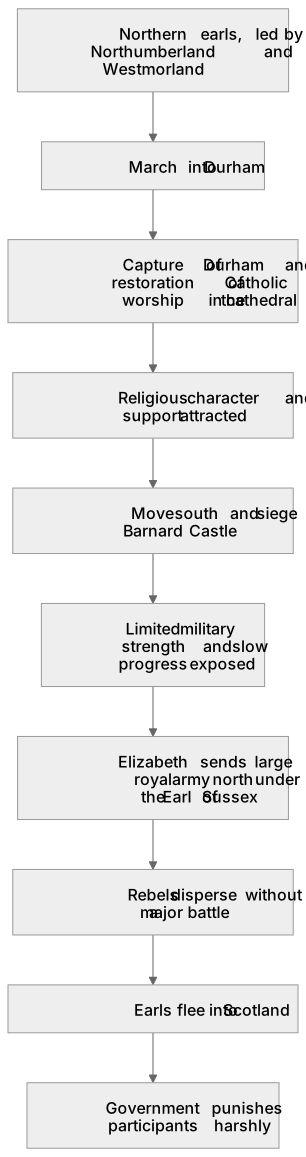
Label the diagram
Some boxes have lost their names. Pick the right name for each number.
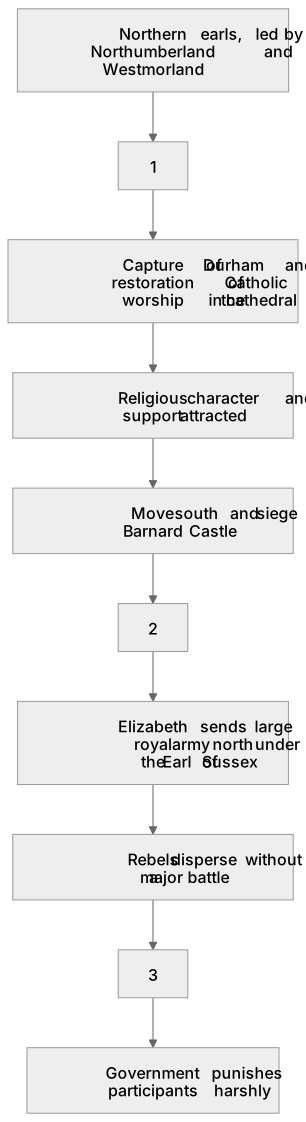
1Box 1
2Box 2
3Box 3
There is more to this lesson
The full lesson goes on to check your understanding and help you earn the marks. Create a free account to carry on, with your progress saved.
A week of Premium from your first lesson · Then the free plan continues · No card, no charge
Test your understanding of Paper 3, Option 31: Rebellion and disorder under the Tudors, 1485–1603 - 4 Queen takes Queen? The revolt of the northern earls, 1569–70: The main events of the revolt: the significance of the capture of Durham and the siege of Barnard Castle; the role of the northern earls; the extent of the threat to Elizabeth.
Active recall beats re-reading. Take an instant quiz now to test what you’ve learned and lock it into long-term memory.
A week of Premium from your first lesson · Then the free plan continues · No card, no charge