Pearson Edexcel · A-Level · History
Course version: 9HI0 · Version from Sept 2015
The witch craze in Britain, Europe and North America, c1580–c1750 - 1 The…
Full specification wording
Paper 3, Option 33: The witch craze in Britain, Europe and North America, c1580–c1750 - 1 The North Berwick witches in Scotland, 1590–91 and the aftermath to 1597: Reasons for the extent of persecutions in Scotland to 1597, including judicial procedures, lack of strong central control, the role of King James and significance of his Daemonologie.
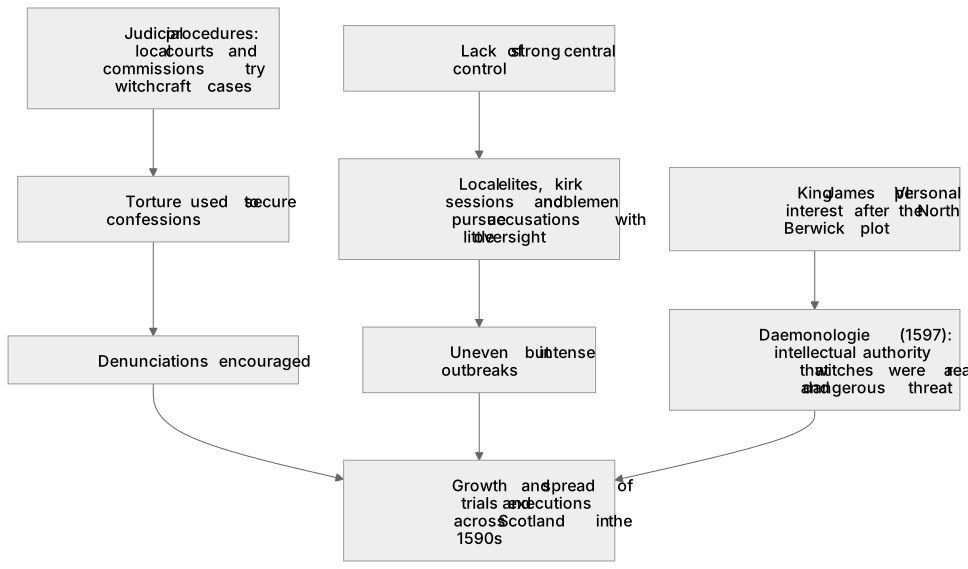
Persecution in Scotland reached a peak by 1597 because several factors combined.
Checked against the Pearson Edexcel 9HI0 specification (opens in a new tab) on .
- Point 3 of 3
- 4 key terms
Study notes
From the checked teaching notes for this specification point.
The idea
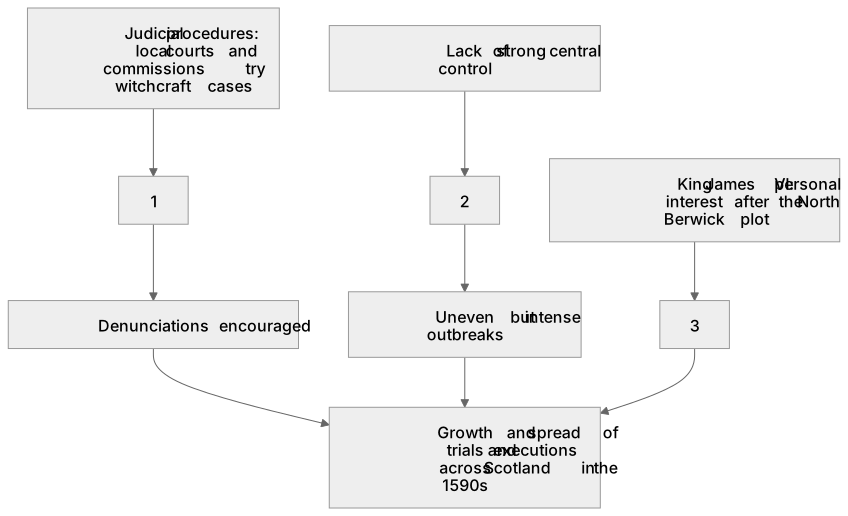
Persecution in Scotland reached a peak by 1597 because several factors combined. Judicial procedures allowed local courts and commissions to try witchcraft cases, often using torture to secure confessions, which encouraged denunciations. A lack of strong central control meant that local elites, kirk sessions and noblemen could pursue accusations with little oversight, producing uneven but intense outbreaks. King James VI took a personal interest after the North Berwick plot, and his Daemonologie (1597) gave intellectual authority to the belief that witches were a real and dangerous threat. Together, these factors explain why the number of trials and executions grew and spread across Scotland in the 1590s.
What earns the marks
- Explains how judicial procedures, including the use of torture and local commissions, made it easier to secure convictions and widen accusations.
- Analyses how the lack of strong central control allowed local authorities and kirk sessions to pursue witch hunts with limited royal oversight.
- Assesses the role of King James VI in promoting persecution through his personal involvement and his written work.
- Evaluates the significance of Daemonologie (1597) as a justification for witch hunting and a guide for interrogators.
- Synthesises the factors to explain the extent of persecutions in Scotland to 1597, rather than listing them separately.
Common mistakes and how to put them right
Treating the lack of central control as simply chaos.
Put it right: It meant local courts and nobles had freedom to act, which could increase persecution.
Assuming Daemonologie was an official law code.
Put it right: It was a royal treatise that shaped beliefs and gave intellectual support to witch hunting.
Overstating James's role as the sole cause.
Put it right: Judicial procedures and local control were also essential, and James's influence worked alongside them.
Ignoring the chronology: correction — the peak of persecution to 1597 followed the North Berwick trials and the publication of Daemonologie.
Exam tips
- Structure your answer around the named factors: judicial procedures, lack of strong central control, King James, and Daemonologie.
- Use the phrase 'extent of persecutions' to focus on scale and spread, not just individual cases.
- Refer to specific examples, such as the North Berwick trials and the publication of Daemonologie in 1597, to support your points.
- Make links between factors, for example how Daemonologie reinforced existing judicial practices.
Try the lesson
The start of the Paper 3, Option 33: The witch craze in Britain, Europe and North America, c1580–c1750 - 1 The North Berwick witches in Scotland, 1590–91 and the aftermath to 1597: Reasons for the extent of persecutions in Scotland to 1597, including judicial procedures, lack of strong central control, the role of King James and significance of his Daemonologie. lesson, made from checked teaching notes for this specification point.
Have a go first
Which king of Scotland took a personal interest in the North Berwick witch trials and later wrote Daemonologie?
Listen
Persecution in Scotland reached a peak by 1597 because several factors combined. Judicial procedures allowed local courts and commissions to try witchcraft cases, often using torture to secure confessions, which encouraged denunciations. A lack of strong central control meant that local elites, kirk sessions and noblemen could pursue accusations with little oversight, producing uneven but intense outbreaks. King James VI took a personal interest after the North Berwick plot, and his Daemonologie (1597) gave intellectual authority to the belief that witches were a real and dangerous threat. Together, these factors explain why the number of trials and executions grew and spread across Scotland in the 1590s. A strong answer earns marks for these points. Explains how judicial procedures, including the use of torture and local commissions, made it easier to secure convictions and widen accusations. Analyses how the lack of strong central control allowed local authorities and kirk sessions to pursue witch hunts with limited royal oversight. Assesses the role of King James VI in promoting persecution through his personal involvement and his written work. Evaluates the significance of Daemonologie (1597) as a justification for witch hunting and a guide for interrogators. A common slip: Treating the lack of central control as simply chaos. Instead, it meant local courts and nobles had freedom to act, which could increase persecution. Exam tip: Structure your answer around the named factors: judicial procedures, lack of strong central control, King James, and Daemonologie.
See it
Key words
Say what each word means before you turn the card.
Judicial procedures and torture
Try answering aloud or in your head before turning the card.
Central versus local authority
Try answering aloud or in your head before turning the card.
Royal influence and intellectual justification
Try answering aloud or in your head before turning the card.
The scale and spread of persecution
Try answering aloud or in your head before turning the card.
See every definition
- Judicial procedures and torture
- Local courts and commissions could try witchcraft cases, often using torture to secure confessions, which encouraged denunciations.
- Central versus local authority
- A lack of strong central control meant local elites, kirk sessions and noblemen could pursue accusations with little oversight, producing uneven but intense outbreaks.
- Royal influence and intellectual justification
- King James VI took a personal interest after the North Berwick plot, and his Daemonologie gave intellectual authority to the belief that witches were a real and dangerous threat.
- The scale and spread of persecution
- The number of trials and executions grew and spread across Scotland in the 1590s, reaching a peak by 1597.
Label the diagram
Some boxes have lost their names. Pick the right name for each number.
1Box 1
2Box 2
3Box 3
There is more to this lesson
The full lesson goes on to check your understanding and help you earn the marks. Create a free account to carry on, with your progress saved.
A week of Premium from your first lesson · Then the free plan continues · No card, no charge
Test your understanding of Paper 3, Option 33: The witch craze in Britain, Europe and North America, c1580–c1750 - 1 The North Berwick witches in Scotland, 1590–91 and the aftermath to 1597: Reasons for the extent of persecutions in Scotland to 1597, including judicial procedures, lack of strong central control, the role of King James and significance of his Daemonologie.
Active recall beats re-reading. Take an instant quiz now to test what you’ve learned and lock it into long-term memory.
A week of Premium from your first lesson · Then the free plan continues · No card, no charge