Pearson Edexcel · A-Level · History
Course version: 9HI0 · Version from Sept 2015
The witch craze in Britain, Europe and North America, c1580–c1750 - 1 The…
Full specification wording
Paper 3, Option 33: The witch craze in Britain, Europe and North America, c1580–c1750 - 1 The North Berwick witches in Scotland, 1590–91 and the aftermath to 1597: The widening net: the case of Agnes Sampson and John Fian; the role of the king and torture; the involvement of the Earl of Bothwell; impact of the confessions, trials and executions.
The North Berwick witch hunt widened from a local dispute into a royal conspiracy because interrogation implicated more people.
Checked against the Pearson Edexcel 9HI0 specification (opens in a new tab) on .
- Point 2 of 3
- 4 key terms
Study notes
From the checked teaching notes for this specification point.
The idea
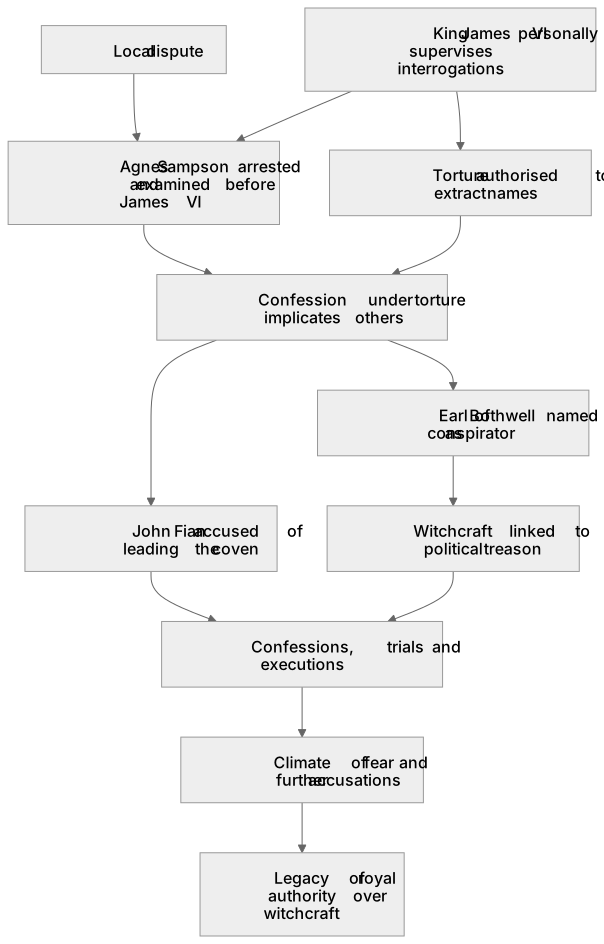
The North Berwick witch hunt widened from a local dispute into a royal conspiracy because interrogation implicated more people. Agnes Sampson, a respected healer, was arrested and examined before James VI; under torture she confessed to assembling with the Devil and to plotting the king's death by storm at sea. John Fian, a schoolmaster, was accused of leading the coven and was tortured and executed. James personally supervised interrogations, and torture was authorised to extract names, turning suspects into informants. The Earl of Bothwell was named as a conspirator, linking witchcraft to political treason. Confessions, trials and executions spread fear, encouraged further accusations and left a legacy of royal authority over witchcraft.
What earns the marks
- Explains how Agnes Sampson's case widened the net: her status as a cunning woman and her confession under torture implicated others, including John Fian and the Earl of Bothwell.
- Analyses the role of King James VI: his personal involvement in interrogation, his belief in the threat, and his use of torture to obtain confessions and names.
- Assesses the involvement of the Earl of Bothwell: accusations against him turned the witch hunt into a political faction struggle, linking sorcery to treason against the crown.
- Evaluates the impact of confessions, trials and executions: they created a climate of fear, legitimised further accusations, and established a model for later Scottish witch hunts to 1597.
- Uses specific evidence, such as the storm at sea, the assembly at North Berwick kirk, and the fate of John Fian, to support arguments about the widening net.
Common mistakes and how to put them right
Treating the North Berwick hunt as only a local event.
Put it right: It became a royal and political conspiracy because the king and the Earl of Bothwell were drawn in.
Assuming torture was routine and unregulated.
Put it right: In Scotland torture required authorisation, and James's personal involvement made it central to this case.
Confusing Agnes Sampson and John Fian.
Put it right: Sampson was a healer whose confession implicated others; Fian was a schoolmaster accused of leading the coven and was executed.
Ignoring the political dimension.
Put it right: The naming of Bothwell shows how witchcraft accusations could be used to attack political enemies.
Exam tips
- Plan your answer around the four clauses: Sampson and Fian, the king and torture, Bothwell, and the impact of confessions, trials and executions.
- Use precise dates and names, such as 1590–91, Agnes Sampson, John Fian and the Earl of Bothwell, to show secure knowledge.
- When discussing impact, distinguish between immediate effects (arrests and executions) and longer-term effects (fear and further hunts to 1597).
- Link each point back to the idea of a 'widening net' to keep your argument focused.
Try the lesson
The start of the Paper 3, Option 33: The witch craze in Britain, Europe and North America, c1580–c1750 - 1 The North Berwick witches in Scotland, 1590–91 and the aftermath to 1597: The widening net: the case of Agnes Sampson and John Fian; the role of the king and torture; the involvement of the Earl of Bothwell; impact of the confessions, trials and executions. lesson, made from checked teaching notes for this specification point.
Have a go first
Which accused figure in the North Berwick proceedings was a schoolmaster in East Lothian?
Listen
The North Berwick witch hunt widened from a local dispute into a royal conspiracy because interrogation implicated more people. Agnes Sampson, a respected healer, was arrested and examined before James VI; under torture she confessed to assembling with the Devil and to plotting the king's death by storm at sea. John Fian, a schoolmaster, was accused of leading the coven and was tortured and executed. James personally supervised interrogations, and torture was authorised to extract names, turning suspects into informants. The Earl of Bothwell was named as a conspirator, linking witchcraft to political treason. Confessions, trials and executions spread fear, encouraged further accusations and left a legacy of royal authority over witchcraft. A strong answer earns marks for these points. Explains how Agnes Sampson's case widened the net: her status as a cunning woman and her confession under torture implicated others, including John Fian and the Earl of Bothwell. Analyses the role of King James VI: his personal involvement in interrogation, his belief in the threat, and his use of torture to obtain confessions and names. Assesses the involvement of the Earl of Bothwell: accusations against him turned the witch hunt into a political faction struggle, linking sorcery to treason against the crown. Evaluates the impact of confessions, trials and executions: they created a climate of fear, legitimised further accusations, and established a model for later Scottish witch hunts to 1597. A common slip: Treating the North Berwick hunt as only a local event. Instead, it became a royal and political conspiracy because the king and the Earl of Bothwell were drawn in. Exam tip: Plan your answer around the four clauses: Sampson and Fian, the king and torture, Bothwell, and the impact of confessions, trials and executions.
See it
Key words
Say what each word means before you turn the card.
Torture
Try answering aloud or in your head before turning the card.
Earl of Bothwell
Try answering aloud or in your head before turning the card.
Agnes Sampson
Try answering aloud or in your head before turning the card.
John Fian
Try answering aloud or in your head before turning the card.
See every definition
- Torture
- Authorised to extract names, it turned suspects into informants, and James personally supervised interrogations.
- Earl of Bothwell
- Named as a conspirator, linking witchcraft to political treason and turning the hunt into a political faction struggle.
- Agnes Sampson
- A respected healer arrested and examined before James VI, who under torture confessed to assembling with the Devil and plotting the king's death by storm at sea.
- John Fian
- A schoolmaster accused of leading the coven, who was tortured and executed.
Label the diagram
Some boxes have lost their names. Pick the right name for each number.
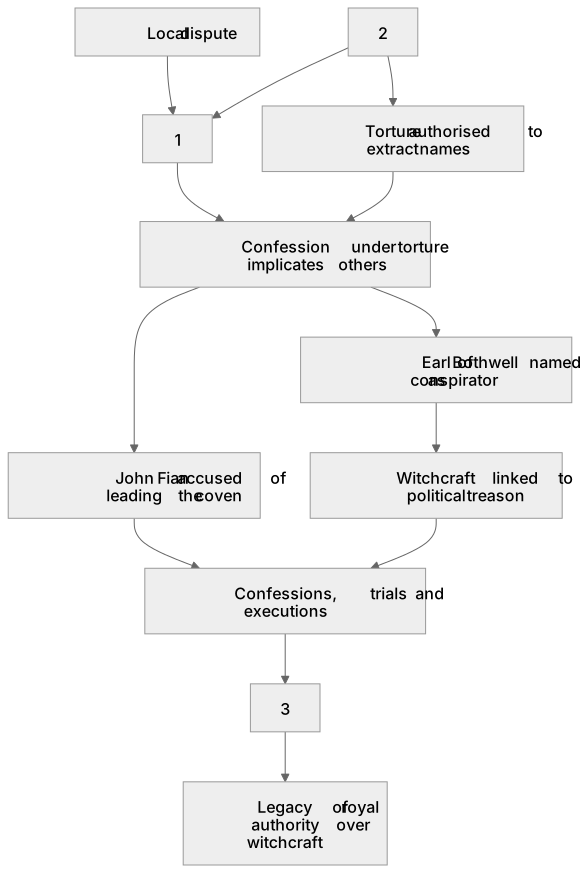
1Box 1
2Box 2
3Box 3
There is more to this lesson
The full lesson goes on to check your understanding and help you earn the marks. Create a free account to carry on, with your progress saved.
A week of Premium from your first lesson · Then the free plan continues · No card, no charge
Test your understanding of Paper 3, Option 33: The witch craze in Britain, Europe and North America, c1580–c1750 - 1 The North Berwick witches in Scotland, 1590–91 and the aftermath to 1597: The widening net: the case of Agnes Sampson and John Fian; the role of the king and torture; the involvement of the Earl of Bothwell; impact of the confessions, trials and executions.
Active recall beats re-reading. Take an instant quiz now to test what you’ve learned and lock it into long-term memory.
A week of Premium from your first lesson · Then the free plan continues · No card, no charge