Pearson Edexcel · A-Level · History
Course version: 9HI0 · Version from Sept 2015
The witch craze in Britain, Europe and North America, c1580–c1750 - 1 The…
Full specification wording
Paper 3, Option 33: The witch craze in Britain, Europe and North America, c1580–c1750 - 1 The North Berwick witches in Scotland, 1590–91 and the aftermath to 1597: The origins of the persecution: Gilly Duncan's confession; the impact of James VI’s voyage from Denmark; the extent to which Danish witch hunting influenced events in Scotland.
The North Berwick witch hunt originated from a convergence of local suspicions and international influences.
Checked against the Pearson Edexcel 9HI0 specification (opens in a new tab) on .
- Point 1 of 3
Study notes
From the checked teaching notes for this specification point.
The idea
The North Berwick witch hunt originated from a convergence of local suspicions and international influences. The persecution began when Gilly Duncan, a maid with sudden healing abilities, was tortured by her employer David Seaton. Her subsequent confession implicated others, sparking a wider hunt. Crucially, this escalated due to James VI’s voyage from Denmark in 1589 to collect his bride, Anne. During the journey, severe storms were blamed on witchcraft. In Denmark, James encountered established witch-hunting traditions and theologians who emphasised the demonic pact. The extent to which this Danish influence shaped Scottish events is significant; it transformed local folk magic suspicions into a state-led hunt for a treasonous, demonic conspiracy aimed directly at the King.
What earns the marks
- Detail the circumstances of Gilly Duncan's confession, including her torture by David Seaton and the naming of accomplices.
- Explain the significance of the severe storms encountered during James VI's voyage from Denmark and their attribution to witchcraft.
- Evaluate the transmission of continental ideas about the demonic pact from Danish theologians to James VI.
- Assess the extent to which Danish influence escalated the Scottish trials from local disputes to a national crisis involving treason.
Common mistakes and how to put them right
Stating that James VI initiated the witch hunt before his voyage to Denmark.
Put it right: Clarify that the initial suspicions began locally with Gilly Duncan, and James became heavily involved only after his Danish voyage.
Assuming Danish witch trials were identical to the subsequent Scottish trials.
Put it right: Note that while Denmark influenced James regarding demonic pacts, Scottish trials became notably more severe and widespread than contemporary Danish ones.
Ignoring the role of David Seaton in the origins of the persecution.
Put it right: Include Seaton's role in torturing Gilly Duncan as the catalyst for the initial confessions.
Exam tips
- When discussing the origins, balance the local trigger (Duncan's confession) with the top-down escalation (James VI's Danish experience).
- Use the concept of 'treason by magic' to explain why James VI took such a personal and intense interest in the North Berwick witches.
- Evaluate the 'extent' of Danish influence by contrasting pre-1590 Scottish witchcraft beliefs with the continental demonic ideas introduced after the voyage.
Try the lesson
The start of the Paper 3, Option 33: The witch craze in Britain, Europe and North America, c1580–c1750 - 1 The North Berwick witches in Scotland, 1590–91 and the aftermath to 1597: The origins of the persecution: Gilly Duncan's confession; the impact of James VI’s voyage from Denmark; the extent to which Danish witch hunting influenced events in Scotland. lesson, made from checked teaching notes for this specification point.
Have a go first
How did James VI's voyage from Denmark in 1589–90 contribute to the origins of the North Berwick witch hunt?
Listen
The North Berwick witch hunt originated from a convergence of local suspicions and international influences. The persecution began when Gilly Duncan, a maid with sudden healing abilities, was tortured by her employer David Seaton. Her subsequent confession implicated others, sparking a wider hunt. Crucially, this escalated due to James VI’s voyage from Denmark in 1589 to collect his bride, Anne. During the journey, severe storms were blamed on witchcraft. In Denmark, James encountered established witch-hunting traditions and theologians who emphasised the demonic pact. The extent to which this Danish influence shaped Scottish events is significant; it transformed local folk magic suspicions into a state-led hunt for a treasonous, demonic conspiracy aimed directly at the King. A strong answer earns marks for these points. Detail the circumstances of Gilly Duncan's confession, including her torture by David Seaton and the naming of accomplices. Explain the significance of the severe storms encountered during James VI's voyage from Denmark and their attribution to witchcraft. Evaluate the transmission of continental ideas about the demonic pact from Danish theologians to James VI. Assess the extent to which Danish influence escalated the Scottish trials from local disputes to a national crisis involving treason. A common slip: Stating that James VI initiated the witch hunt before his voyage to Denmark. Instead, Clarify that the initial suspicions began locally with Gilly Duncan, and James became heavily involved only after his Danish voyage. Exam tip: When discussing the origins, balance the local trigger (Duncan's confession) with the top-down escalation (James VI's Danish experience).
See it
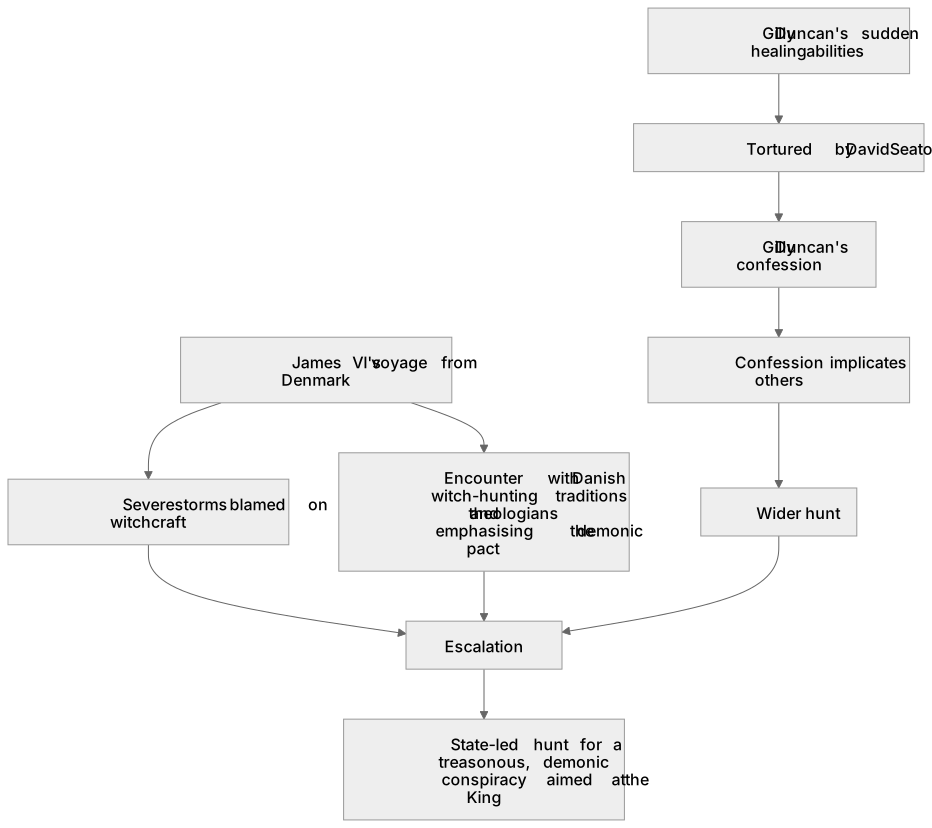
Label the diagram
Some boxes have lost their names. Pick the right name for each number.
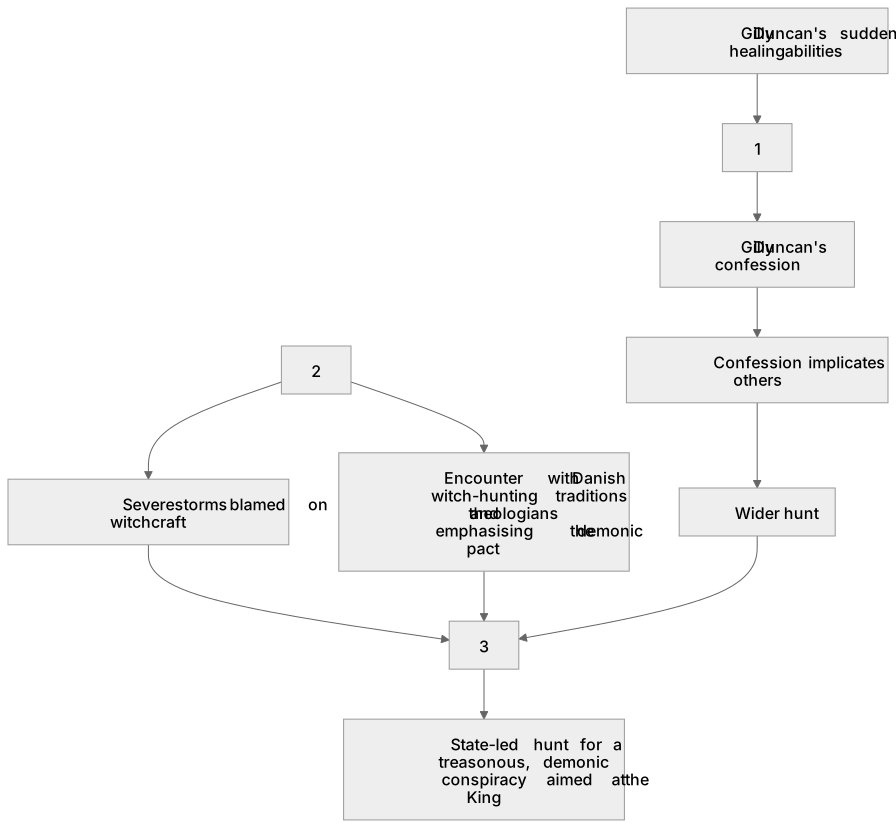
1Box 1
2Box 2
3Box 3
There is more to this lesson
The full lesson goes on to check your understanding and help you earn the marks. Create a free account to carry on, with your progress saved.
A week of Premium from your first lesson · Then the free plan continues · No card, no charge
Test your understanding of Paper 3, Option 33: The witch craze in Britain, Europe and North America, c1580–c1750 - 1 The North Berwick witches in Scotland, 1590–91 and the aftermath to 1597: The origins of the persecution: Gilly Duncan's confession; the impact of James VI’s voyage from Denmark; the extent to which Danish witch hunting influenced events in Scotland.
Active recall beats re-reading. Take an instant quiz now to test what you’ve learned and lock it into long-term memory.
A week of Premium from your first lesson · Then the free plan continues · No card, no charge