Pearson Edexcel · A-Level · History
Course version: 9HI0 · Version from Sept 2015
The witch craze in Britain, Europe and North America, c1580–c1750 - 2 The…
Full specification wording
Paper 3, Option 33: The witch craze in Britain, Europe and North America, c1580–c1750 - 2 The wider intellectual context: the coming of the age of science and reason: The changing approach to human understanding and knowledge, c1580–c1750 (key developments: Francis Bacon and the empirical scientific approach, the foundation of Gresham College 1597 and the Royal Society 1662, Thomas Hobbes’s deductive reasoning and materialism, John Locke and his Essay Concerning Human Understanding 1690).
Between 1580 and 1750, intellectual paradigms shifted from religious dogma to scientific reason.
Checked against the Pearson Edexcel 9HI0 specification (opens in a new tab) on .
- Point 2 of 2
- 3 key terms
Study notes
From the checked teaching notes for this specification point.
The idea
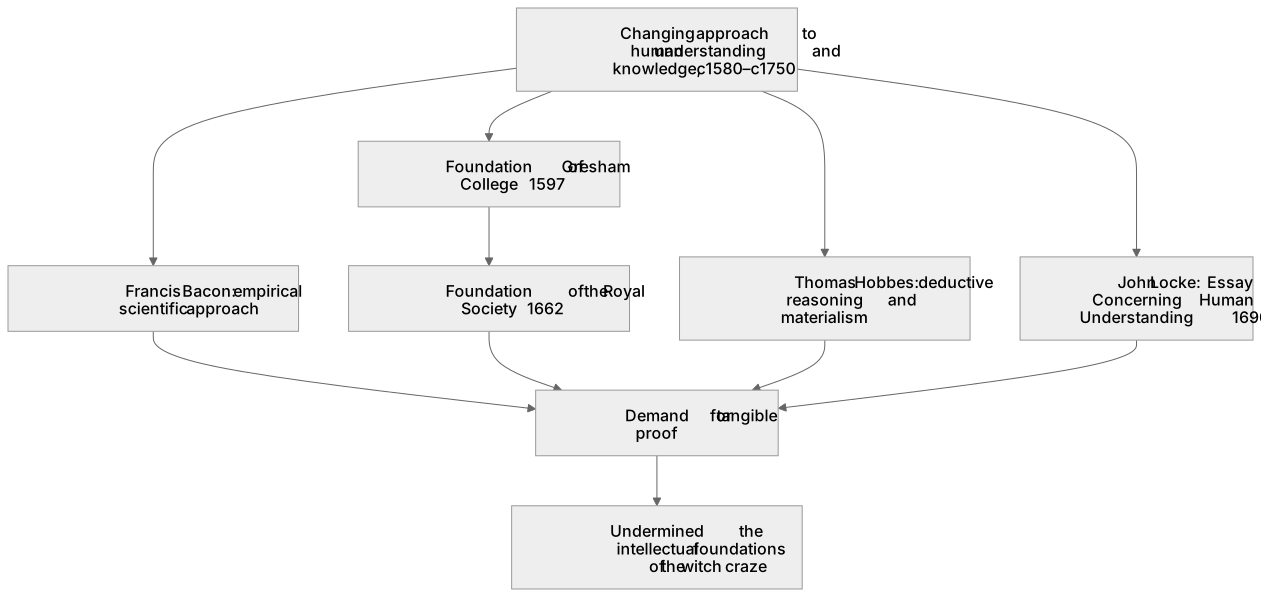
Between 1580 and 1750, intellectual paradigms shifted from religious dogma to scientific reason. Francis Bacon pioneered the empirical approach, arguing knowledge must come from observation and inductive reasoning. This practical science was institutionalised by the foundation of Gresham College in 1597, which funded public lectures, and later the Royal Society in 1662, which promoted experimental philosophy. Conversely, Thomas Hobbes championed deductive reasoning and materialism, arguing that everything consists of matter and rejecting supernatural explanations. Finally, John Locke’s 1690 Essay Concerning Human Understanding argued that the mind is a blank slate at birth, cementing empiricism. These developments collectively undermined the intellectual foundations of the witch craze by demanding tangible proof.
What earns the marks
- Explain Bacon's inductive method and how it shifted focus towards empirical evidence and observation.
- Assess the role of Gresham College (1597) and the Royal Society (1662) in formalising and sharing scientific knowledge.
- Analyse Hobbes's materialism and deductive reasoning, specifically how his rejection of incorporeal spirits challenged witchcraft beliefs.
- Evaluate Locke's Essay Concerning Human Understanding (1690) and its argument that knowledge derives solely from sensory experience.
Common mistakes and how to put them right
Confusing Bacon's inductive reasoning with Hobbes's deductive reasoning.
Put it right: Bacon built conclusions from specific observations (inductive), whereas Hobbes applied general rules to specific cases (deductive).
Claiming the Royal Society was founded before Gresham College.
Put it right: Gresham College was founded in 1597, providing the early foundation that eventually led to the Royal Society in 1662.
Stating that these thinkers explicitly campaigned against witch trials.
Put it right: Acknowledge that while their philosophical frameworks undermined witchcraft beliefs, they rarely focused directly on debunking witches.
Exam tips
- Link the philosophical shift towards materialism directly to the decline in belief in supernatural entities like witches.
- Use the Royal Society's motto 'Nullius in verba' (take nobody's word for it) to illustrate the new demand for empirical proof.
- Contrast Locke's empiricism with traditional reliance on religious texts to show the changing basis of human knowledge.
Try the lesson
The start of the Paper 3, Option 33: The witch craze in Britain, Europe and North America, c1580–c1750 - 2 The wider intellectual context: the coming of the age of science and reason: The changing approach to human understanding and knowledge, c1580–c1750 (key developments: Francis Bacon and the empirical scientific approach, the foundation of Gresham College 1597 and the Royal Society 1662, Thomas Hobbes’s deductive reasoning and materialism, John Locke and his Essay Concerning Human Understanding 1690). lesson, made from checked teaching notes for this specification point.
Have a go first
Which institution, founded in London in 1662, became the leading body for the empirical investigation of nature in later seventeenth-century England?
Listen
Between 1580 and 1750, intellectual paradigms shifted from religious dogma to scientific reason. Francis Bacon pioneered the empirical approach, arguing knowledge must come from observation and inductive reasoning. This practical science was institutionalised by the foundation of Gresham College in 1597, which funded public lectures, and later the Royal Society in 1662, which promoted experimental philosophy. Conversely, Thomas Hobbes championed deductive reasoning and materialism, arguing that everything consists of matter and rejecting supernatural explanations. Finally, John Locke’s 1690 Essay Concerning Human Understanding argued that the mind is a blank slate at birth, cementing empiricism. These developments collectively undermined the intellectual foundations of the witch craze by demanding tangible proof. A strong answer earns marks for these points. Explain Bacon's inductive method and how it shifted focus towards empirical evidence and observation. Assess the role of Gresham College (1597) and the Royal Society (1662) in formalising and sharing scientific knowledge. Analyse Hobbes's materialism and deductive reasoning, specifically how his rejection of incorporeal spirits challenged witchcraft beliefs. Evaluate Locke's Essay Concerning Human Understanding (1690) and its argument that knowledge derives solely from sensory experience. A common slip: Confusing Bacon's inductive reasoning with Hobbes's deductive reasoning. Instead, Bacon built conclusions from specific observations (inductive), whereas Hobbes applied general rules to specific cases (deductive). Exam tip: Link the philosophical shift towards materialism directly to the decline in belief in supernatural entities like witches.
See it
Put the events in order
Put these events in the order they happened, earliest first.
- 1. Foundation of Gresham College
- 2. Locke's Essay Concerning Human Understanding
- 3. Foundation of the Royal Society
Key words
Say what each word means before you turn the card.
Empiricism and Rationalism
Try answering aloud or in your head before turning the card.
Institutionalisation of Science
Try answering aloud or in your head before turning the card.
Materialism vs Supernaturalism
Try answering aloud or in your head before turning the card.
See every definition
- Empiricism and Rationalism
- The changing approach to human understanding and knowledge, in which Bacon pioneered the empirical approach and Hobbes championed deductive reasoning.
- Institutionalisation of Science
- Practical science was formalised by the foundation of Gresham College in 1597, which funded public lectures, and later the Royal Society in 1662, which promoted experimental philosophy.
- Materialism vs Supernaturalism
- Hobbes argued that everything consists of matter and rejected supernatural explanations, which undermined the intellectual foundations of the witch craze by demanding tangible proof.
Label the diagram
Some boxes have lost their names. Pick the right name for each number.
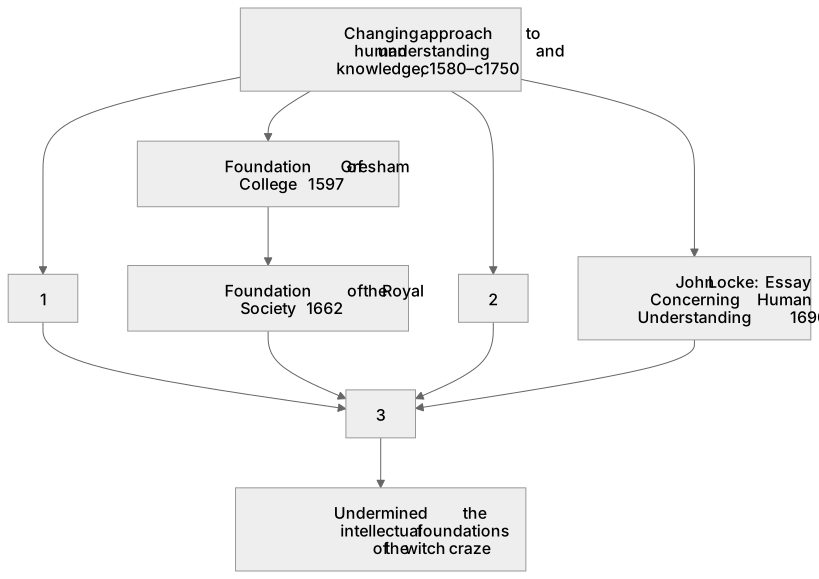
1Box 1
2Box 2
3Box 3
There is more to this lesson
The full lesson goes on to check your understanding and help you earn the marks. Create a free account to carry on, with your progress saved.
A week of Premium from your first lesson · Then the free plan continues · No card, no charge
Test your understanding of Paper 3, Option 33: The witch craze in Britain, Europe and North America, c1580–c1750 - 2 The wider intellectual context: the coming of the age of science and reason: The changing approach to human understanding and knowledge, c1580–c1750 (key developments: Francis Bacon and the empirical scientific approach, the foundation of Gresham College 1597 and the Royal Society 1662, Thomas Hobbes’s deductive reasoning and materialism, John Locke and his Essay Concerning Human Understanding 1690).
Active recall beats re-reading. Take an instant quiz now to test what you’ve learned and lock it into long-term memory.
A week of Premium from your first lesson · Then the free plan continues · No card, no charge