Pearson Edexcel · A-Level · History
Course version: 9HI0 · Version from Sept 2015
The witch craze in Britain, Europe and North America, c1580–c1750 - 3 The…
Full specification wording
Paper 3, Option 33: The witch craze in Britain, Europe and North America, c1580–c1750 - 3 The Great Witch Hunt, in Bamberg, Germany, 1623–32: Numbers and social groups affected by the witch hunts; the use of torture and property confiscations; the roles of the Prince-Bishop von Dornheim and Frederick Forner.
Bamberg's witch hunts peaked under Prince-Bishop Johann Georg II Fuchs von Dornheim.
Checked against the Pearson Edexcel 9HI0 specification (opens in a new tab) on .
- Point 2 of 3
- 4 key terms
Study notes
From the checked teaching notes for this specification point.
The idea
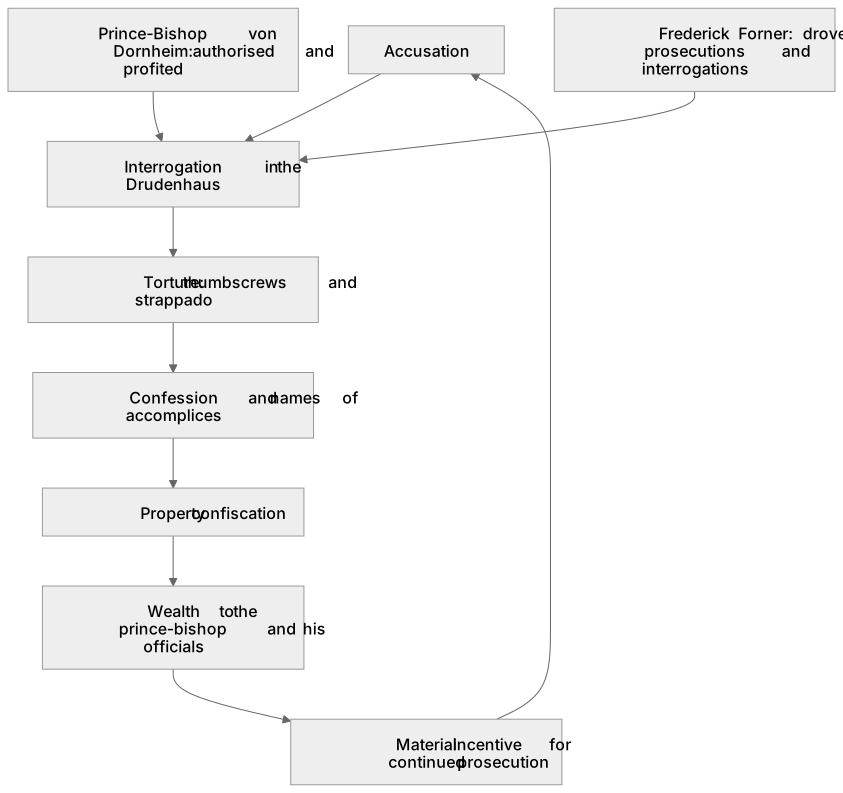
Bamberg's witch hunts peaked under Prince-Bishop Johann Georg II Fuchs von Dornheim. Estimates suggest around 600 executions in the prince-bishopric during the 1620s, though exact totals are debated. Victims came disproportionately from elite and propertied groups: councillors, burgomasters, merchants, clergy and their families, not only the poor. Torture was central: suspects were interrogated in the Drudenhaus, a purpose-built witch prison, using instruments such as thumbscrews and the strappado. Confessions extracted under torture allowed property confiscation, enriching the prince-bishop and his officials. Von Dornheim authorised and profited from the trials; Frederick Forner, his suffragan bishop and chief commissioner, drove prosecutions and interrogations. Assessed through source analysis and essay explanation of causation, scale and responsibility.
What earns the marks
- Quantify the scale of the Bamberg hunts with cautious estimates, for example around 600 executions in the prince-bishopric during the 1620s, while noting that surviving records are incomplete and totals are debated.
- Identify the social groups affected: councillors, burgomasters, merchants, clergy, artisans and their families, showing that hunts reached elite and propertied circles rather than only marginalised people.
- Explain how torture was used systematically in the Drudenhaus, with instruments such as thumbscrews and the strappado, to extract confessions and names of accomplices.
- Explain how property confiscation followed confession, transferring wealth from accused families to the prince-bishop and his officials, and thus creating material incentives for continued prosecution.
- Analyse the role of Prince-Bishop von Dornheim as the political and legal authority who authorised, funded and benefited from the trials.
- Analyse the role of Frederick Forner as suffragan bishop and chief commissioner who directed interrogations and expanded the prosecutions.
- Use contemporary evidence, such as the Drudenhaus, trial records or the Bamberg witch trials' chronology, to support claims about numbers, groups, torture, confiscation and individual responsibility.
Common mistakes and how to put them right
Treating the accused as uniformly poor and marginalised.
Put it right: Bamberg evidence shows many victims were prosperous, educated or connected to the administration.
Assuming torture was occasional or unofficial.
Put it right: In Bamberg it was a systematic, legally sanctioned procedure central to securing confessions.
Confusing Frederick Forner with the prince-bishop or treating him as a minor figure.
Put it right: Forner was suffragan bishop and chief commissioner, a leading driver of the trials.
Presenting confiscation as a minor side-effect.
Put it right: It was a major material motive and consequence, enriching the prince-bishop and officials.
Exam tips
- Anchor answers in specific Bamberg evidence, such as the Drudenhaus, named officials and approximate execution figures, rather than general witch-craze assertions.
- When discussing numbers, use cautious language such as 'estimates suggest' and acknowledge gaps in the surviving records.
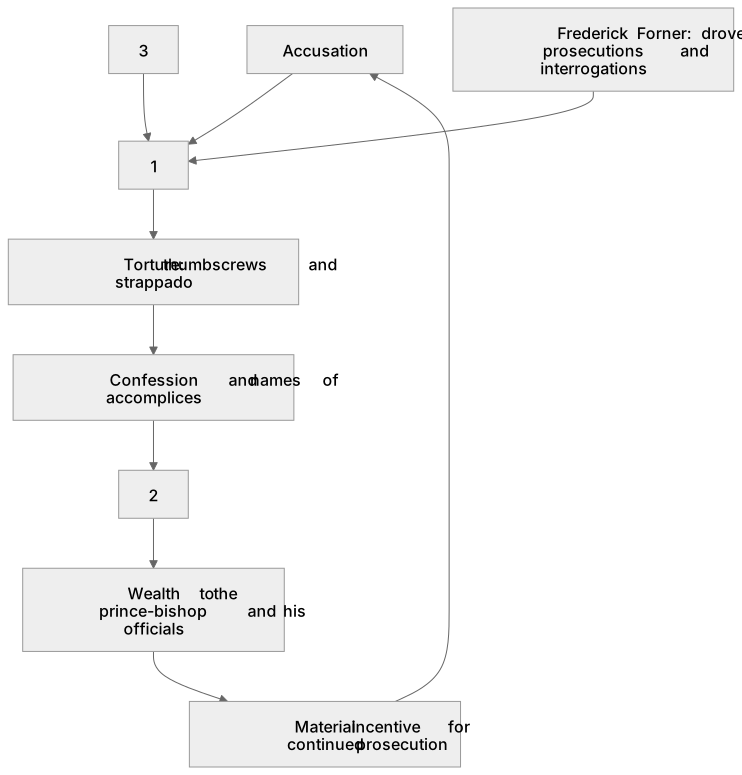
- Link social groups, torture and confiscation into a causal chain: accusation, interrogation, confession, confiscation, further accusation.
- Distinguish clearly between von Dornheim's authorising and profiting role and Forner's operational and interrogatory role.
Try the lesson
The start of the Paper 3, Option 33: The witch craze in Britain, Europe and North America, c1580–c1750 - 3 The Great Witch Hunt, in Bamberg, Germany, 1623–32: Numbers and social groups affected by the witch hunts; the use of torture and property confiscations; the roles of the Prince-Bishop von Dornheim and Frederick Forner. lesson, made from checked teaching notes for this specification point.
Have a go first
Which official held the position of Prince-Bishop of Bamberg during the mass witch trials of 1623–32?
Listen
Bamberg's witch hunts peaked under Prince-Bishop Johann Georg II Fuchs von Dornheim. Estimates suggest around 600 executions in the prince-bishopric during the 1620s, though exact totals are debated. Victims came disproportionately from elite and propertied groups: councillors, burgomasters, merchants, clergy and their families, not only the poor. Torture was central: suspects were interrogated in the Drudenhaus, a purpose-built witch prison, using instruments such as thumbscrews and the strappado. Confessions extracted under torture allowed property confiscation, enriching the prince-bishop and his officials. Von Dornheim authorised and profited from the trials; Frederick Forner, his suffragan bishop and chief commissioner, drove prosecutions and interrogations. Assessed through source analysis and essay explanation of causation, scale and responsibility. A strong answer earns marks for these points. Quantify the scale of the Bamberg hunts with cautious estimates, for example around 600 executions in the prince-bishopric during the 1620s, while noting that surviving records are incomplete and totals are debated. Identify the social groups affected: councillors, burgomasters, merchants, clergy, artisans and their families, showing that hunts reached elite and propertied circles rather than only marginalised people. Explain how torture was used systematically in the Drudenhaus, with instruments such as thumbscrews and the strappado, to extract confessions and names of accomplices. Explain how property confiscation followed confession, transferring wealth from accused families to the prince-bishop and his officials, and thus creating material incentives for continued prosecution. A common slip: Treating the accused as uniformly poor and marginalised. Instead, Bamberg evidence shows many victims were prosperous, educated or connected to the administration. Exam tip: Anchor answers in specific Bamberg evidence, such as the Drudenhaus, named officials and approximate execution figures, rather than general witch-craze assertions.
See it
Key words
Say what each word means before you turn the card.
Scale and social reach of witch persecution
Try answering aloud or in your head before turning the card.
Torture as a legal and investigative instrument
Try answering aloud or in your head before turning the card.
Economic motives and property confiscation
Try answering aloud or in your head before turning the card.
Authority and responsibility of individual officials
Try answering aloud or in your head before turning the card.
See every definition
- Scale and social reach of witch persecution
- Around 600 executions in the prince-bishopric during the 1620s, with victims drawn from elite and propertied groups such as councillors, burgomasters, merchants and clergy.
- Torture as a legal and investigative instrument
- Systematic interrogation in the Drudenhaus using instruments such as thumbscrews and the strappado to extract confessions and names of accomplices.
- Economic motives and property confiscation
- Confessions extracted under torture allowed property confiscation, enriching the prince-bishop and his officials and creating material incentives for continued prosecution.
- Authority and responsibility of individual officials
- Von Dornheim authorised and profited from the trials, while Frederick Forner, suffragan bishop and chief commissioner, drove prosecutions and interrogations.
Label the diagram
Some boxes have lost their names. Pick the right name for each number.
1Box 1
2Box 2
3Box 3
There is more to this lesson
The full lesson goes on to check your understanding and help you earn the marks. Create a free account to carry on, with your progress saved.
A week of Premium from your first lesson · Then the free plan continues · No card, no charge
Test your understanding of Paper 3, Option 33: The witch craze in Britain, Europe and North America, c1580–c1750 - 3 The Great Witch Hunt, in Bamberg, Germany, 1623–32: Numbers and social groups affected by the witch hunts; the use of torture and property confiscations; the roles of the Prince-Bishop von Dornheim and Frederick Forner.
Active recall beats re-reading. Take an instant quiz now to test what you’ve learned and lock it into long-term memory.
A week of Premium from your first lesson · Then the free plan continues · No card, no charge