Pearson Edexcel · A-Level · History
Course version: 9HI0 · Version from Sept 2015
The witch craze in Britain, Europe and North America, c1580–c1750 - 3 The…
Full specification wording
Paper 3, Option 33: The witch craze in Britain, Europe and North America, c1580–c1750 - 3 The Great Witch Hunt, in Bamberg, Germany, 1623–32: The economic, political and religious context: reclaiming territory for the Catholic Church; the impact of the Thirty Years War on Bamberg in these years; economic crises.
The Bamberg witch hunt of 1623–32 occurred within a context of Catholic Reformation and the Thirty Years War.
Checked against the Pearson Edexcel 9HI0 specification (opens in a new tab) on .
- Point 1 of 3
- 4 key terms
Study notes
From the checked teaching notes for this specification point.
The idea
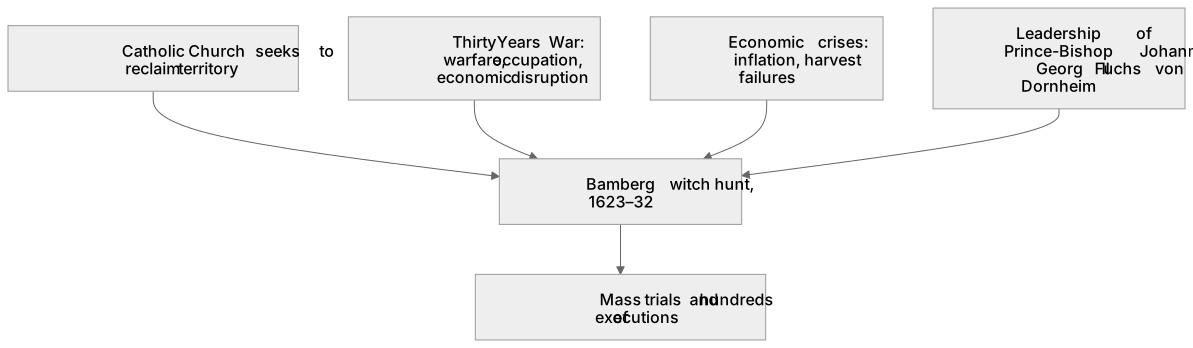
The Bamberg witch hunt of 1623–32 occurred within a context of Catholic Reformation and the Thirty Years War. The Catholic Church sought to reclaim territory lost to Protestantism, using witch trials to enforce religious conformity. The Thirty Years War brought warfare, occupation, and economic disruption to Bamberg, exacerbating social tensions. Economic crises, including inflation and harvest failures, created scapegoats. These factors combined to fuel the mass trials, led by Prince-Bishop Johann Georg II Fuchs von Dornheim, resulting in hundreds of executions. Understanding this context explains why Bamberg became a centre of persecution.
What earns the marks
- Explain how the Catholic Church's efforts to reclaim territory influenced the witch hunts in Bamberg.
- Describe the impact of the Thirty Years War on Bamberg, including military events, occupation, and economic strain.
- Analyse the role of economic crises (e.g., inflation, crop failures) in intensifying witch accusations.
- Link these contextual factors to the scale and intensity of the Bamberg witch hunt under Prince-Bishop Fuchs von Dornheim.
Common mistakes and how to put them right
Treating the witch hunt as solely driven by religious factors.
Put it right: Economic and political factors were equally important.
Assuming the Thirty Years War had a uniform impact across Germany.
Put it right: Local experiences varied; Bamberg's specific situation must be examined.
Overlooking the role of Prince-Bishop Fuchs von Dornheim.
Put it right: His leadership was central to the persecution.
Exam tips
- Use specific examples of economic crises, such as the Kipper und Wipper inflation, to support analysis.
- Connect the Catholic Reformation to the witch hunts by explaining how reclaiming territory involved eliminating heresy and witchcraft.
- Discuss the Thirty Years War's impact on Bamberg with reference to dates and events to show precise knowledge.
Try the lesson
The start of the Paper 3, Option 33: The witch craze in Britain, Europe and North America, c1580–c1750 - 3 The Great Witch Hunt, in Bamberg, Germany, 1623–32: The economic, political and religious context: reclaiming territory for the Catholic Church; the impact of the Thirty Years War on Bamberg in these years; economic crises. lesson, made from checked teaching notes for this specification point.
Have a go first
Which religious aim shaped the witch hunt in Bamberg during the 1620s?
Listen
The Bamberg witch hunt of 1623–32 occurred within a context of Catholic Reformation and the Thirty Years War. The Catholic Church sought to reclaim territory lost to Protestantism, using witch trials to enforce religious conformity. The Thirty Years War brought warfare, occupation, and economic disruption to Bamberg, exacerbating social tensions. Economic crises, including inflation and harvest failures, created scapegoats. These factors combined to fuel the mass trials, led by Prince-Bishop Johann Georg II Fuchs von Dornheim, resulting in hundreds of executions. Understanding this context explains why Bamberg became a centre of persecution. A strong answer earns marks for these points. Explain how the Catholic Church's efforts to reclaim territory influenced the witch hunts in Bamberg. Describe the impact of the Thirty Years War on Bamberg, including military events, occupation, and economic strain. Analyse the role of economic crises (e.g., inflation, crop failures) in intensifying witch accusations. Link these contextual factors to the scale and intensity of the Bamberg witch hunt under Prince-Bishop Fuchs von Dornheim. A common slip: Treating the witch hunt as solely driven by religious factors. Instead, Economic and political factors were equally important. Exam tip: Use specific examples of economic crises, such as the Kipper und Wipper inflation, to support analysis.
See it
Key words
Say what each word means before you turn the card.
Religious conflict and the Counter-Reformation
Try answering aloud or in your head before turning the card.
The impact of war on civilian populations
Try answering aloud or in your head before turning the card.
Economic instability and scapegoating
Try answering aloud or in your head before turning the card.
The role of local authorities in mass persecution
Try answering aloud or in your head before turning the card.
See every definition
- Religious conflict and the Counter-Reformation
- The Catholic Church sought to reclaim territory lost to Protestantism, using witch trials to enforce religious conformity.
- The impact of war on civilian populations
- The Thirty Years War brought warfare, occupation and economic disruption to Bamberg, exacerbating social tensions.
- Economic instability and scapegoating
- Economic crises, including inflation and harvest failures, created scapegoats.
- The role of local authorities in mass persecution
- The mass trials were led by Prince-Bishop Johann Georg II Fuchs von Dornheim, resulting in hundreds of executions.
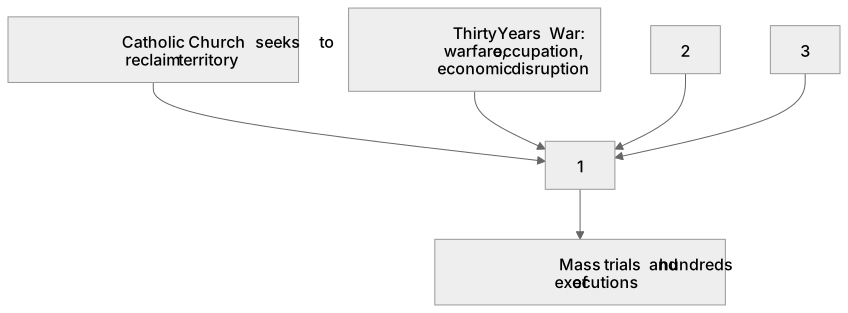
Label the diagram
Some boxes have lost their names. Pick the right name for each number.
1Box 1
2Box 2
3Box 3
There is more to this lesson
The full lesson goes on to check your understanding and help you earn the marks. Create a free account to carry on, with your progress saved.
A week of Premium from your first lesson · Then the free plan continues · No card, no charge
Test your understanding of Paper 3, Option 33: The witch craze in Britain, Europe and North America, c1580–c1750 - 3 The Great Witch Hunt, in Bamberg, Germany, 1623–32: The economic, political and religious context: reclaiming territory for the Catholic Church; the impact of the Thirty Years War on Bamberg in these years; economic crises.
Active recall beats re-reading. Take an instant quiz now to test what you’ve learned and lock it into long-term memory.
A week of Premium from your first lesson · Then the free plan continues · No card, no charge