Pearson Edexcel · A-Level · History
Course version: 9HI0 · Version from Sept 2015
The witch craze in Britain, Europe and North America, c1580–c1750 - 4…
Full specification wording
Paper 3, Option 33: The witch craze in Britain, Europe and North America, c1580–c1750 - 4 Matthew Hopkins and the East Anglian witch craze, 1645–47: Economic and political context: the impact of the breakdown of traditional authority and legal structures; economic crises.
The English Civil War shattered the normal machinery of government in East Anglia.
Checked against the Pearson Edexcel 9HI0 specification (opens in a new tab) on .
- Point 1 of 3
- 4 key terms
Study notes
From the checked teaching notes for this specification point.
The idea
The English Civil War shattered the normal machinery of government in East Anglia. Royal authority collapsed, episcopal church courts ceased to function, and county magistrates were divided by allegiance, so the customary checks on accusation and prosecution weakened. Into this vacuum stepped local committees and Parliament's assize judges, who were willing to hear witchcraft cases. At the same time the war brought severe economic crises: heavy taxation, requisitioning, failed harvests and disrupted trade produced hunger, unemployment and vagrancy. These pressures made communities anxious and suspicious, and they made poor, dependent neighbours easier to scapegoat. The breakdown of authority and economic distress together created the conditions in which Hopkins and Stearne could operate with unusual freedom.
What earns the marks
- Explains how the collapse of royal and episcopal authority removed the church courts and traditional checks on witchcraft prosecution.
- Links the division of county magistrates and local committees to inconsistent or weakened local justice.
- Shows that Parliament's assize judges and local committees were willing to hear witchcraft accusations during the 1640s.
- Connects wartime taxation, requisitioning, failed harvests and disrupted trade to hunger, unemployment and vagrancy.
- Explains how economic distress made poor and dependent neighbours more vulnerable to scapegoating.
- Argues that the breakdown of authority and economic crisis together created the conditions for the East Anglian witch craze.
Common mistakes and how to put them right
Treating the Civil War as only a political event and ignoring its legal and economic consequences.
Put it right by linking political breakdown to the collapse of church courts and to wartime economic hardship.
Assuming that all traditional authority vanished everywhere.
Put it right by explaining that authority fragmented unevenly, with some local officials continuing while others lost power.
Presenting economic crisis as a direct cause of every accusation.
Put it right by treating it as a background pressure that made communities more anxious and more willing to scapegoat the poor.
Exam tips
- Anchor answers in the specific period 1645–47 and the East Anglian context rather than generalising about all of Europe.
- Use precise causal language such as 'weakened', 'removed' and 'intensified' to show how each factor operated.
- Integrate political and economic factors in one argument instead of listing them separately.
Try the lesson
The start of the Paper 3, Option 33: The witch craze in Britain, Europe and North America, c1580–c1750 - 4 Matthew Hopkins and the East Anglian witch craze, 1645–47: Economic and political context: the impact of the breakdown of traditional authority and legal structures; economic crises. lesson, made from checked teaching notes for this specification point.
Have a go first
How did the English Civil War contribute to the breakdown of legal structures in East Anglia during the 1645–47 witch craze?
Listen
The English Civil War shattered the normal machinery of government in East Anglia. Royal authority collapsed, episcopal church courts ceased to function, and county magistrates were divided by allegiance, so the customary checks on accusation and prosecution weakened. Into this vacuum stepped local committees and Parliament's assize judges, who were willing to hear witchcraft cases. At the same time the war brought severe economic crises: heavy taxation, requisitioning, failed harvests and disrupted trade produced hunger, unemployment and vagrancy. These pressures made communities anxious and suspicious, and they made poor, dependent neighbours easier to scapegoat. The breakdown of authority and economic distress together created the conditions in which Hopkins and Stearne could operate with unusual freedom. A strong answer earns marks for these points. Explains how the collapse of royal and episcopal authority removed the church courts and traditional checks on witchcraft prosecution. Links the division of county magistrates and local committees to inconsistent or weakened local justice. Shows that Parliament's assize judges and local committees were willing to hear witchcraft accusations during the 1640s. Connects wartime taxation, requisitioning, failed harvests and disrupted trade to hunger, unemployment and vagrancy. A common slip: Treating the Civil War as only a political event and ignoring its legal and economic consequences. Instead, linking political breakdown to the collapse of church courts and to wartime economic hardship. Exam tip: Anchor answers in the specific period 1645–47 and the East Anglian context rather than generalising about all of Europe.
See it

Key words
Say what each word means before you turn the card.
Breakdown of traditional authority
Try answering aloud or in your head before turning the card.
Collapse of legal and church structures
Try answering aloud or in your head before turning the card.
Economic crisis and wartime hardship
Try answering aloud or in your head before turning the card.
Scapegoating of the poor
Try answering aloud or in your head before turning the card.
See every definition
- Breakdown of traditional authority
- Royal authority collapsed and episcopal church courts ceased to function, so the customary checks on accusation and prosecution weakened.
- Collapse of legal and church structures
- County magistrates were divided by allegiance and the church courts ceased to function, weakening the customary checks on prosecution.
- Economic crisis and wartime hardship
- Heavy taxation, requisitioning, failed harvests and disrupted trade produced hunger, unemployment and vagrancy, making communities anxious and suspicious.
- Scapegoating of the poor
- Economic distress made poor, dependent neighbours easier to scapegoat, as communities grew anxious and suspicious.
Label the diagram
Some boxes have lost their names. Pick the right name for each number.
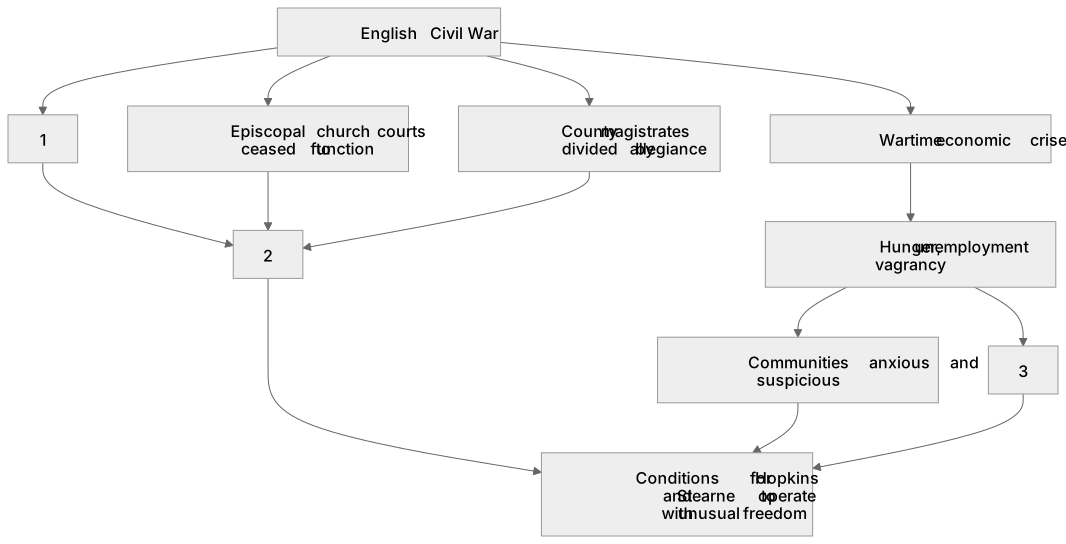
1Box 1
2Box 2
3Box 3
There is more to this lesson
The full lesson goes on to check your understanding and help you earn the marks. Create a free account to carry on, with your progress saved.
A week of Premium from your first lesson · Then the free plan continues · No card, no charge
Test your understanding of Paper 3, Option 33: The witch craze in Britain, Europe and North America, c1580–c1750 - 4 Matthew Hopkins and the East Anglian witch craze, 1645–47: Economic and political context: the impact of the breakdown of traditional authority and legal structures; economic crises.
Active recall beats re-reading. Take an instant quiz now to test what you’ve learned and lock it into long-term memory.
A week of Premium from your first lesson · Then the free plan continues · No card, no charge