Pearson Edexcel · A-Level · History
Course version: 9HI0 · Version from Sept 2015
The witch craze in Britain, Europe and North America, c1580–c1750 - 4…
Full specification wording
Paper 3, Option 33: The witch craze in Britain, Europe and North America, c1580–c1750 - 4 Matthew Hopkins and the East Anglian witch craze, 1645–47: Geography, numbers, class and gender of victims; the roles and methods of Matthew Hopkins and John Stearne and reasons for their influence and power.
The East Anglian witch craze was concentrated in Essex, Suffolk, Norfolk and the associated counties, with the largest clusters in towns such as Manningtree, Chelmsford and Bury St Edmunds.
Checked against the Pearson Edexcel 9HI0 specification (opens in a new tab) on .
- Point 2 of 3
- 4 key terms
Study notes
From the checked teaching notes for this specification point.
The idea
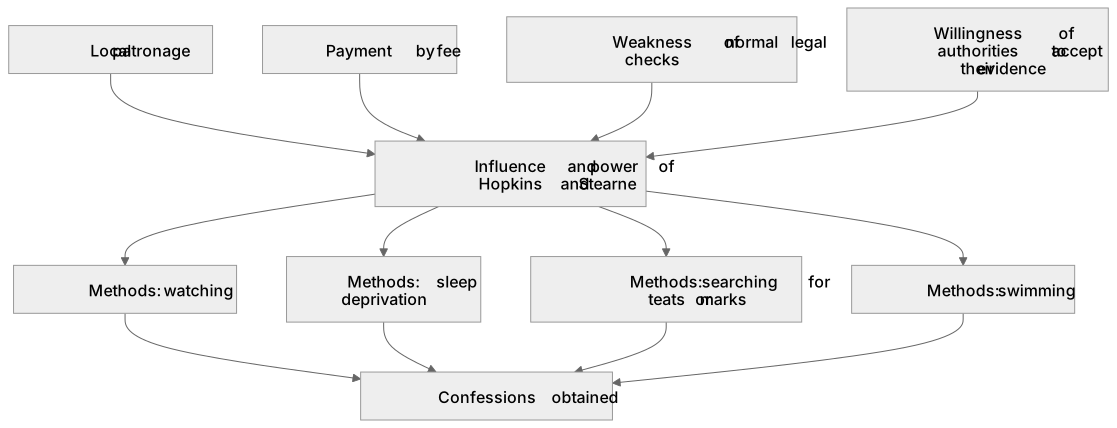
The East Anglian witch craze was concentrated in Essex, Suffolk, Norfolk and the associated counties, with the largest clusters in towns such as Manningtree, Chelmsford and Bury St Edmunds. Estimates of those accused run into the hundreds, with a high proportion executed. Victims were disproportionately poor, often older women, though men and people of higher status were also accused. Matthew Hopkins, calling himself Witchfinder General, and his associate John Stearne used watching, sleep deprivation, searching for teats or marks, and swimming to obtain confessions. Their influence rested on local patronage, payment by fee, the weakness of normal legal checks and the willingness of authorities to accept their evidence.
What earns the marks
- Identifies the geographical concentration of the craze in Essex, Suffolk, Norfolk and neighbouring counties.
- Gives an approximate scale of accusations and executions while recognising that exact numbers are debated.
- Explains that victims were disproportionately poor and often older women, while noting that men and higher-status people were also accused.
- Describes Hopkins's and Stearne's methods, including watching, sleep deprivation, searching for marks and swimming.
- Explains that their power came from local patronage, fee-based payment, weak legal checks and official acceptance of their evidence.
- Assesses the relative importance of Hopkins's and Stearne's personal roles against wider social and legal conditions.
Common mistakes and how to put them right
Treating all victims as old women.
Put it right by acknowledging that men and people of higher status were also accused, even if poor older women predominated.
Presenting Hopkins as an official government appointee.
Put it right by explaining that his authority was largely self-styled and dependent on local patronage.
Describing the methods without explaining why they produced confessions.
Put it right by linking sleep deprivation, watching and searching to coercion and to contemporary beliefs about witches' marks.
Exam tips
- Use specific place names and approximate figures to show secure contextual knowledge.
- Distinguish clearly between Hopkins's and Stearne's roles rather than treating them as one person.
- Explain the reasons for their influence, not just the methods they used.
Try the lesson
The start of the Paper 3, Option 33: The witch craze in Britain, Europe and North America, c1580–c1750 - 4 Matthew Hopkins and the East Anglian witch craze, 1645–47: Geography, numbers, class and gender of victims; the roles and methods of Matthew Hopkins and John Stearne and reasons for their influence and power. lesson, made from checked teaching notes for this specification point.
Have a go first
Which demographic group constituted the vast majority of the victims targeted by Matthew Hopkins and John Stearne during the East Anglian witch craze?
Listen
The East Anglian witch craze was concentrated in Essex, Suffolk, Norfolk and the associated counties, with the largest clusters in towns such as Manningtree, Chelmsford and Bury St Edmunds. Estimates of those accused run into the hundreds, with a high proportion executed. Victims were disproportionately poor, often older women, though men and people of higher status were also accused. Matthew Hopkins, calling himself Witchfinder General, and his associate John Stearne used watching, sleep deprivation, searching for teats or marks, and swimming to obtain confessions. Their influence rested on local patronage, payment by fee, the weakness of normal legal checks and the willingness of authorities to accept their evidence. A strong answer earns marks for these points. Identifies the geographical concentration of the craze in Essex, Suffolk, Norfolk and neighbouring counties. Gives an approximate scale of accusations and executions while recognising that exact numbers are debated. Explains that victims were disproportionately poor and often older women, while noting that men and higher-status people were also accused. Describes Hopkins's and Stearne's methods, including watching, sleep deprivation, searching for marks and swimming. A common slip: Treating all victims as old women. Instead, acknowledging that men and people of higher status were also accused, even if poor older women predominated. Exam tip: Use specific place names and approximate figures to show secure contextual knowledge.
See it
Key words
Say what each word means before you turn the card.
Geography of the craze
Try answering aloud or in your head before turning the card.
Scale of accusations and executions
Try answering aloud or in your head before turning the card.
Class and gender of victims
Try answering aloud or in your head before turning the card.
Methods and influence of the witchfinders
Try answering aloud or in your head before turning the card.
See every definition
- Geography of the craze
- The craze was concentrated in Essex, Suffolk, Norfolk and the associated counties, with the largest clusters in towns such as Manningtree, Chelmsford and Bury St Edmunds.
- Scale of accusations and executions
- Estimates of those accused run into the hundreds, with a high proportion executed.
- Class and gender of victims
- Victims were disproportionately poor, often older women, though men and people of higher status were also accused.
- Methods and influence of the witchfinders
- Watching, sleep deprivation, searching for teats or marks, and swimming were used to obtain confessions, while influence rested on local patronage, payment by fee, weak legal checks and official acceptance of their evidence.
Label the diagram
Some boxes have lost their names. Pick the right name for each number.
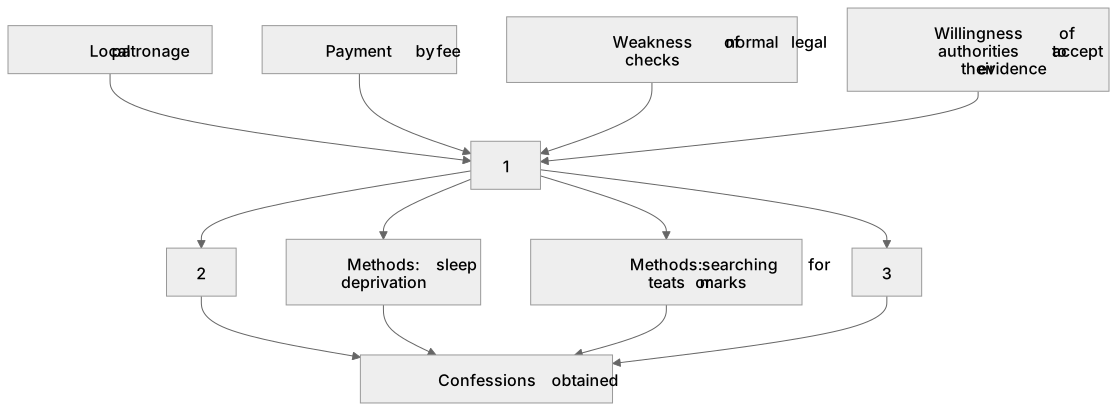
1Box 1
2Box 2
3Box 3
There is more to this lesson
The full lesson goes on to check your understanding and help you earn the marks. Create a free account to carry on, with your progress saved.
A week of Premium from your first lesson · Then the free plan continues · No card, no charge
Test your understanding of Paper 3, Option 33: The witch craze in Britain, Europe and North America, c1580–c1750 - 4 Matthew Hopkins and the East Anglian witch craze, 1645–47: Geography, numbers, class and gender of victims; the roles and methods of Matthew Hopkins and John Stearne and reasons for their influence and power.
Active recall beats re-reading. Take an instant quiz now to test what you’ve learned and lock it into long-term memory.
A week of Premium from your first lesson · Then the free plan continues · No card, no charge