Pearson Edexcel · A-Level · History
Course version: 9HI0 · Version from Sept 2015
The witch craze in Britain, Europe and North America, c1580–c1750 - 4…
Full specification wording
Paper 3, Option 33: The witch craze in Britain, Europe and North America, c1580–c1750 - 4 Matthew Hopkins and the East Anglian witch craze, 1645–47: The ending of the witch craze: the growing cost; the re- establishment of traditional authority; the role of John Gaule.
The craze wound down as prosecutions became too costly and disruptive.
Checked against the Pearson Edexcel 9HI0 specification (opens in a new tab) on .
- Point 3 of 3
- 3 key terms
Study notes
From the checked teaching notes for this specification point.
The idea
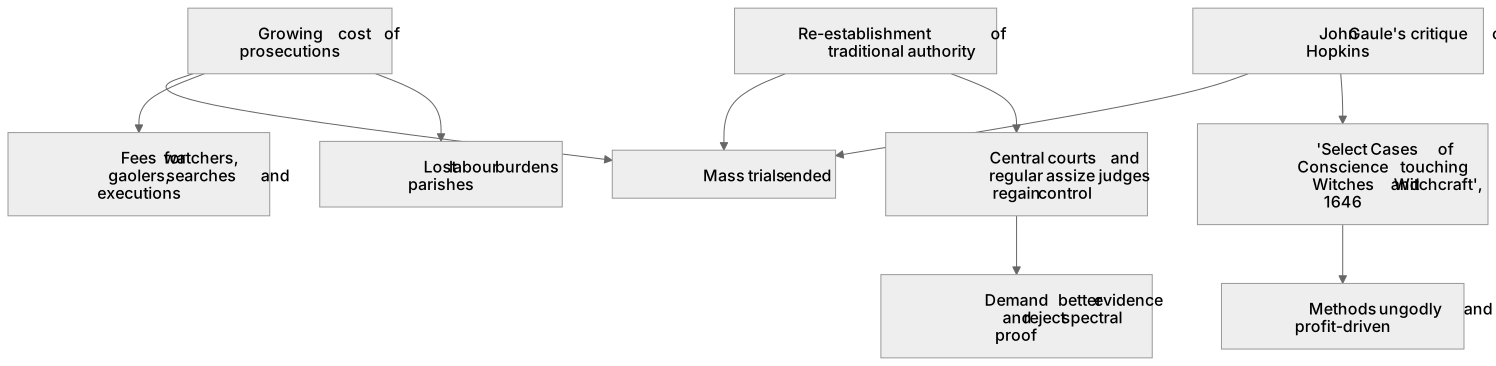
The craze wound down as prosecutions became too costly and disruptive. Growing cost covers fees for watchers, gaolers, searches and executions, plus lost labour, making ratepayers and parishes reluctant to fund trials. Re-established traditional authority occurred as the Civil War concluded; central courts and regular assize judges regained control from local zealots and special commissioners, demanding better evidence and rejecting spectral proof. John Gaule, a Huntingdonshire clergyman, attacked Hopkins in 1646 in 'Select Cases of Conscience touching Witches and Witchcraft', arguing that witch-finding methods were ungodly and that Hopkins profited from fear. Together these pressures ended mass trials.
What earns the marks
- Explains growing cost: fees for watchers, gaolers, searches, executions and lost labour made prosecutions burdensome for parishes.
- Explains re-establishment of traditional authority: the return of regular assize judges and central courts reasserted legal control, demanding stronger evidence.
- Explains John Gaule's role: his 1646 'Select Cases of Conscience touching Witches and Witchcraft' attacked Hopkins's methods as ungodly and profit-driven.
- Links the three factors: cost, restored legal authority and Gaule's critique combined to end the East Anglian craze and discourage mass prosecutions.
Common mistakes and how to put them right
Treating the ending as caused by a single factor.
Put it right: Show how cost, restored authority and Gaule's critique interacted.
Citing special commissioners like John Godbolt as ending the craze.
Put it right: Godbolt presided over mass convictions in 1645, whereas it was the return of regular assize judges that ended the craze.
Confusing the ending of the craze with the end of belief in witchcraft.
Put it right: Prosecutions declined while belief persisted in many communities.
Exam tips
- Plan an answer that addresses each clause of the statement before writing.
- Use Gaule's text and the return of regular assize judges as precise supporting evidence.
Try the lesson
The start of the Paper 3, Option 33: The witch craze in Britain, Europe and North America, c1580–c1750 - 4 Matthew Hopkins and the East Anglian witch craze, 1645–47: The ending of the witch craze: the growing cost; the re- establishment of traditional authority; the role of John Gaule. lesson, made from checked teaching notes for this specification point.
Have a go first
What was the primary argument made by John Gaule in his 1646 publication that helped to undermine the East Anglian witch craze?
Listen
The craze wound down as prosecutions became too costly and disruptive. Growing cost covers fees for watchers, gaolers, searches and executions, plus lost labour, making ratepayers and parishes reluctant to fund trials. Re-established traditional authority occurred as the Civil War concluded; central courts and regular assize judges regained control from local zealots and special commissioners, demanding better evidence and rejecting spectral proof. John Gaule, a Huntingdonshire clergyman, attacked Hopkins in 1646 in 'Select Cases of Conscience touching Witches and Witchcraft', arguing that witch-finding methods were ungodly and that Hopkins profited from fear. Together these pressures ended mass trials. A strong answer earns marks for these points. Explains growing cost: fees for watchers, gaolers, searches, executions and lost labour made prosecutions burdensome for parishes. Explains re-establishment of traditional authority: the return of regular assize judges and central courts reasserted legal control, demanding stronger evidence. Explains John Gaule's role: his 1646 'Select Cases of Conscience touching Witches and Witchcraft' attacked Hopkins's methods as ungodly and profit-driven. Links the three factors: cost, restored legal authority and Gaule's critique combined to end the East Anglian craze and discourage mass prosecutions. A common slip: Treating the ending as caused by a single factor. Instead, show how cost, restored authority and Gaule's critique interacted. Exam tip: Plan an answer that addresses each clause of the statement before writing.
See it
Key words
Say what each word means before you turn the card.
Cost of prosecution
Try answering aloud or in your head before turning the card.
Restoration of authority
Try answering aloud or in your head before turning the card.
Critique of witch-finding
Try answering aloud or in your head before turning the card.
See every definition
- Cost of prosecution
- Fees for watchers, gaolers, searches and executions, plus lost labour, made trials burdensome for parishes and ratepayers.
- Restoration of authority
- Central courts and regular assize judges regained control from local zealots and special commissioners, demanding better evidence and rejecting spectral proof.
- Critique of witch-finding
- John Gaule argued that witch-finding methods were ungodly and that Hopkins profited from fear.
Label the diagram
Some boxes have lost their names. Pick the right name for each number.
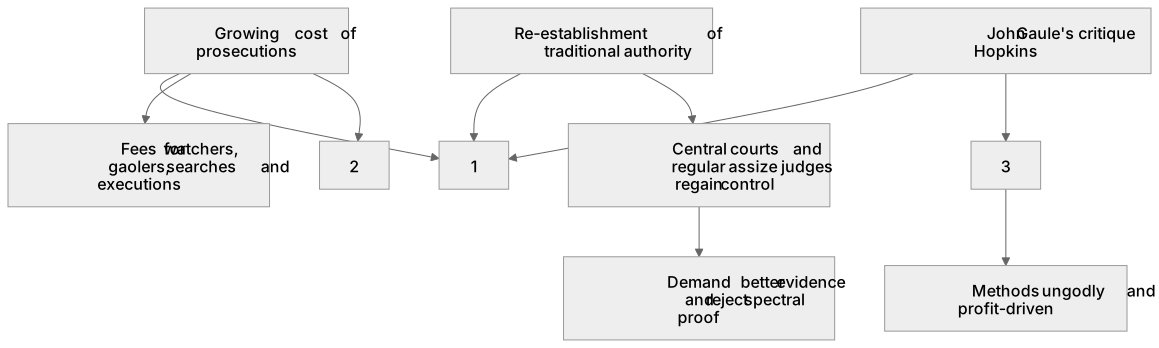
1Box 1
2Box 2
3Box 3
There is more to this lesson
The full lesson goes on to check your understanding and help you earn the marks. Create a free account to carry on, with your progress saved.
A week of Premium from your first lesson · Then the free plan continues · No card, no charge
Test your understanding of Paper 3, Option 33: The witch craze in Britain, Europe and North America, c1580–c1750 - 4 Matthew Hopkins and the East Anglian witch craze, 1645–47: The ending of the witch craze: the growing cost; the re- establishment of traditional authority; the role of John Gaule.
Active recall beats re-reading. Take an instant quiz now to test what you’ve learned and lock it into long-term memory.
A week of Premium from your first lesson · Then the free plan continues · No card, no charge