Pearson Edexcel · A-Level · History
Course version: 9HI0 · Version from Sept 2015
Industrialisation and social change in Britain, 1759–1928: forging a new…
Full specification wording
Paper 3, Option 34.1: Industrialisation and social change in Britain, 1759–1928: forging a new society - 2 Samuel Greg: cotton and cottages, 1784–1816: Dealing with the labour problem; connections with the Poor Law system; accommodating and managing the workforce.
Early cotton mills faced a labour problem: they needed many hands, but free workers were scarce, mobile and resistant to factory discipline.
Checked against the Pearson Edexcel 9HI0 specification (opens in a new tab) on .
- Point 2 of 3
- 4 key terms
Study notes
From the checked teaching notes for this specification point.
The idea
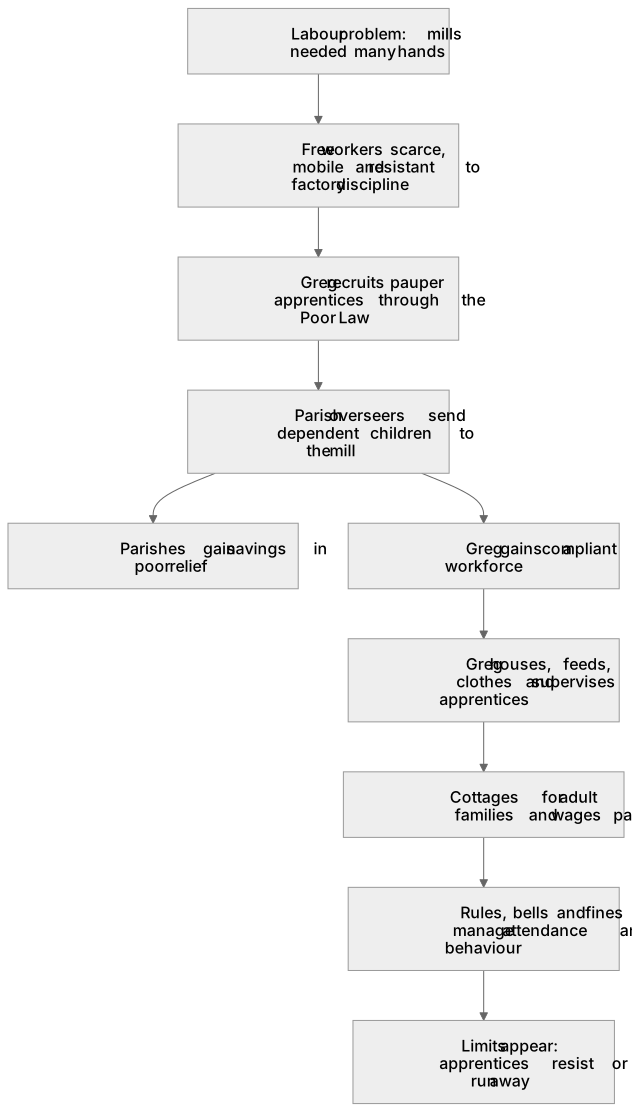
Early cotton mills faced a labour problem: they needed many hands, but free workers were scarce, mobile and resistant to factory discipline. Samuel Greg addressed this at Quarry Bank by recruiting pauper apprentices through the Poor Law. Parish overseers relieved ratepayers by sending dependent children to the mill, where Greg housed, fed, clothed and supervised them. This linked industrial labour to poor relief: parishes gained savings, Greg gained a compliant workforce. He also built cottages for adult families, paid wages and imposed rules, bells and fines to manage attendance and behaviour. The system combined accommodation with control, and its limits appeared when apprentices resisted or ran away.
What earns the marks
- Explain the labour problem: rapid mill expansion created demand for workers that local free labour could not meet, especially in rural sites such as Styal.
- Show how the Poor Law connection worked: parish overseers apprenticed poor children to Greg, transferring the cost of relief and gaining a supply of young workers.
- Describe accommodation and management: purpose-built apprentice houses, cottages for families, provision of food and clothing, and rules enforced by overseers and teachers.
- Assess the balance of care and control: Greg's provision improved welfare for some children but also created dependence and strict discipline, with resistance such as running away.
- Link the workforce system to business needs: a settled, trained and supervised labour force reduced turnover and supported continuous production at Quarry Bank.
Common mistakes and how to put them right
Treating the labour problem as only a shortage of adult workers.
Put it right: It also concerned discipline, turnover and the cost of poor relief.
Assuming all Quarry Bank workers were apprentices.
Put it right: Greg also employed local families and adult wage labourers alongside pauper apprentices.
Presenting the Poor Law connection as purely charitable.
Put it right: It was a bargain between parishes seeking savings and a manufacturer seeking labour.
Describing management as either wholly benevolent or wholly harsh.
Put it right: Evidence shows both provision and control operating together.
Exam tips
- Anchor answers in specific Quarry Bank practices such as apprentice houses, parish indentures and factory rules rather than general statements about factories.
- When discussing the Poor Law, explain the interests of both parish and employer to show causation, not just describe the system.
- Use the wording of the question to organise paragraphs around labour problem, Poor Law connection, and accommodation and management.
- Support judgements about welfare and control with named examples, such as children's diet, clothing, schooling or punishments.
Try the lesson
The start of the Paper 3, Option 34.1: Industrialisation and social change in Britain, 1759–1928: forging a new society - 2 Samuel Greg: cotton and cottages, 1784–1816: Dealing with the labour problem; connections with the Poor Law system; accommodating and managing the workforce. lesson, made from checked teaching notes for this specification point.
Have a go first
Which group of workers did Samuel Greg's Quarry Bank Mill rely on most heavily for its early workforce?
Listen
Early cotton mills faced a labour problem: they needed many hands, but free workers were scarce, mobile and resistant to factory discipline. Samuel Greg addressed this at Quarry Bank by recruiting pauper apprentices through the Poor Law. Parish overseers relieved ratepayers by sending dependent children to the mill, where Greg housed, fed, clothed and supervised them. This linked industrial labour to poor relief: parishes gained savings, Greg gained a compliant workforce. He also built cottages for adult families, paid wages and imposed rules, bells and fines to manage attendance and behaviour. The system combined accommodation with control, and its limits appeared when apprentices resisted or ran away. A strong answer earns marks for these points. Explain the labour problem: rapid mill expansion created demand for workers that local free labour could not meet, especially in rural sites such as Styal. Show how the Poor Law connection worked: parish overseers apprenticed poor children to Greg, transferring the cost of relief and gaining a supply of young workers. Describe accommodation and management: purpose-built apprentice houses, cottages for families, provision of food and clothing, and rules enforced by overseers and teachers. Assess the balance of care and control: Greg's provision improved welfare for some children but also created dependence and strict discipline, with resistance such as running away. A common slip: Treating the labour problem as only a shortage of adult workers. Instead, it also concerned discipline, turnover and the cost of poor relief. Exam tip: Anchor answers in specific Quarry Bank practices such as apprentice houses, parish indentures and factory rules rather than general statements about factories.
See it
Key words
Say what each word means before you turn the card.
Industrial labour supply and recruitment
Try answering aloud or in your head before turning the card.
Poor Law administration and pauper apprenticeship
Try answering aloud or in your head before turning the card.
Paternalism, welfare and social control
Try answering aloud or in your head before turning the card.
Factory discipline and worker resistance
Try answering aloud or in your head before turning the card.
See every definition
- Industrial labour supply and recruitment
- Early cotton mills needed many hands, but free workers were scarce, mobile and resistant to factory discipline, so Greg recruited pauper apprentices through the Poor Law.
- Poor Law administration and pauper apprenticeship
- Parish overseers relieved ratepayers by sending dependent children to the mill, gaining savings while Greg gained a compliant workforce.
- Paternalism, welfare and social control
- Greg housed, fed, clothed and supervised apprentices and built cottages for adult families, combining accommodation with control.
- Factory discipline and worker resistance
- Greg imposed rules, bells and fines to manage attendance and behaviour, and its limits appeared when apprentices resisted or ran away.
Label the diagram
Some boxes have lost their names. Pick the right name for each number.
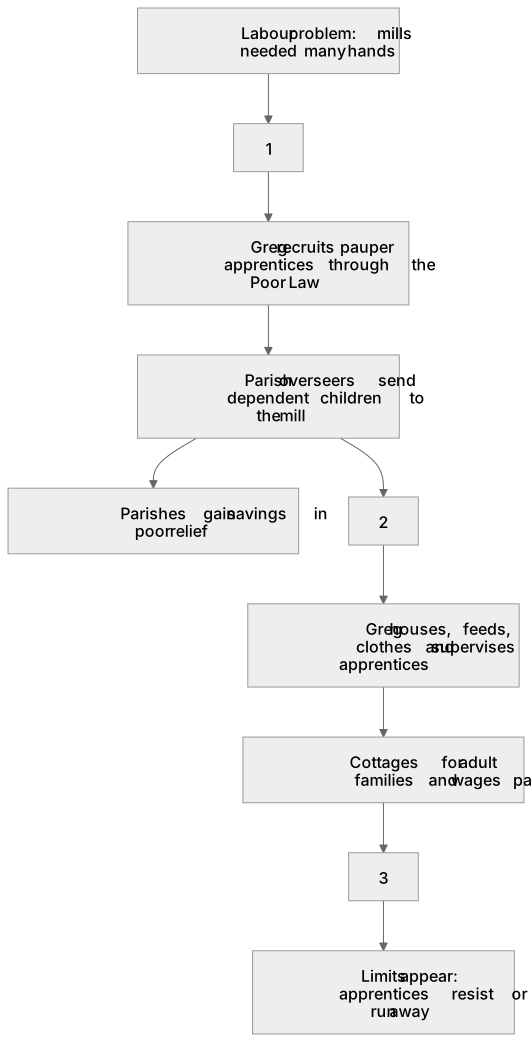
1Box 1
2Box 2
3Box 3
There is more to this lesson
The full lesson goes on to check your understanding and help you earn the marks. Create a free account to carry on, with your progress saved.
A week of Premium from your first lesson · Then the free plan continues · No card, no charge
Test your understanding of Paper 3, Option 34.1: Industrialisation and social change in Britain, 1759–1928: forging a new society - 2 Samuel Greg: cotton and cottages, 1784–1816: Dealing with the labour problem; connections with the Poor Law system; accommodating and managing the workforce.
Active recall beats re-reading. Take an instant quiz now to test what you’ve learned and lock it into long-term memory.
A week of Premium from your first lesson · Then the free plan continues · No card, no charge