Pearson Edexcel · A-Level · History
Course version: 9HI0 · Version from Sept 2015
Industrialisation and social change in Britain, 1759–1928: forging a new…
Full specification wording
Paper 3, Option 34.1: Industrialisation and social change in Britain, 1759–1928: forging a new society - 2 Samuel Greg: cotton and cottages, 1784–1816: The growth of Quarry Bank Mill: choice of site, impact of the French wars, 1793–1815, the roles of Samuel Greg, Peter Ewart, Matthew Fawkner and Hannah Greg.
Samuel Greg built Quarry Bank Mill at Styal, Cheshire, from 1784, choosing a site with the River Bollin for water power, nearby coal, transport links and a rural labour supply.
Checked against the Pearson Edexcel 9HI0 specification (opens in a new tab) on .
- Point 1 of 3
- 2 key terms
Study notes
From the checked teaching notes for this specification point.
The idea
Samuel Greg built Quarry Bank Mill at Styal, Cheshire, from 1784, choosing a site with the River Bollin for water power, nearby coal, transport links and a rural labour supply. Growth depended on technology and people: Peter Ewart improved water wheels and power transmission, while Matthew Fawkner managed production and workforce discipline. The French wars of 1793–1815 disrupted trade and raised food prices, yet also stimulated some domestic demand and encouraged investment in machinery and apprentices. Hannah Greg shaped welfare, education and religion in the village, influencing the mill's reputation and workforce stability. Together these factors explain how a water-powered cotton spinning concern expanded into a substantial industrial community by 1816.
What earns the marks
- Explains site selection at Styal: the River Bollin for water power, available land, coal and transport access, and a local population including pauper apprentices.
- Analyses how the French wars, 1793–1815, affected the mill through trade disruption, fluctuating cotton prices, food scarcity and pressure on wages, while also creating opportunities for some producers.
- Assesses Samuel Greg's role as entrepreneur and owner, securing capital, partners and markets and directing the mill's expansion.
- Explains Peter Ewart's engineering contribution to water power and machinery, and Matthew Fawkner's role in managing production and the workforce.
- Evaluates Hannah Greg's influence through education, religion and welfare provision, and how this shaped labour supply, discipline and the mill's public image.
Common mistakes and how to put them right
Treating the French wars as purely damaging.
Put it right by explaining both disruption to trade and the mixed effects on demand, prices and investment.
Confusing the roles of Ewart and Fawkner.
Put it right by distinguishing Ewart's engineering and power improvements from Fawkner's management of production and workers.
Ignoring Hannah Greg or reducing her to a domestic figure.
Put it right by analysing her practical role in education, welfare and the mill community's stability.
Exam tips
- Organise paragraphs around the named factors in the statement so every clause is addressed explicitly.
- Use precise site details, dates and named individuals as evidence, then explain how each factor enabled or constrained growth.
- Weigh the factors against one another to reach a supported judgement about which mattered most for growth by 1816.
Try the lesson
The start of the Paper 3, Option 34.1: Industrialisation and social change in Britain, 1759–1928: forging a new society - 2 Samuel Greg: cotton and cottages, 1784–1816: The growth of Quarry Bank Mill: choice of site, impact of the French wars, 1793–1815, the roles of Samuel Greg, Peter Ewart, Matthew Fawkner and Hannah Greg. lesson, made from checked teaching notes for this specification point.
Have a go first
Which natural feature made the site at Quarry Bank suitable for Samuel Greg's cotton mill?
Listen
Samuel Greg built Quarry Bank Mill at Styal, Cheshire, from 1784, choosing a site with the River Bollin for water power, nearby coal, transport links and a rural labour supply. Growth depended on technology and people: Peter Ewart improved water wheels and power transmission, while Matthew Fawkner managed production and workforce discipline. The French wars of 1793–1815 disrupted trade and raised food prices, yet also stimulated some domestic demand and encouraged investment in machinery and apprentices. Hannah Greg shaped welfare, education and religion in the village, influencing the mill's reputation and workforce stability. Together these factors explain how a water-powered cotton spinning concern expanded into a substantial industrial community by 1816. A strong answer earns marks for these points. Explains site selection at Styal: the River Bollin for water power, available land, coal and transport access, and a local population including pauper apprentices. Analyses how the French wars, 1793–1815, affected the mill through trade disruption, fluctuating cotton prices, food scarcity and pressure on wages, while also creating opportunities for some producers. Assesses Samuel Greg's role as entrepreneur and owner, securing capital, partners and markets and directing the mill's expansion. Explains Peter Ewart's engineering contribution to water power and machinery, and Matthew Fawkner's role in managing production and the workforce. A common slip: Treating the French wars as purely damaging. Instead, explaining both disruption to trade and the mixed effects on demand, prices and investment. Exam tip: Organise paragraphs around the named factors in the statement so every clause is addressed explicitly.
See it

Put the events in order
Put these events in the order they happened, earliest first.
- 1. Samuel Greg built Quarry Bank Mill at Styal
- 2. The mill had expanded into a substantial industrial community
- 3. The French wars began, disrupting trade and raising food prices
Key words
Say what each word means before you turn the card.
Industrial location and the exploitation of water power
Try answering aloud or in your head before turning the card.
The impact of war on early industrial enterprise
Try answering aloud or in your head before turning the card.
See every definition
- Industrial location and the exploitation of water power
- Choosing a site with the River Bollin for water power, available land, coal and transport access, and a local population including pauper apprentices.
- The impact of war on early industrial enterprise
- The French wars of 1793–1815 disrupted trade and raised food prices, yet also stimulated some domestic demand and encouraged investment in machinery and apprentices.
Label the diagram
Some boxes have lost their names. Pick the right name for each number.
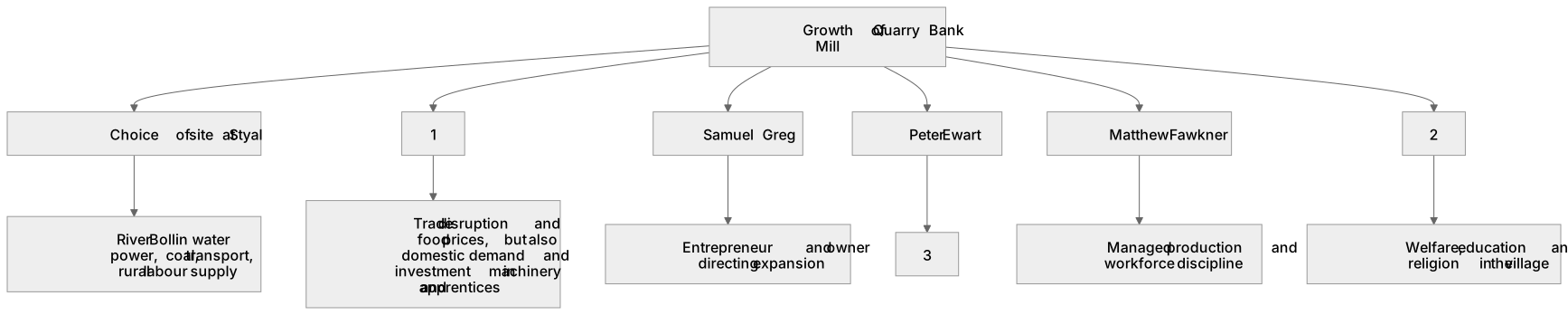
1Box 1
2Box 2
3Box 3
There is more to this lesson
The full lesson goes on to check your understanding and help you earn the marks. Create a free account to carry on, with your progress saved.
A week of Premium from your first lesson · Then the free plan continues · No card, no charge
Test your understanding of Paper 3, Option 34.1: Industrialisation and social change in Britain, 1759–1928: forging a new society - 2 Samuel Greg: cotton and cottages, 1784–1816: The growth of Quarry Bank Mill: choice of site, impact of the French wars, 1793–1815, the roles of Samuel Greg, Peter Ewart, Matthew Fawkner and Hannah Greg.
Active recall beats re-reading. Take an instant quiz now to test what you’ve learned and lock it into long-term memory.
A week of Premium from your first lesson · Then the free plan continues · No card, no charge