Pearson Edexcel · A-Level · History
Course version: 9HI0 · Version from Sept 2015
Industrialisation and social change in Britain, 1759–1928: forging a new…
Full specification wording
Paper 3, Option 34.1: Industrialisation and social change in Britain, 1759–1928: forging a new society - 3 Isambard Kingdom Brunel: railways and ships, 1833–59: Impact of Brunel’s work for passenger travel and for goods transport; the significance of Brunel’s attempts to extend the GWR westwards to the USA.
Brunel’s railways transformed passenger travel by offering speed, comfort and regular services, while goods transport benefited from bulk movement of coal, raw materials and manufactured goods.
Checked against the Pearson Edexcel 9HI0 specification (opens in a new tab) on .
- Point 3 of 3
Study notes
From the checked teaching notes for this specification point.
The idea
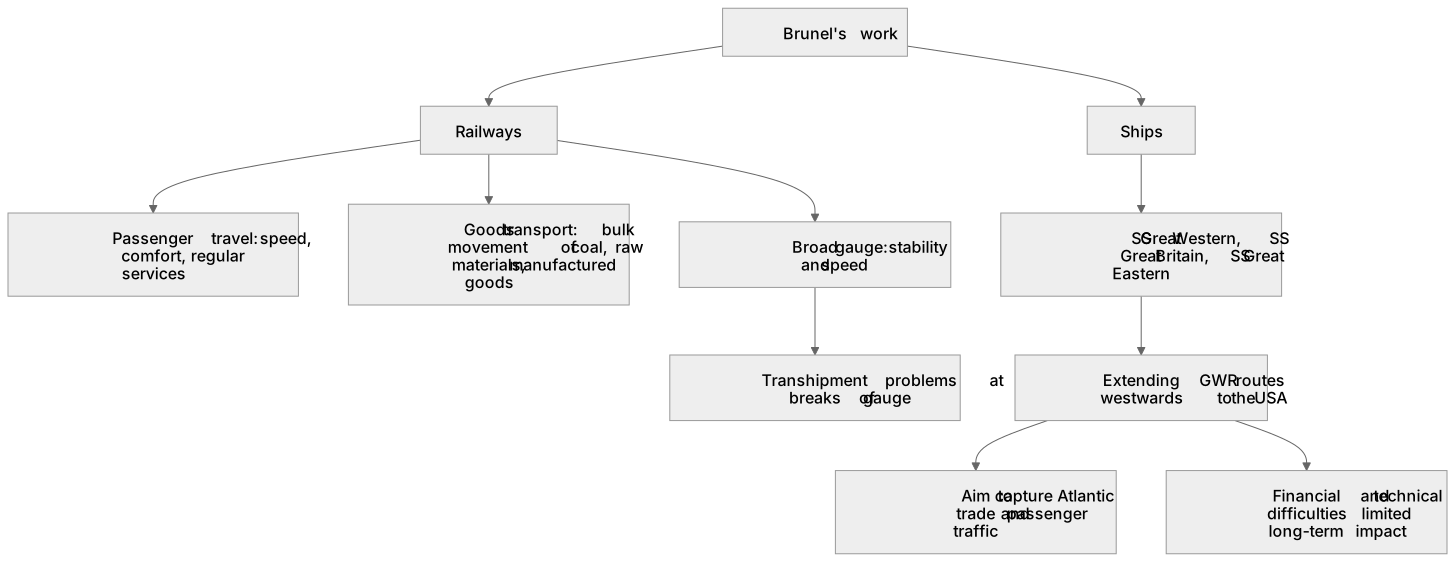
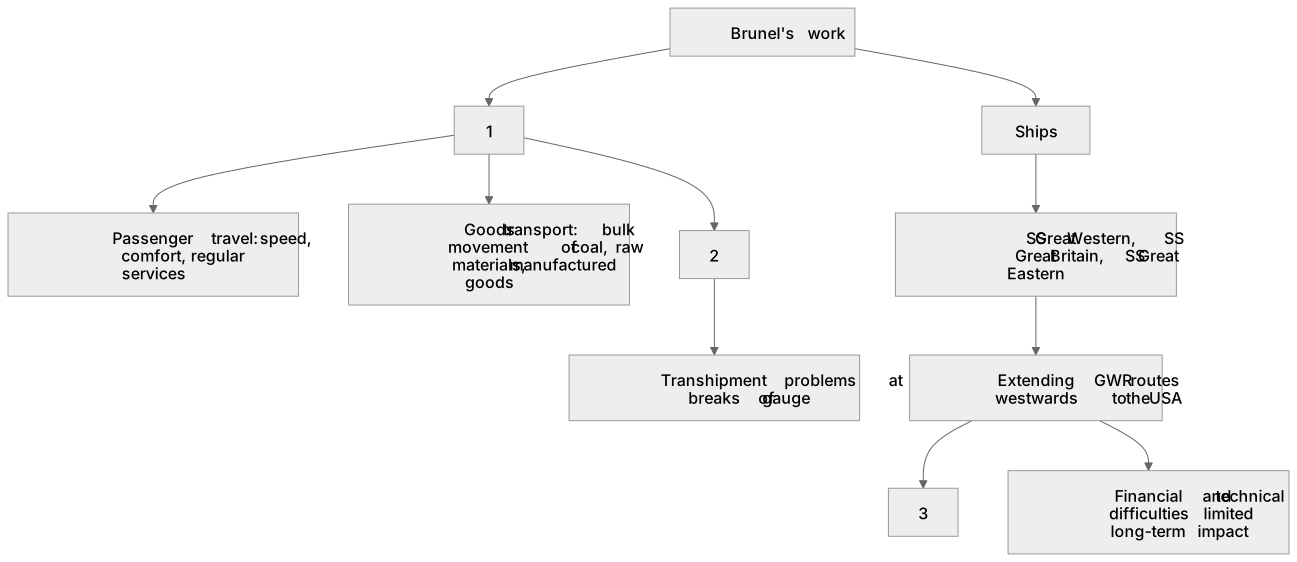
Brunel’s railways transformed passenger travel by offering speed, comfort and regular services, while goods transport benefited from bulk movement of coal, raw materials and manufactured goods. The GWR’s broad gauge (7 ft 0¼ in) improved stability and speed, but created transhipment problems at breaks of gauge. Brunel’s ships, notably SS Great Western (1837), SS Great Britain (1843) and SS Great Eastern (1858), extended GWR routes westwards towards the USA, aiming to capture Atlantic trade and passenger traffic. The Great Western established regular transatlantic steam services, but the Great Eastern proved commercially unsuccessful. These attempts show Brunel’s ambition to integrate rail and sea, though financial and technical difficulties limited their long-term impact.
What earns the marks
- Explains how Brunel’s railways improved passenger travel through faster journey times, greater comfort and more reliable timetables compared with coaching or early railways.
- Analyses how goods transport was transformed by the GWR’s ability to carry heavy, bulky goods such as coal, timber and manufactured products over long distances at lower unit cost.
- Evaluates the significance of the broad gauge in enabling higher speeds and smoother rides, while noting the costs of gauge breaks and transhipment.
- Assesses Brunel’s steamships as an attempt to extend the GWR’s influence westwards to the USA, linking rail networks to Atlantic passenger and freight routes.
- Judges the overall impact of Brunel’s work, recognising that some schemes were commercially unsuccessful but technologically influential.
Common mistakes and how to put them right
Assuming the broad gauge was universally adopted.
Put it right: The standard gauge (4 ft 8½ in) eventually prevailed, and gauge differences caused practical problems.
Treating Brunel’s ships as unqualified successes.
Put it right: The SS Great Eastern, in particular, was commercially disappointing despite its technical innovation.
Ignoring the distinction between passenger and goods transport.
Put it right: Address both separately, noting different requirements such as speed and comfort versus capacity and cost.
Exam tips
- Use specific examples such as the Great Western Railway’s London to Bristol route and the SS Great Western’s 1838 crossing to support your points.
- When discussing the westward extension to the USA, link it to the GWR’s broader strategy of integrated transport rather than treating it as an isolated venture.
- Balance technological achievement against economic and operational outcomes to reach a supported judgement.
Try the lesson
The start of the Paper 3, Option 34.1: Industrialisation and social change in Britain, 1759–1928: forging a new society - 3 Isambard Kingdom Brunel: railways and ships, 1833–59: Impact of Brunel’s work for passenger travel and for goods transport; the significance of Brunel’s attempts to extend the GWR westwards to the USA. lesson, made from checked teaching notes for this specification point.
Have a go first
Which of Brunel's achievements is most closely associated with his attempt to extend the Great Western Railway's route westwards towards the United States?
Listen
Brunel’s railways transformed passenger travel by offering speed, comfort and regular services, while goods transport benefited from bulk movement of coal, raw materials and manufactured goods. The GWR’s broad gauge (7 ft 0¼ in) improved stability and speed, but created transhipment problems at breaks of gauge. Brunel’s ships, notably SS Great Western (1837), SS Great Britain (1843) and SS Great Eastern (1858), extended GWR routes westwards towards the USA, aiming to capture Atlantic trade and passenger traffic. The Great Western established regular transatlantic steam services, but the Great Eastern proved commercially unsuccessful. These attempts show Brunel’s ambition to integrate rail and sea, though financial and technical difficulties limited their long-term impact. A strong answer earns marks for these points. Explains how Brunel’s railways improved passenger travel through faster journey times, greater comfort and more reliable timetables compared with coaching or early railways. Analyses how goods transport was transformed by the GWR’s ability to carry heavy, bulky goods such as coal, timber and manufactured products over long distances at lower unit cost. Evaluates the significance of the broad gauge in enabling higher speeds and smoother rides, while noting the costs of gauge breaks and transhipment. Assesses Brunel’s steamships as an attempt to extend the GWR’s influence westwards to the USA, linking rail networks to Atlantic passenger and freight routes. A common slip: assuming the broad gauge was universally adopted. Instead, the standard gauge (4 ft 8½ in) eventually prevailed, and gauge differences caused practical problems. Exam tip: Use specific examples such as the Great Western Railway’s London to Bristol route and the SS Great Western’s 1838 crossing to support your points.
See it
Put the events in order
Put these events in the order they happened, earliest first.
- 1. SS Great Western launched as a Brunel steamship
- 2. SS Great Eastern launched as a Brunel steamship
- 3. SS Great Britain launched as a Brunel steamship
Label the diagram
Some boxes have lost their names. Pick the right name for each number.
1Box 1
2Box 2
3Box 3
There is more to this lesson
The full lesson goes on to check your understanding and help you earn the marks. Create a free account to carry on, with your progress saved.
A week of Premium from your first lesson · Then the free plan continues · No card, no charge
Test your understanding of Paper 3, Option 34.1: Industrialisation and social change in Britain, 1759–1928: forging a new society - 3 Isambard Kingdom Brunel: railways and ships, 1833–59: Impact of Brunel’s work for passenger travel and for goods transport; the significance of Brunel’s attempts to extend the GWR westwards to the USA.
Active recall beats re-reading. Take an instant quiz now to test what you’ve learned and lock it into long-term memory.
A week of Premium from your first lesson · Then the free plan continues · No card, no charge