Pearson Edexcel · A-Level · History
Course version: 9HI0 · Version from Sept 2015
Industrialisation and social change in Britain, 1759–1928: forging a new…
Full specification wording
Paper 3, Option 34.1: Industrialisation and social change in Britain, 1759–1928: forging a new society - 3 Isambard Kingdom Brunel: railways and ships, 1833–59: Brunel’s diverse design and engineering skills: problem solving during GWR line construction; innovative design of bridges, stations, ships and pre-fabricated hospitals for the Crimean War.
Brunel’s engineering genius spanned railways, bridges, ships and wartime logistics.
Checked against the Pearson Edexcel 9HI0 specification (opens in a new tab) on .
- Point 2 of 3
- 4 key terms
Study notes
From the checked teaching notes for this specification point.
The idea
Brunel’s engineering genius spanned railways, bridges, ships and wartime logistics. On the GWR, he solved problems of route and terrain with viaducts, tunnels and the broad gauge. His bridges, such as the Royal Albert Bridge (1859), used innovative designs like the lenticular truss. He designed stations including Temple Meads, and ships such as the SS Great Western (1837), SS Great Britain (1843) and SS Great Eastern (1858), pioneering iron hulls and screw propulsion. During the Crimean War, he designed a prefabricated hospital at Renkioi (1855), demonstrating versatility. These projects show his problem-solving approach and lasting impact on Victorian engineering.
What earns the marks
- Explains how Brunel solved engineering problems during GWR construction, such as the Box Tunnel and the Sonning Cutting.
- Describes Brunel’s innovative bridge designs, including the Royal Albert Bridge and the Clifton Suspension Bridge.
- Identifies Brunel’s station designs, such as Temple Meads, and their functional and aesthetic features.
- Explains Brunel’s ship designs, including the SS Great Western, SS Great Britain and SS Great Eastern, and their technological advances.
- Describes the prefabricated hospital at Renkioi for the Crimean War and its significance for military medicine.
- Evaluates the extent to which Brunel’s diverse projects demonstrate consistent problem-solving and innovation.
Common mistakes and how to put them right
Attributing the Clifton Suspension Bridge entirely to Brunel’s design without noting it was completed after his death.
Put it right: Brunel designed it, but it was finished in 1864.
Claiming the SS Great Eastern was a commercial success.
Put it right: It was technologically advanced but financially unsuccessful.
Stating the Renkioi hospital was built in the Crimea.
Put it right: It was prefabricated in Britain and shipped to Renkioi, near Constantinople.
Exam tips
- Use specific examples to illustrate each area of Brunel’s work.
- Connect Brunel’s designs to the broader context of industrialisation and imperial conflict.
- When assessing ‘diverse skills’, compare different projects to show range.
Try the lesson
The start of the Paper 3, Option 34.1: Industrialisation and social change in Britain, 1759–1928: forging a new society - 3 Isambard Kingdom Brunel: railways and ships, 1833–59: Brunel’s diverse design and engineering skills: problem solving during GWR line construction; innovative design of bridges, stations, ships and pre-fabricated hospitals for the Crimean War. lesson, made from checked teaching notes for this specification point.
Have a go first
Which innovative structure did Isambard Kingdom Brunel design to improve medical care for British soldiers during the Crimean War?
Listen
Brunel’s engineering genius spanned railways, bridges, ships and wartime logistics. On the GWR, he solved problems of route and terrain with viaducts, tunnels and the broad gauge. His bridges, such as the Royal Albert Bridge (1859), used innovative designs like the lenticular truss. He designed stations including Temple Meads, and ships such as the SS Great Western (1837), SS Great Britain (1843) and SS Great Eastern (1858), pioneering iron hulls and screw propulsion. During the Crimean War, he designed a prefabricated hospital at Renkioi (1855), demonstrating versatility. These projects show his problem-solving approach and lasting impact on Victorian engineering. A strong answer earns marks for these points. Explains how Brunel solved engineering problems during GWR construction, such as the Box Tunnel and the Sonning Cutting. Describes Brunel’s innovative bridge designs, including the Royal Albert Bridge and the Clifton Suspension Bridge. Identifies Brunel’s station designs, such as Temple Meads, and their functional and aesthetic features. Explains Brunel’s ship designs, including the SS Great Western, SS Great Britain and SS Great Eastern, and their technological advances. A common slip: attributing the Clifton Suspension Bridge entirely to Brunel’s design without noting it was completed after his death. Instead, Brunel designed it, but it was finished in 1864. Exam tip: Use specific examples to illustrate each area of Brunel’s work.
See it

Put the events in order
Put these events in the order they happened, earliest first.
- 1. Brunel designed the SS Great Britain ship
- 2. Brunel designed the SS Great Western ship
- 3. Brunel designed the Royal Albert Bridge
- 4. Brunel designed prefabricated hospital at Renkioi for Crimean War
- 5. Brunel designed the SS Great Eastern ship
Key words
Say what each word means before you turn the card.
Engineering problem-solving
Try answering aloud or in your head before turning the card.
Technological innovation
Try answering aloud or in your head before turning the card.
Transport and communication
Try answering aloud or in your head before turning the card.
War and logistics
Try answering aloud or in your head before turning the card.
See every definition
- Engineering problem-solving
- Brunel's approach of solving problems of route and terrain during GWR line construction, for example with viaducts and tunnels.
- Technological innovation
- Brunel's innovative designs, including the lenticular truss, iron hulls and screw propulsion in his ships.
- Transport and communication
- Brunel's work on railways, bridges, stations and ships, spanning the GWR and vessels such as the SS Great Western.
- War and logistics
- Brunel's design of a prefabricated hospital at Renkioi for the Crimean War, showing his versatility.
Label the diagram
Some boxes have lost their names. Pick the right name for each number.
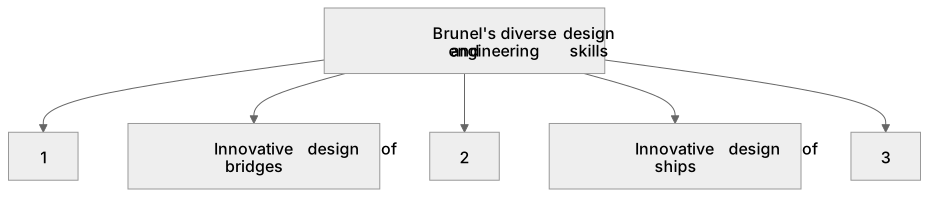
1Box 1
2Box 2
3Box 3
There is more to this lesson
The full lesson goes on to check your understanding and help you earn the marks. Create a free account to carry on, with your progress saved.
A week of Premium from your first lesson · Then the free plan continues · No card, no charge
Test your understanding of Paper 3, Option 34.1: Industrialisation and social change in Britain, 1759–1928: forging a new society - 3 Isambard Kingdom Brunel: railways and ships, 1833–59: Brunel’s diverse design and engineering skills: problem solving during GWR line construction; innovative design of bridges, stations, ships and pre-fabricated hospitals for the Crimean War.
Active recall beats re-reading. Take an instant quiz now to test what you’ve learned and lock it into long-term memory.
A week of Premium from your first lesson · Then the free plan continues · No card, no charge