Pearson Edexcel · A-Level · History
Course version: 9HI0 · Version from Sept 2015
Industrialisation and social change in Britain, 1759–1928: forging a new…
Full specification wording
Paper 3, Option 34.1: Industrialisation and social change in Britain, 1759–1928: forging a new society - 3 Isambard Kingdom Brunel: railways and ships, 1833–59: The construction of the Great Western Railway: the role of Brunel; the reasons for the ‘battle of the gauges’; the Royal Commission 1845 and the Gauge Act 1846; reasons why Stephenson’s narrower gauge became the standard.
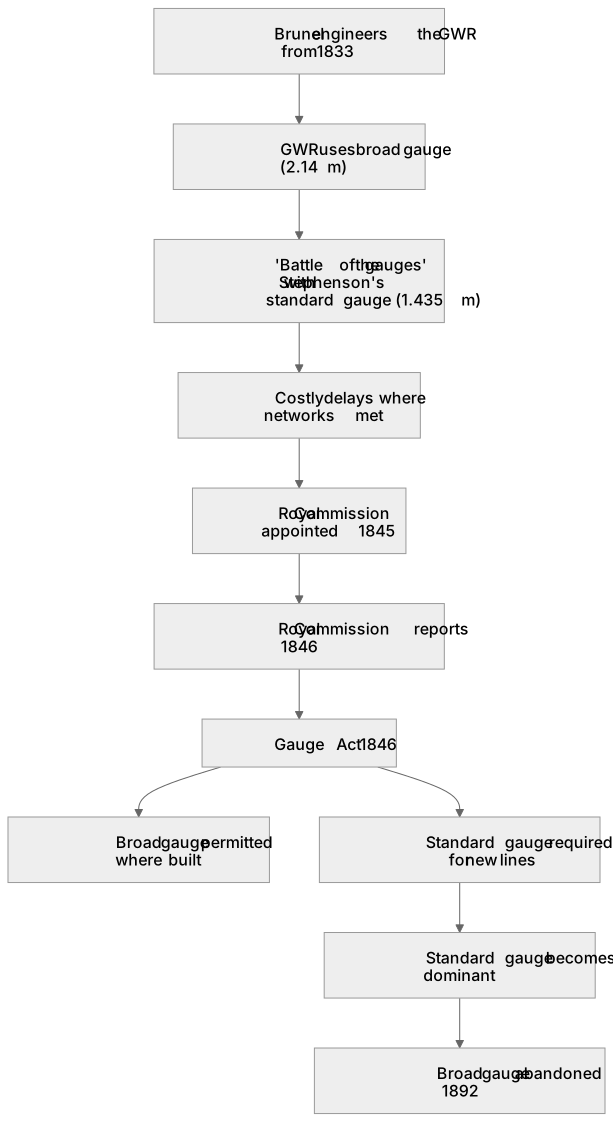
Brunel engineered the GWR from 1833, using broad gauge (2.14 m) for speed and stability.
Checked against the Pearson Edexcel 9HI0 specification (opens in a new tab) on .
- Point 1 of 3
- 4 key terms
Study notes
From the checked teaching notes for this specification point.
The idea
Brunel engineered the GWR from 1833, using broad gauge (2.14 m) for speed and stability. This sparked the ‘battle of the gauges’ with Stephenson’s standard gauge (1.435 m), causing costly delays where networks met. The Royal Commission was appointed in 1845 and reported in 1846, investigating the issue. The resulting Gauge Act 1846 permitted both but favoured standard for new lines. Standard gauge became dominant because it already covered more route miles, offered cheaper through-running, and was backed by Parliament. Brunel’s broad gauge was abandoned by 1892. The episode shows how engineering choice, commercial interest and state regulation interacted.
What earns the marks
- Explains Brunel’s role in constructing the GWR, including his appointment as chief engineer in 1833 and use of broad gauge (2.14 m).
- Identifies the reasons for the ‘battle of the gauges’, such as break-of-gauge costs and competition for traffic against standard gauge (1.435 m).
- Describes the Royal Commission appointed in 1845 and the Gauge Act 1846, which retained broad gauge where built but required standard for new lines.
- Analyses why Stephenson’s narrower gauge became standard: greater existing mileage, lower costs, and parliamentary preference.
Common mistakes and how to put them right
Stating that the Gauge Act 1846 immediately abolished broad gauge.
Put it right: It allowed broad gauge on existing lines but required standard gauge for new lines.
Claiming Brunel invented the broad gauge.
Put it right: Broad gauge was already used on some lines; Brunel adopted and championed it for the GWR.
Saying the Royal Commission reported in 1845.
Put it right: It was appointed in 1845 but reported in 1846, leading to the Gauge Act.
Exam tips
- Use specific dates and terms: 1833, 1845, 1846, 2.14 m, 1.435 m.
- Link the gauge debate to wider themes of industrialisation and state intervention.
Try the lesson
The start of the Paper 3, Option 34.1: Industrialisation and social change in Britain, 1759–1928: forging a new society - 3 Isambard Kingdom Brunel: railways and ships, 1833–59: The construction of the Great Western Railway: the role of Brunel; the reasons for the ‘battle of the gauges’; the Royal Commission 1845 and the Gauge Act 1846; reasons why Stephenson’s narrower gauge became the standard. lesson, made from checked teaching notes for this specification point.
Have a go first
What was the primary recommendation of the Royal Commission of 1845 regarding railway gauges in Great Britain?
Listen
Brunel engineered the GWR from 1833, using broad gauge (2.14 m) for speed and stability. This sparked the ‘battle of the gauges’ with Stephenson’s standard gauge (1.435 m), causing costly delays where networks met. The Royal Commission was appointed in 1845 and reported in 1846, investigating the issue. The resulting Gauge Act 1846 permitted both but favoured standard for new lines. Standard gauge became dominant because it already covered more route miles, offered cheaper through-running, and was backed by Parliament. Brunel’s broad gauge was abandoned by 1892. The episode shows how engineering choice, commercial interest and state regulation interacted. A strong answer earns marks for these points. Explains Brunel’s role in constructing the GWR, including his appointment as chief engineer in 1833 and use of broad gauge (2.14 m). Identifies the reasons for the ‘battle of the gauges’, such as break-of-gauge costs and competition for traffic against standard gauge (1.435 m). Describes the Royal Commission appointed in 1845 and the Gauge Act 1846, which retained broad gauge where built but required standard for new lines. Analyses why Stephenson’s narrower gauge became standard: greater existing mileage, lower costs, and parliamentary preference. A common slip: Stating that the Gauge Act 1846 immediately abolished broad gauge. Instead, it allowed broad gauge on existing lines but required standard gauge for new lines. Exam tip: Use specific dates and terms: 1833, 1845, 1846, 2.14 m, 1.435 m.
See it
Put the events in order
Put these events in the order they happened, earliest first.
- 1. Brunel appointed chief engineer and began constructing the Great Western Railway
- 2. Gauge Act permitted both gauges but favoured standard for new lines
- 3. Royal Commission appointed to investigate the gauge question
Key words
Say what each word means before you turn the card.
battle of the gauges
Try answering aloud or in your head before turning the card.
Royal Commission
Try answering aloud or in your head before turning the card.
Gauge Act 1846
Try answering aloud or in your head before turning the card.
standard gauge
Try answering aloud or in your head before turning the card.
See every definition
- battle of the gauges
- Conflict between Brunel's broad gauge and Stephenson's standard gauge, causing costly delays where networks met.
- Royal Commission
- Body appointed in 1845 and reporting in 1846 to investigate the gauge issue.
- Gauge Act 1846
- Law permitting both gauges but favouring standard gauge for new lines.
- standard gauge
- Stephenson's narrower gauge, which became dominant because it covered more route miles, offered cheaper through-running and was backed by Parliament.
Label the diagram
Some boxes have lost their names. Pick the right name for each number.
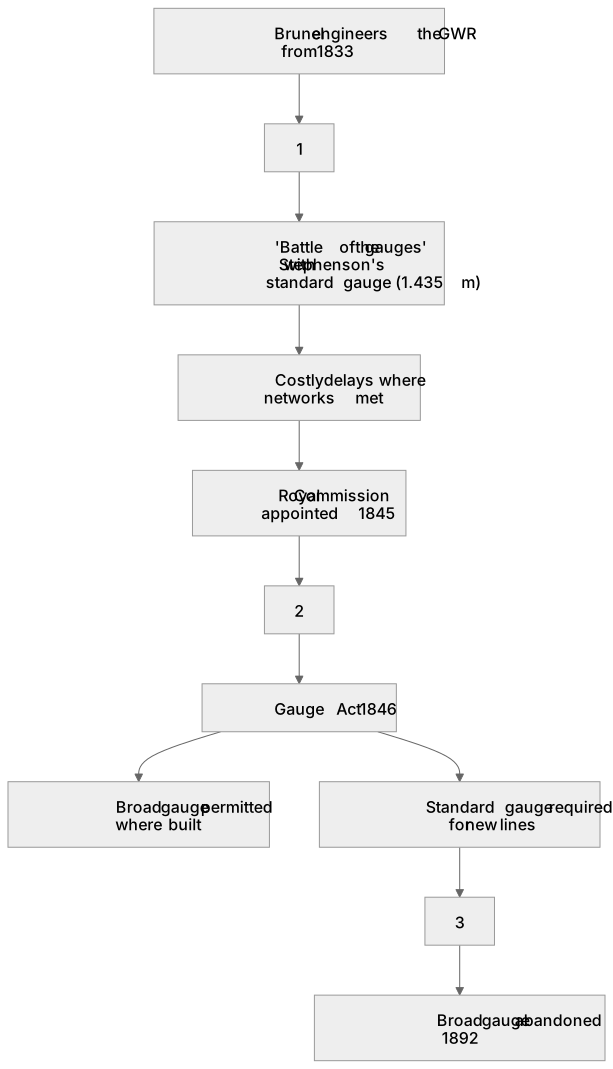
1Box 1
2Box 2
3Box 3
There is more to this lesson
The full lesson goes on to check your understanding and help you earn the marks. Create a free account to carry on, with your progress saved.
A week of Premium from your first lesson · Then the free plan continues · No card, no charge
Test your understanding of Paper 3, Option 34.1: Industrialisation and social change in Britain, 1759–1928: forging a new society - 3 Isambard Kingdom Brunel: railways and ships, 1833–59: The construction of the Great Western Railway: the role of Brunel; the reasons for the ‘battle of the gauges’; the Royal Commission 1845 and the Gauge Act 1846; reasons why Stephenson’s narrower gauge became the standard.
Active recall beats re-reading. Take an instant quiz now to test what you’ve learned and lock it into long-term memory.
A week of Premium from your first lesson · Then the free plan continues · No card, no charge