Pearson Edexcel · A-Level · History
Course version: 9HI0 · Version from Sept 2015
Industrialisation and social change in Britain, 1759–1928: forging a new…
Full specification wording
Paper 3, Option 34.1: Industrialisation and social change in Britain, 1759–1928: forging a new society - 5 Herbert Austin: creating and adapting to market forces, 1905–28: The Austin 7: reasons for its development and success; the impact on the Longbridge works.
The Austin 7, launched in 1922, was developed to meet demand for a small, affordable car.
Checked against the Pearson Edexcel 9HI0 specification (opens in a new tab) on .
- Point 2 of 3
- 4 key terms
Study notes
From the checked teaching notes for this specification point.
The idea
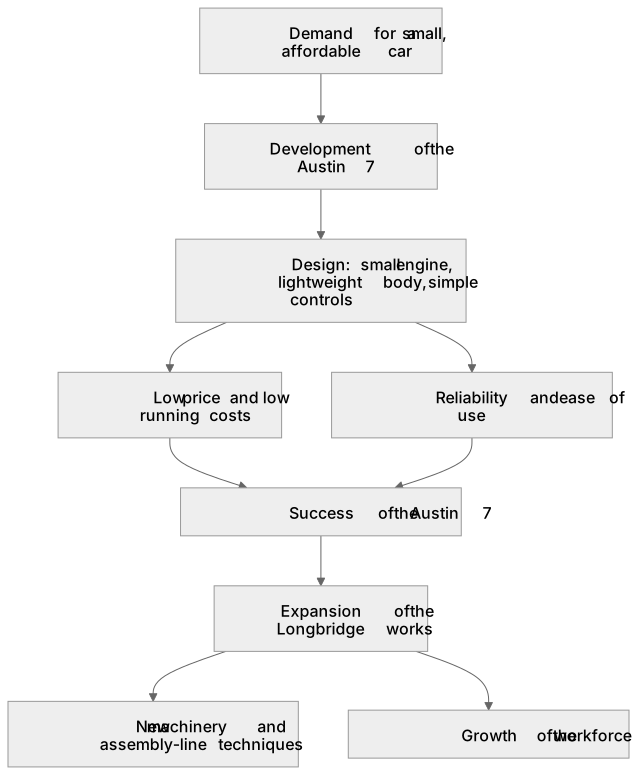
The Austin 7, launched in 1922, was developed to meet demand for a small, affordable car. Herbert Austin and a team including Stanley Edge designed it with a simple, lightweight structure and a small engine, making it cheap to run and buy. Its success stemmed from its low price, reliability, and ease of use, appealing to families and first-time buyers. This success transformed Longbridge: production expanded massively, new machinery and assembly-line techniques were introduced, and the workforce grew. The Austin 7 thus became a cornerstone of the company's fortunes, demonstrating how market forces drove innovation and industrial growth.
What earns the marks
- Reasons for development: post-First World War demand for affordable personal transport and Austin's desire to compete with motorcycles and cyclecars.
- Design features: the Austin 7 had a small four-cylinder engine, lightweight body, and simple controls, making it economical and easy to drive.
- Reasons for success: low purchase price, low running costs, reliability, and versatility (available in various body styles).
- Impact on Longbridge: mass production of the Austin 7 led to expansion of the works, increased employment, and adoption of more efficient production methods.
Common mistakes and how to put them right
Claiming the Austin 7 was the first car produced at Longbridge.
Put it right: Longbridge had produced cars since 1905, but the Austin 7 was a later, highly successful model.
Stating that the Austin 7 was designed solely by Herbert Austin.
Put it right: It was a team effort, with significant contributions from Stanley Edge.
Ignoring the impact on production methods.
Put it right: The Austin 7's success led to changes such as increased mechanisation and assembly-line techniques at Longbridge.
Exam tips
- Explain both the reasons for the Austin 7's development and why it succeeded, using specific details like price and design.
- Assess the impact on Longbridge by referring to expansion, employment, and production methods.
- Use the Austin 7 as an example of how market forces shaped industrial change.
Try the lesson
The start of the Paper 3, Option 34.1: Industrialisation and social change in Britain, 1759–1928: forging a new society - 5 Herbert Austin: creating and adapting to market forces, 1905–28: The Austin 7: reasons for its development and success; the impact on the Longbridge works. lesson, made from checked teaching notes for this specification point.
Have a go first
Which model, launched by Herbert Austin in the early 1920s, became the firm's most famous small car?
Listen
The Austin 7, launched in 1922, was developed to meet demand for a small, affordable car. Herbert Austin and a team including Stanley Edge designed it with a simple, lightweight structure and a small engine, making it cheap to run and buy. Its success stemmed from its low price, reliability, and ease of use, appealing to families and first-time buyers. This success transformed Longbridge: production expanded massively, new machinery and assembly-line techniques were introduced, and the workforce grew. The Austin 7 thus became a cornerstone of the company's fortunes, demonstrating how market forces drove innovation and industrial growth. A strong answer earns marks for these points. Reasons for development: post-First World War demand for affordable personal transport and Austin's desire to compete with motorcycles and cyclecars. Design features: the Austin 7 had a small four-cylinder engine, lightweight body, and simple controls, making it economical and easy to drive. Reasons for success: low purchase price, low running costs, reliability, and versatility (available in various body styles). Impact on Longbridge: mass production of the Austin 7 led to expansion of the works, increased employment, and adoption of more efficient production methods. A common slip: claiming the Austin 7 was the first car produced at Longbridge. Instead, Longbridge had produced cars since 1905, but the Austin 7 was a later, highly successful model. Exam tip: Explain both the reasons for the Austin 7's development and why it succeeded, using specific details like price and design.
See it
Key words
Say what each word means before you turn the card.
Innovation and design
Try answering aloud or in your head before turning the card.
Mass production and consumerism
Try answering aloud or in your head before turning the card.
Business strategy and market forces
Try answering aloud or in your head before turning the card.
Industrial growth and employment
Try answering aloud or in your head before turning the card.
See every definition
- Innovation and design
- A simple, lightweight structure and a small engine made the car cheap to run and buy.
- Mass production and consumerism
- Production expanded massively, with new machinery and assembly-line techniques introduced and the workforce growing.
- Business strategy and market forces
- The car was developed to meet demand for a small, affordable car and to compete with motorcycles and cyclecars.
- Industrial growth and employment
- Mass production of the Austin 7 led to expansion of the works and increased employment.
Label the diagram
Some boxes have lost their names. Pick the right name for each number.
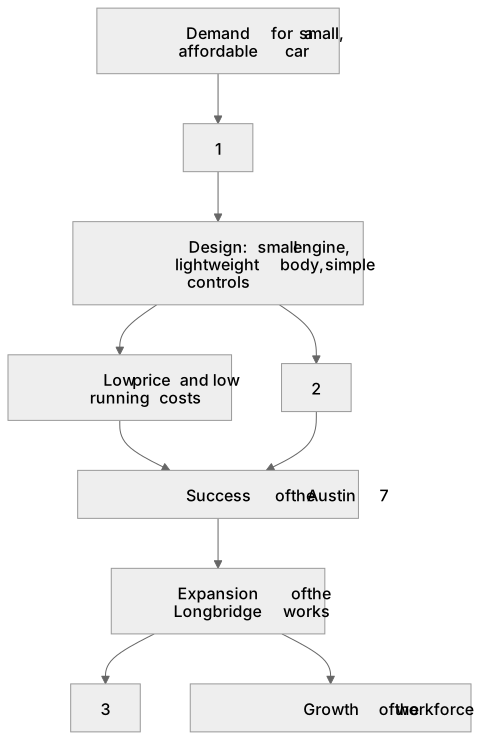
1Box 1
2Box 2
3Box 3
There is more to this lesson
The full lesson goes on to check your understanding and help you earn the marks. Create a free account to carry on, with your progress saved.
A week of Premium from your first lesson · Then the free plan continues · No card, no charge
Test your understanding of Paper 3, Option 34.1: Industrialisation and social change in Britain, 1759–1928: forging a new society - 5 Herbert Austin: creating and adapting to market forces, 1905–28: The Austin 7: reasons for its development and success; the impact on the Longbridge works.
Active recall beats re-reading. Take an instant quiz now to test what you’ve learned and lock it into long-term memory.
A week of Premium from your first lesson · Then the free plan continues · No card, no charge