Pearson Edexcel · A-Level · History
Course version: 9HI0 · Version from Sept 2015
Industrialisation and social change in Britain, 1759–1928: forging a new…
Full specification wording
Paper 3, Option 34.1: Industrialisation and social change in Britain, 1759–1928: forging a new society - 5 Herbert Austin: creating and adapting to market forces, 1905–28: The significance of the affordability and availability of the Austin 7 – social and economic effects of increased car ownership.
The Austin 7, launched in 1922, was cheap to buy and run, so it became available to a new mass market.
Checked against the Pearson Edexcel 9HI0 specification (opens in a new tab) on .
- Point 3 of 3
- 3 key terms
Study notes
From the checked teaching notes for this specification point.
The idea
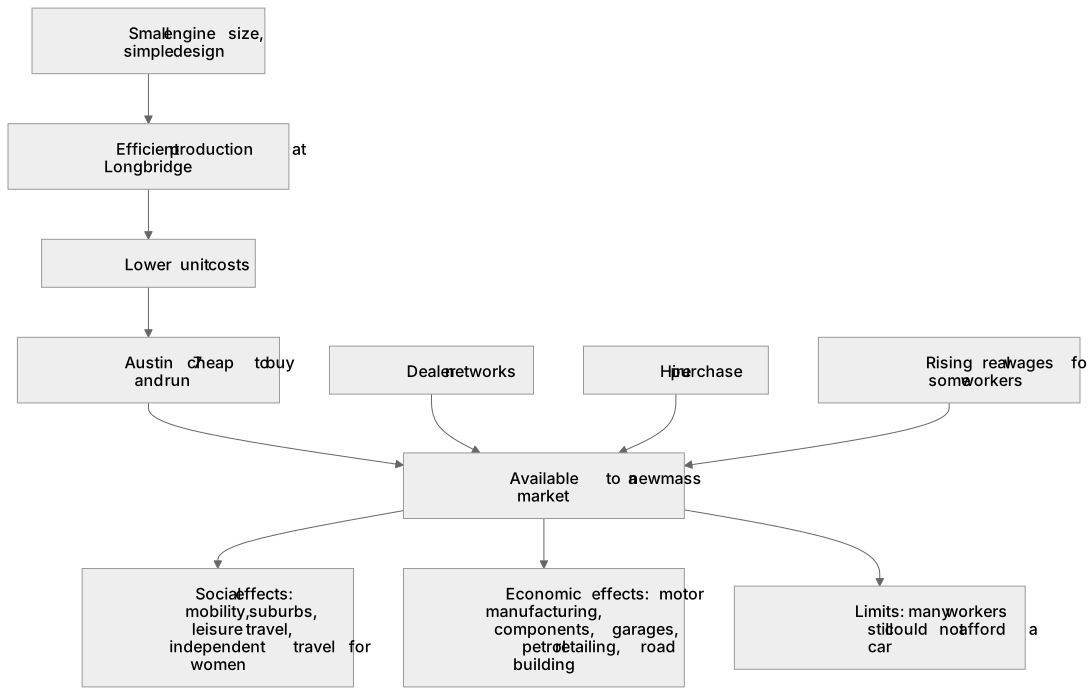
The Austin 7, launched in 1922, was cheap to buy and run, so it became available to a new mass market. Its affordability rested on small engine size, simple design and efficient production at Longbridge, which lowered unit costs. Availability grew through dealer networks, hire purchase and rising real wages for some workers. Socially, ownership widened mobility: families travelled for leisure, suburbs expanded and women gained independent travel. Economically, it stimulated motor manufacturing, component firms, garages, petrol retailing and road building, while threatening some older trades. Assess significance by weighing scale, pace and who benefited, noting that many workers still could not afford a car.
What earns the marks
- Explains how design and production methods made the Austin 7 affordable, for example small engines and efficient assembly reducing unit costs.
- Explains how availability widened through dealer networks, hire purchase and rising real wages for some groups.
- Analyses social effects such as greater mobility, suburban growth, leisure travel and independent travel for women.
- Analyses economic effects such as growth in motor manufacturing, components, garages, petrol retailing and road construction.
- Judges overall significance by weighing scale, pace of change and the limits of ownership among poorer workers.
Common mistakes and how to put them right
Treating the Austin 7 as instantly affordable for all.
Put it right by explaining that hire purchase and regional wage differences limited ownership.
Listing effects without linking them to affordability or availability.
Put it right by explaining the causal chain from cheap production to wider ownership to social and economic change.
Assuming car ownership only helped owners.
Put it right: Also considering workers in new motor trades and those displaced in older transport trades.
Exam tips
- Anchor each paragraph in a clear causal link between price, availability and a named social or economic effect.
- Use precise contemporary detail such as the 1922 launch, Longbridge production or hire purchase to support claims.
- Reserve time for a judgement that weighs the depth and breadth of change against continuity for poorer households.
Try the lesson
The start of the Paper 3, Option 34.1: Industrialisation and social change in Britain, 1759–1928: forging a new society - 5 Herbert Austin: creating and adapting to market forces, 1905–28: The significance of the affordability and availability of the Austin 7 – social and economic effects of increased car ownership. lesson, made from checked teaching notes for this specification point.
Have a go first
Which description best fits the Austin 7 when it was launched in 1922?
Listen
The Austin 7, launched in 1922, was cheap to buy and run, so it became available to a new mass market. Its affordability rested on small engine size, simple design and efficient production at Longbridge, which lowered unit costs. Availability grew through dealer networks, hire purchase and rising real wages for some workers. Socially, ownership widened mobility: families travelled for leisure, suburbs expanded and women gained independent travel. Economically, it stimulated motor manufacturing, component firms, garages, petrol retailing and road building, while threatening some older trades. Assess significance by weighing scale, pace and who benefited, noting that many workers still could not afford a car. A strong answer earns marks for these points. Explains how design and production methods made the Austin 7 affordable, for example small engines and efficient assembly reducing unit costs. Explains how availability widened through dealer networks, hire purchase and rising real wages for some groups. Analyses social effects such as greater mobility, suburban growth, leisure travel and independent travel for women. Analyses economic effects such as growth in motor manufacturing, components, garages, petrol retailing and road construction. A common slip: Treating the Austin 7 as instantly affordable for all. Instead, explaining that hire purchase and regional wage differences limited ownership. Exam tip: Anchor each paragraph in a clear causal link between price, availability and a named social or economic effect.
See it
Key words
Say what each word means before you turn the card.
Mass production and falling unit costs
Try answering aloud or in your head before turning the card.
Consumer credit and widening markets
Try answering aloud or in your head before turning the card.
Industrial growth and structural change
Try answering aloud or in your head before turning the card.
See every definition
- Mass production and falling unit costs
- Efficient production at Longbridge, with small engine size and simple design, lowered the cost of each car produced.
- Consumer credit and widening markets
- Hire purchase and dealer networks, together with rising real wages for some workers, made the car available to more buyers.
- Industrial growth and structural change
- Motor manufacturing, component firms, garages, petrol retailing and road building grew, while some older trades were threatened.
Label the diagram
Some boxes have lost their names. Pick the right name for each number.
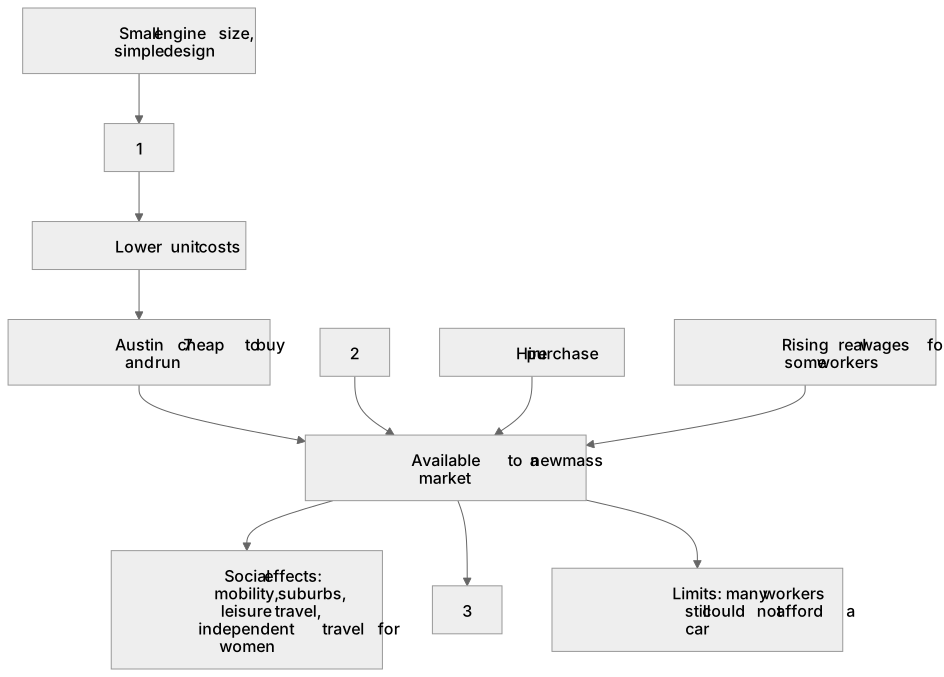
1Box 1
2Box 2
3Box 3
There is more to this lesson
The full lesson goes on to check your understanding and help you earn the marks. Create a free account to carry on, with your progress saved.
A week of Premium from your first lesson · Then the free plan continues · No card, no charge
Test your understanding of Paper 3, Option 34.1: Industrialisation and social change in Britain, 1759–1928: forging a new society - 5 Herbert Austin: creating and adapting to market forces, 1905–28: The significance of the affordability and availability of the Austin 7 – social and economic effects of increased car ownership.
Active recall beats re-reading. Take an instant quiz now to test what you’ve learned and lock it into long-term memory.
A week of Premium from your first lesson · Then the free plan continues · No card, no charge