Pearson Edexcel · A-Level · History
Course version: 9HI0 · Version from Sept 2015
Poverty, public health and the state in Britain, c1780–1939 - 1 Paupers…
Full specification wording
Paper 3, Option 34.2: Poverty, public health and the state in Britain, c1780–1939 - 1 Paupers and pauperism, 1780–1832: Indoor relief in poorhouses, workhouses and houses of correction; the impact of Gilbert’s Act 1782 and the Sturges-Bourne Acts 1818 and 1819.
Indoor relief meant housing paupers in institutions rather than paying outdoor doles.
Checked against the Pearson Edexcel 9HI0 specification (opens in a new tab) on .
- Point 2 of 3
- 4 key terms
Study notes
From the checked teaching notes for this specification point.
The idea
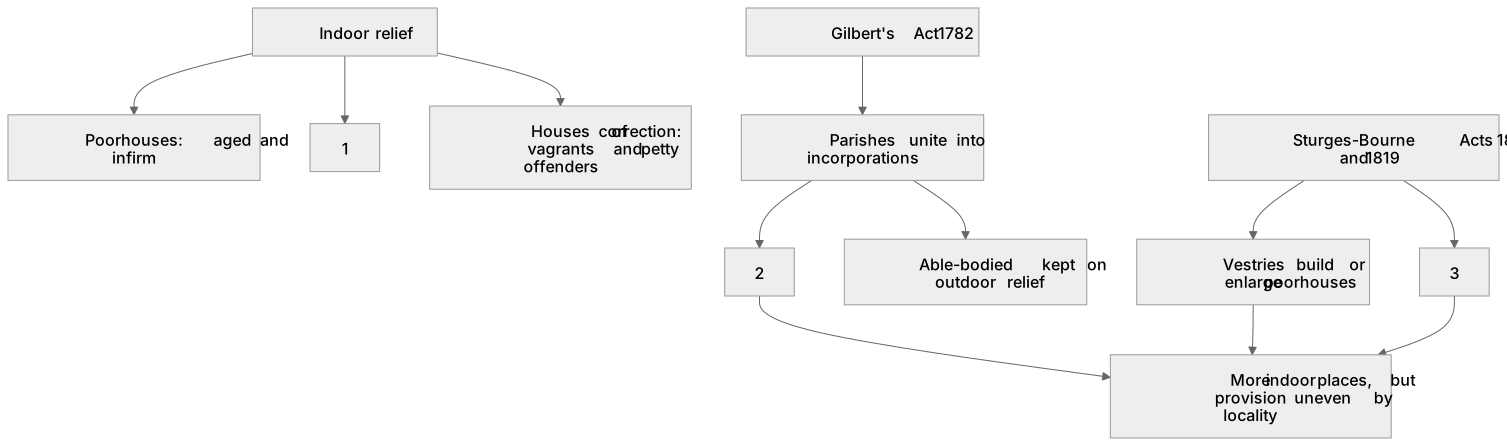
Indoor relief meant housing paupers in institutions rather than paying outdoor doles. Poorhouses sheltered the aged and infirm; workhouses set the able-bodied to labour; houses of correction punished vagrants and petty offenders. Gilbert’s Act 1782 let parishes unite into incorporations, build poorhouses for the old, sick and orphaned, and keep the able-bodied on outdoor relief. The Sturges-Bourne Acts 1818 and 1819 allowed vestries to build or enlarge poorhouses and to borrow against parish poor rates, spreading institutional relief. Together they expanded capacity but varied by locality, so provision stayed uneven.
What earns the marks
- Explains the three institutional types: poorhouses for the aged and infirm, workhouses for the able-bodied poor, houses of correction for vagrants and petty offenders.
- Shows Gilbert’s Act 1782 permitted parish unions and poorhouses for the aged, sick and orphaned while excluding the able-bodied from indoor relief.
- Explains that the Sturges-Bourne Acts 1818 and 1819 empowered vestries to build or enlarge poorhouses and to borrow against parish poor rates.
- Assesses impact: more indoor places and greater uniformity in some regions, but local variation and continued outdoor relief limited change.
- Links indoor relief to contemporary debates about cost, deterrence and the deserving versus undeserving poor.
Common mistakes and how to put them right
Treating poorhouse, workhouse and house of correction as identical.
Put it right by distinguishing their intended inmates and regimes.
Claiming Gilbert’s Act compelled all parishes to build workhouses.
Put it right by noting it was permissive, applied to united parishes, and provided poorhouses for the non-able-bodied.
Assuming the Sturges-Bourne Acts allowed borrowing against county rates.
Put it right by explaining they enabled borrowing on the security of parish poor rates.
Exam tips
- Anchor each institution with one named example of its inmate group to show precise knowledge.
- Use the dates 1782, 1818 and 1819 to structure a paragraph on change over time.
Try the lesson
The start of the Paper 3, Option 34.2: Poverty, public health and the state in Britain, c1780–1939 - 1 Paupers and pauperism, 1780–1832: Indoor relief in poorhouses, workhouses and houses of correction; the impact of Gilbert’s Act 1782 and the Sturges-Bourne Acts 1818 and 1819. lesson, made from checked teaching notes for this specification point.
Have a go first
Under Gilbert's Act 1782, which group of paupers was to be provided for in a poorhouse rather than given outdoor relief?
Listen
Indoor relief meant housing paupers in institutions rather than paying outdoor doles. Poorhouses sheltered the aged and infirm; workhouses set the able-bodied to labour; houses of correction punished vagrants and petty offenders. Gilbert’s Act 1782 let parishes unite into incorporations, build poorhouses for the old, sick and orphaned, and keep the able-bodied on outdoor relief. The Sturges-Bourne Acts 1818 and 1819 allowed vestries to build or enlarge poorhouses and to borrow against parish poor rates, spreading institutional relief. Together they expanded capacity but varied by locality, so provision stayed uneven. A strong answer earns marks for these points. Explains the three institutional types: poorhouses for the aged and infirm, workhouses for the able-bodied poor, houses of correction for vagrants and petty offenders. Shows Gilbert’s Act 1782 permitted parish unions and poorhouses for the aged, sick and orphaned while excluding the able-bodied from indoor relief. Explains that the Sturges-Bourne Acts 1818 and 1819 empowered vestries to build or enlarge poorhouses and to borrow against parish poor rates. Assesses impact: more indoor places and greater uniformity in some regions, but local variation and continued outdoor relief limited change. A common slip: Treating poorhouse, workhouse and house of correction as identical. Instead, distinguishing their intended inmates and regimes. Exam tip: Anchor each institution with one named example of its inmate group to show precise knowledge.
See it
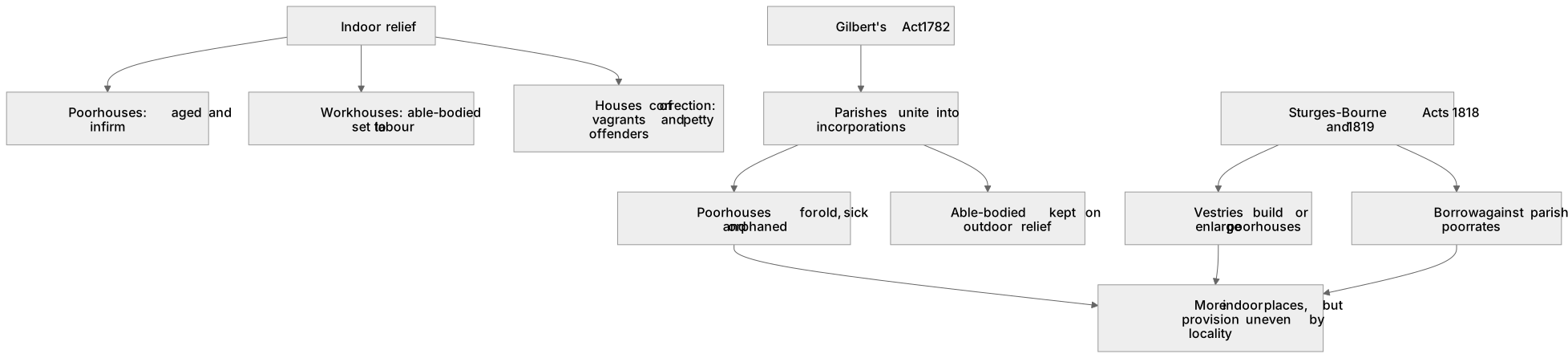
Key words
Say what each word means before you turn the card.
Indoor relief
Try answering aloud or in your head before turning the card.
Poorhouses
Try answering aloud or in your head before turning the card.
Workhouses
Try answering aloud or in your head before turning the card.
Houses of correction
Try answering aloud or in your head before turning the card.
See every definition
- Indoor relief
- Housing paupers in institutions rather than paying outdoor doles.
- Poorhouses
- Institutions that sheltered the aged and infirm.
- Workhouses
- Institutions that set the able-bodied to labour.
- Houses of correction
- Institutions that punished vagrants and petty offenders.
Label the diagram
Some boxes have lost their names. Pick the right name for each number.
1Box 1
2Box 2
3Box 3
There is more to this lesson
The full lesson goes on to check your understanding and help you earn the marks. Create a free account to carry on, with your progress saved.
A week of Premium from your first lesson · Then the free plan continues · No card, no charge
Test your understanding of Paper 3, Option 34.2: Poverty, public health and the state in Britain, c1780–1939 - 1 Paupers and pauperism, 1780–1832: Indoor relief in poorhouses, workhouses and houses of correction; the impact of Gilbert’s Act 1782 and the Sturges-Bourne Acts 1818 and 1819.
Active recall beats re-reading. Take an instant quiz now to test what you’ve learned and lock it into long-term memory.
A week of Premium from your first lesson · Then the free plan continues · No card, no charge