Pearson Edexcel · A-Level · History
Course version: 9HI0 · Version from Sept 2015
Poverty, public health and the state in Britain, c1780–1939 - 1 Paupers…
Full specification wording
Paper 3, Option 34.2: Poverty, public health and the state in Britain, c1780–1939 - 1 Paupers and pauperism, 1780–1832: The organisation of the parish-based relief system; the problem of the ‘able-bodied pauper’; outdoor relief systems – Speenhamland, Roundsman and the Labour Rate.
This topic examines how poor relief was organised before 1834.
Checked against the Pearson Edexcel 9HI0 specification (opens in a new tab) on .
- Point 1 of 3
Study notes
From the checked teaching notes for this specification point.
The idea
This topic examines how poor relief was organised before 1834. Each parish administered relief, often through overseers of the poor and vestries, funded by a poor rate on property. The 'able-bodied pauper' posed a problem: giving relief to those who could work might discourage effort, yet denying it risked starvation and unrest. Outdoor relief, given outside a workhouse, included three systems. Speenhamland (from 1795) topped up wages based on bread prices and family size. The Roundsman system sent paupers to work for local farmers in turn, with wages subsidised from the poor rate. The Labour Rate set a parish-wide wage or provided work funded by a rate, aiming to reduce relief costs. These systems were criticised for encouraging dependency and lowering wages, leading to the 1834 Poor Law Amendment Act.
What earns the marks
- Describes the parish-based relief system, including the role of overseers, vestries, and the poor rate in funding relief.
- Explains why the 'able-bodied pauper' was seen as a problem, linking relief to concerns about idleness, wage levels, and rising poor rates.
- Outlines the Speenhamland system, including its wage top-up based on bread prices and family size, and its intended effect.
- Explains the Roundsman system, where paupers were sent to work for farmers in turn, with wages subsidised by the parish.
- Describes the Labour Rate, where a parish set a wage or provided work funded by a rate, and assesses its impact on relief costs and employment.
- Evaluates the strengths and weaknesses of outdoor relief systems and their contribution to the 1834 Poor Law Amendment Act.
Common mistakes and how to put them right
Confusing Speenhamland with the Roundsman system.
Put it right: Speenhamland topped up wages based on bread prices, while the Roundsman system rotated paupers among employers with subsidised wages.
Assuming all relief was outdoor.
Put it right: Indoor relief in workhouses also existed, and the balance varied by parish and period.
Believing the Labour Rate guaranteed higher wages for all.
Put it right: It often set a minimum wage or provided work, but could reduce overall employment and was not universally applied.
Exam tips
- Use precise terms: 'overseers of the poor', 'vestry', 'poor rate', 'outdoor relief', 'Speenhamland', 'Roundsman', 'Labour Rate'.
- When discussing the able-bodied pauper, link to contemporary debates about deserving and undeserving poor, and to rising poor rates.
- Compare the three outdoor relief systems in a table to clarify their mechanisms and effects before writing an essay.
Try the lesson
The start of the Paper 3, Option 34.2: Poverty, public health and the state in Britain, c1780–1939 - 1 Paupers and pauperism, 1780–1832: The organisation of the parish-based relief system; the problem of the ‘able-bodied pauper’; outdoor relief systems – Speenhamland, Roundsman and the Labour Rate. lesson, made from checked teaching notes for this specification point.
Have a go first
Under the parish-based relief system before 1834, which body was mainly responsible for providing relief to the poor?
Listen
This topic examines how poor relief was organised before 1834. Each parish administered relief, often through overseers of the poor and vestries, funded by a poor rate on property. The 'able-bodied pauper' posed a problem: giving relief to those who could work might discourage effort, yet denying it risked starvation and unrest. Outdoor relief, given outside a workhouse, included three systems. Speenhamland (from 1795) topped up wages based on bread prices and family size. The Roundsman system sent paupers to work for local farmers in turn, with wages subsidised from the poor rate. The Labour Rate set a parish-wide wage or provided work funded by a rate, aiming to reduce relief costs. These systems were criticised for encouraging dependency and lowering wages, leading to the 1834 Poor Law Amendment Act. A strong answer earns marks for these points. Describes the parish-based relief system, including the role of overseers, vestries, and the poor rate in funding relief. Explains why the 'able-bodied pauper' was seen as a problem, linking relief to concerns about idleness, wage levels, and rising poor rates. Outlines the Speenhamland system, including its wage top-up based on bread prices and family size, and its intended effect. Explains the Roundsman system, where paupers were sent to work for farmers in turn, with wages subsidised by the parish. A common slip: Confusing Speenhamland with the Roundsman system. Instead, Speenhamland topped up wages based on bread prices, while the Roundsman system rotated paupers among employers with subsidised wages. Exam tip: Use precise terms: 'overseers of the poor', 'vestry', 'poor rate', 'outdoor relief', 'Speenhamland', 'Roundsman', 'Labour Rate'.
See it
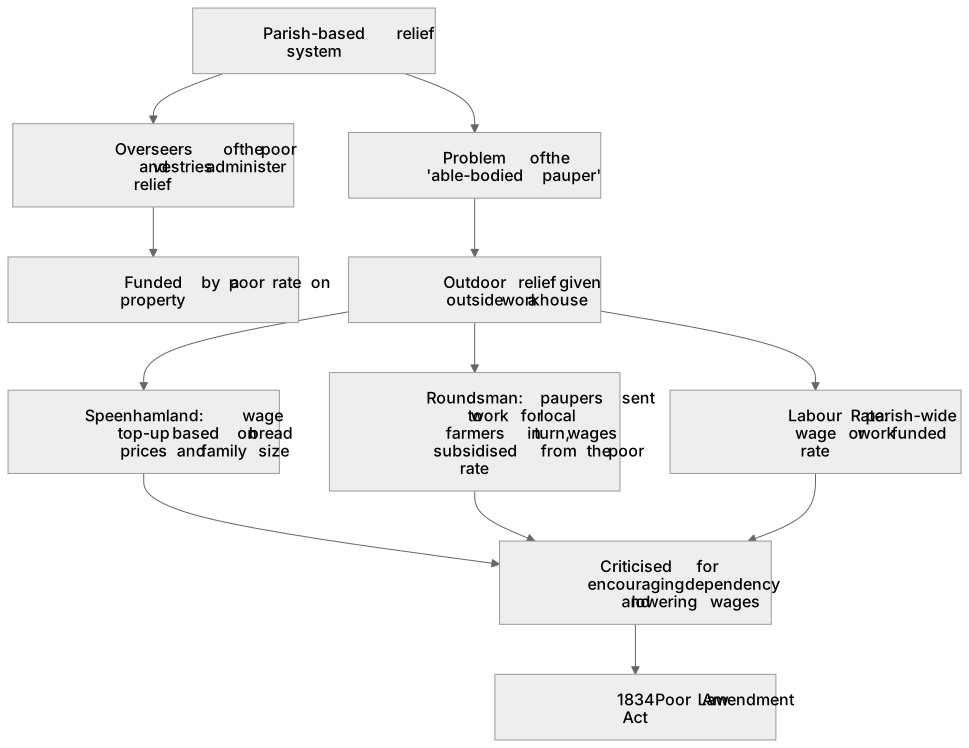
Label the diagram
Some boxes have lost their names. Pick the right name for each number.
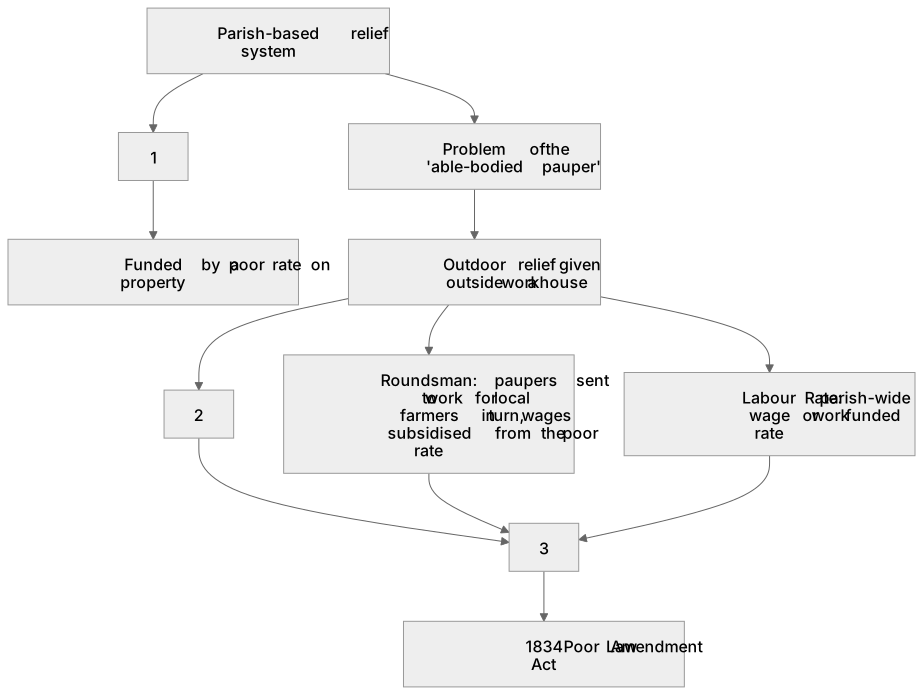
1Box 1
2Box 2
3Box 3
There is more to this lesson
The full lesson goes on to check your understanding and help you earn the marks. Create a free account to carry on, with your progress saved.
A week of Premium from your first lesson · Then the free plan continues · No card, no charge
Test your understanding of Paper 3, Option 34.2: Poverty, public health and the state in Britain, c1780–1939 - 1 Paupers and pauperism, 1780–1832: The organisation of the parish-based relief system; the problem of the ‘able-bodied pauper’; outdoor relief systems – Speenhamland, Roundsman and the Labour Rate.
Active recall beats re-reading. Take an instant quiz now to test what you’ve learned and lock it into long-term memory.
A week of Premium from your first lesson · Then the free plan continues · No card, no charge