Pearson Edexcel · A-Level · History
Course version: 9HI0 · Version from Sept 2015
Poverty, public health and the state in Britain, c1780–1939 - 3 The…
Full specification wording
Paper 3, Option 34.2: Poverty, public health and the state in Britain, c1780–1939 - 3 The government, self-help and charity, 1847–80: Changing government control: significance of the Andover workhouse scandal; the Poor Law Board; the impact of the Parliamentary Reform Act 1867 on poor law policy; the Local Government Board.
Between 1847 and 1880 changing government control over poor relief was evident.
Checked against the Pearson Edexcel 9HI0 specification (opens in a new tab) on .
- Point 1 of 3
- 4 key terms
Study notes
From the checked teaching notes for this specification point.
The idea
Between 1847 and 1880 changing government control over poor relief was evident. The Andover workhouse scandal of 1845–46, where inmates gnawed bones for food, discredited the Poor Law Commission. In 1847 the Poor Law Board took over, a central authority with a president answerable to Parliament. The impact of the Parliamentary Reform Act 1867 on poor law policy was significant: working-class enfranchisement prompted central government fears of generous local relief, leading to top-down enforcement of strictness. In 1871 the Local Government Board was created, absorbing the Poor Law Board and centralising poor law, public health and local government business under one body. Together these changes show growing but contested state control.
What earns the marks
- Explains the significance of the Andover workhouse scandal in exposing cruelty and maladministration and in discrediting the Poor Law Commission.
- Explains the creation and role of the Poor Law Board in 1847 as a central supervisory authority with a parliamentary president.
- Analyses the impact of the Parliamentary Reform Act 1867 on poor law policy, explaining how working-class enfranchisement led to central government enforcing stricter relief.
- Explains the establishment of the Local Government Board in 1871 and its absorption of poor law and public health functions.
- Assesses the extent to which these changes increased central government control over local poor relief.
- Links institutional change to shifts in policy, such as pressure for stricter relief and greater uniformity.
Common mistakes and how to put them right
Confusing the Poor Law Commission with the Poor Law Board.
Put it right: State that the Commission was replaced in 1847 by the Board, which had a president in Parliament.
Dating the Local Government Board to 1847.
Put it right: Place its creation in 1871, when it absorbed the Poor Law Board.
Assuming the 1867 Reform Act led local guardians to voluntarily adopt stricter policies.
Put it right: Working-class enfranchisement caused central government to fear generous local relief, prompting top-down enforcement of strictness.
Exam tips
- Organise the answer around each named development and its effect on changing government control.
- Use precise dates and institutional names to show secure knowledge.
- Judge change over time by comparing the supervisory role of the Poor Law Board with the broader remit of the Local Government Board.
Try the lesson
The start of the Paper 3, Option 34.2: Poverty, public health and the state in Britain, c1780–1939 - 3 The government, self-help and charity, 1847–80: Changing government control: significance of the Andover workhouse scandal; the Poor Law Board; the impact of the Parliamentary Reform Act 1867 on poor law policy; the Local Government Board. lesson, made from checked teaching notes for this specification point.
Have a go first
Which body replaced the Poor Law Commission in 1847 to oversee the administration of the new Poor Law?
Listen
Between 1847 and 1880 changing government control over poor relief was evident. The Andover workhouse scandal of 1845–46, where inmates gnawed bones for food, discredited the Poor Law Commission. In 1847 the Poor Law Board took over, a central authority with a president answerable to Parliament. The impact of the Parliamentary Reform Act 1867 on poor law policy was significant: working-class enfranchisement prompted central government fears of generous local relief, leading to top-down enforcement of strictness. In 1871 the Local Government Board was created, absorbing the Poor Law Board and centralising poor law, public health and local government business under one body. Together these changes show growing but contested state control. A strong answer earns marks for these points. Explains the significance of the Andover workhouse scandal in exposing cruelty and maladministration and in discrediting the Poor Law Commission. Explains the creation and role of the Poor Law Board in 1847 as a central supervisory authority with a parliamentary president. Analyses the impact of the Parliamentary Reform Act 1867 on poor law policy, explaining how working-class enfranchisement led to central government enforcing stricter relief. Explains the establishment of the Local Government Board in 1871 and its absorption of poor law and public health functions. A common slip: Confusing the Poor Law Commission with the Poor Law Board. Instead, state that the Commission was replaced in 1847 by the Board, which had a president in Parliament. Exam tip: Organise the answer around each named development and its effect on changing government control.
See it
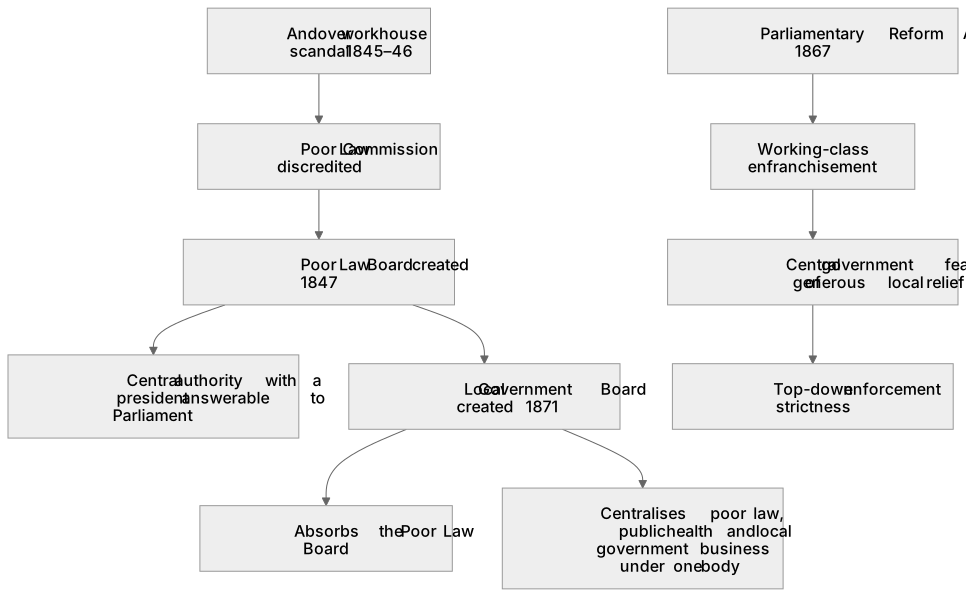
Put the events in order
Put these events in the order they happened, earliest first.
- 1. Local Government Board created, absorbing the Poor Law Board
- 2. Andover workhouse scandal discredited the Poor Law Commission
- 3. Parliamentary Reform Act prompted top-down enforcement of strictness
- 4. Poor Law Board took over as central authority
Key words
Say what each word means before you turn the card.
Andover workhouse scandal
Try answering aloud or in your head before turning the card.
Poor Law Board
Try answering aloud or in your head before turning the card.
Parliamentary Reform Act 1867
Try answering aloud or in your head before turning the card.
Local Government Board
Try answering aloud or in your head before turning the card.
See every definition
- Andover workhouse scandal
- A scandal of 1845–46, where inmates gnawed bones for food, that exposed cruelty and maladministration and discredited the Poor Law Commission.
- Poor Law Board
- A central authority created in 1847 with a president answerable to Parliament, which took over from the Poor Law Commission.
- Parliamentary Reform Act 1867
- Working-class enfranchisement that prompted central government fears of generous local relief, leading to top-down enforcement of strictness.
- Local Government Board
- A body created in 1871 that absorbed the Poor Law Board and centralised poor law, public health and local government business under one body.
Label the diagram
Some boxes have lost their names. Pick the right name for each number.
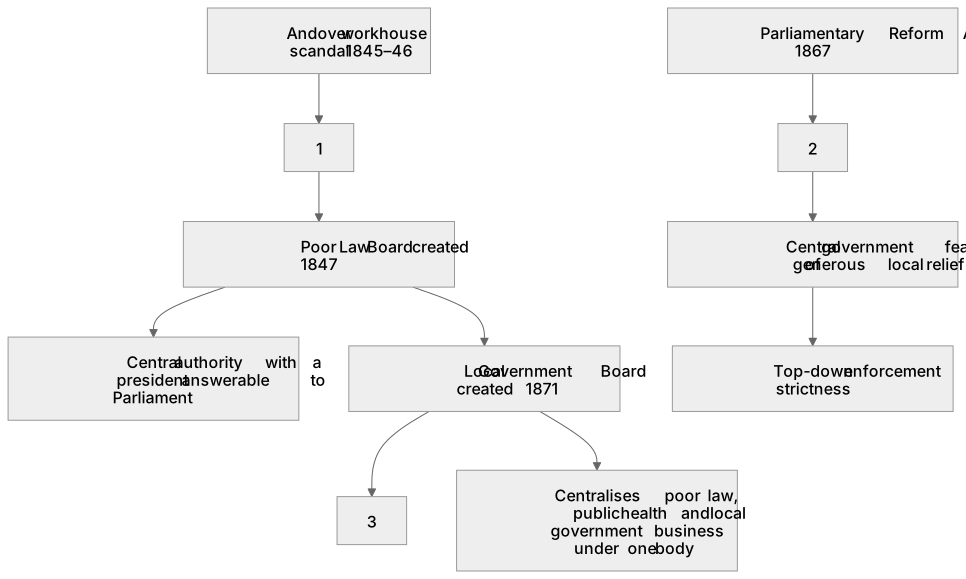
1Box 1
2Box 2
3Box 3
There is more to this lesson
The full lesson goes on to check your understanding and help you earn the marks. Create a free account to carry on, with your progress saved.
A week of Premium from your first lesson · Then the free plan continues · No card, no charge
Test your understanding of Paper 3, Option 34.2: Poverty, public health and the state in Britain, c1780–1939 - 3 The government, self-help and charity, 1847–80: Changing government control: significance of the Andover workhouse scandal; the Poor Law Board; the impact of the Parliamentary Reform Act 1867 on poor law policy; the Local Government Board.
Active recall beats re-reading. Take an instant quiz now to test what you’ve learned and lock it into long-term memory.
A week of Premium from your first lesson · Then the free plan continues · No card, no charge