Pearson Edexcel · A-Level · History
Course version: 9HI0 · Version from Sept 2015
Poverty, public health and the state in Britain, c1780–1939 - 3 The…
Full specification wording
Paper 3, Option 34.2: Poverty, public health and the state in Britain, c1780–1939 - 3 The government, self-help and charity, 1847–80: The importance of charity and self-help in dealing with poverty: the Charity Organisation Society, Friendly Societies, trade unions and cooperatives.
During the mid-nineteenth century, state provision for poverty was minimal, making charity and self-help crucial.
Checked against the Pearson Edexcel 9HI0 specification (opens in a new tab) on .
- Point 2 of 3
Study notes
From the checked teaching notes for this specification point.
The idea
During the mid-nineteenth century, state provision for poverty was minimal, making charity and self-help crucial. The Charity Organisation Society (COS), founded in 1869, aimed to distinguish between the 'deserving' and 'undeserving' poor, ensuring aid only went to those who would use it to become self-sufficient. Working-class self-help took several forms. Friendly Societies provided insurance against sickness and death in exchange for weekly subscriptions. Trade unions offered financial support to members during strikes or unemployment. Meanwhile, cooperatives, like the Rochdale Pioneers, allowed workers to buy affordable, unadulterated food and share in the profits, fostering economic independence and mutual support.
What earns the marks
- Evaluate the role of the Charity Organisation Society in systematising philanthropy and reinforcing the concept of the 'deserving' poor.
- Assess the financial security provided by Friendly Societies through mutual insurance against illness and funeral costs.
- Analyse how trade unions functioned as self-help organisations by providing out-of-work benefits and strike pay to skilled workers.
- Explain the economic impact of the cooperative movement in providing affordable goods and a dividend to working-class members.
Common mistakes and how to put them right
Confusing the roles of different self-help groups.
Put it right: Friendly Societies focused on insurance, while cooperatives focused on affordable retail and profit-sharing.
Assuming the COS provided unconditional aid.
Put it right: The COS strictly investigated applicants to ensure only the 'deserving' poor received help.
Overstating the reach of self-help.
Put it right: Acknowledge that trade unions and Friendly Societies primarily benefited the skilled working class who could afford regular subscriptions, leaving the poorest unsupported.
Exam tips
- Compare the effectiveness of middle-class philanthropy (like the COS) with working-class mutual aid (like cooperatives) in alleviating poverty.
- Use the Rochdale Pioneers as a specific example when discussing the success and principles of the cooperative movement.
- Discuss the limitations of self-help by highlighting how the requirement for regular financial contributions excluded the most destitute.
Try the lesson
The start of the Paper 3, Option 34.2: Poverty, public health and the state in Britain, c1780–1939 - 3 The government, self-help and charity, 1847–80: The importance of charity and self-help in dealing with poverty: the Charity Organisation Society, Friendly Societies, trade unions and cooperatives. lesson, made from checked teaching notes for this specification point.
Have a go first
Which organisation, founded in London in 1869, aimed to coordinate charitable relief and to distinguish between the 'deserving' and 'undeserving' poor?
Listen
During the mid-nineteenth century, state provision for poverty was minimal, making charity and self-help crucial. The Charity Organisation Society (COS), founded in 1869, aimed to distinguish between the 'deserving' and 'undeserving' poor, ensuring aid only went to those who would use it to become self-sufficient. Working-class self-help took several forms. Friendly Societies provided insurance against sickness and death in exchange for weekly subscriptions. Trade unions offered financial support to members during strikes or unemployment. Meanwhile, cooperatives, like the Rochdale Pioneers, allowed workers to buy affordable, unadulterated food and share in the profits, fostering economic independence and mutual support. A strong answer earns marks for these points. Evaluate the role of the Charity Organisation Society in systematising philanthropy and reinforcing the concept of the 'deserving' poor. Assess the financial security provided by Friendly Societies through mutual insurance against illness and funeral costs. Analyse how trade unions functioned as self-help organisations by providing out-of-work benefits and strike pay to skilled workers. Explain the economic impact of the cooperative movement in providing affordable goods and a dividend to working-class members. A common slip: Confusing the roles of different self-help groups. Instead, Friendly Societies focused on insurance, while cooperatives focused on affordable retail and profit-sharing. Exam tip: Compare the effectiveness of middle-class philanthropy (like the COS) with working-class mutual aid (like cooperatives) in alleviating poverty.
See it
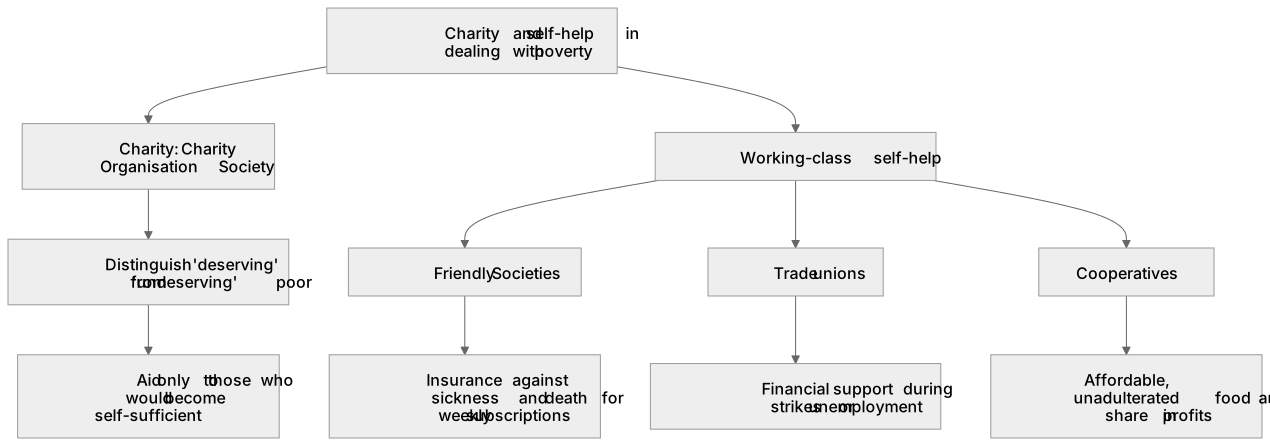
Label the diagram
Some boxes have lost their names. Pick the right name for each number.
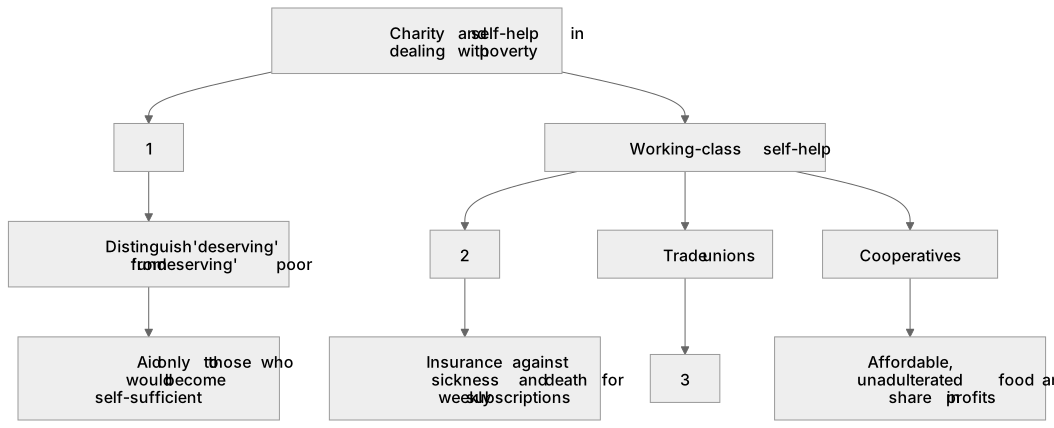
1Box 1
2Box 2
3Box 3
There is more to this lesson
The full lesson goes on to check your understanding and help you earn the marks. Create a free account to carry on, with your progress saved.
A week of Premium from your first lesson · Then the free plan continues · No card, no charge
Test your understanding of Paper 3, Option 34.2: Poverty, public health and the state in Britain, c1780–1939 - 3 The government, self-help and charity, 1847–80: The importance of charity and self-help in dealing with poverty: the Charity Organisation Society, Friendly Societies, trade unions and cooperatives.
Active recall beats re-reading. Take an instant quiz now to test what you’ve learned and lock it into long-term memory.
A week of Premium from your first lesson · Then the free plan continues · No card, no charge