Pearson Edexcel · A-Level · History
Course version: 9HI0 · Version from Sept 2015
Poverty, public health and the state in Britain, c1780–1939 - 4 Social and…
Full specification wording
Paper 3, Option 34.2: Poverty, public health and the state in Britain, c1780–1939 - 4 Social and welfare reforms: pressure and action, 1880–1914: The impact of the Liberal government’s reforms: old age pensions and National Insurance; the Trade Boards Act 1909 and the Labour Exchanges Act 1909.
The Liberal reforms of 1906–1914 marked a shift from laissez-faire to state intervention.
Checked against the Pearson Edexcel 9HI0 specification (opens in a new tab) on .
- Point 3 of 3
- 4 key terms
Study notes
From the checked teaching notes for this specification point.
The idea
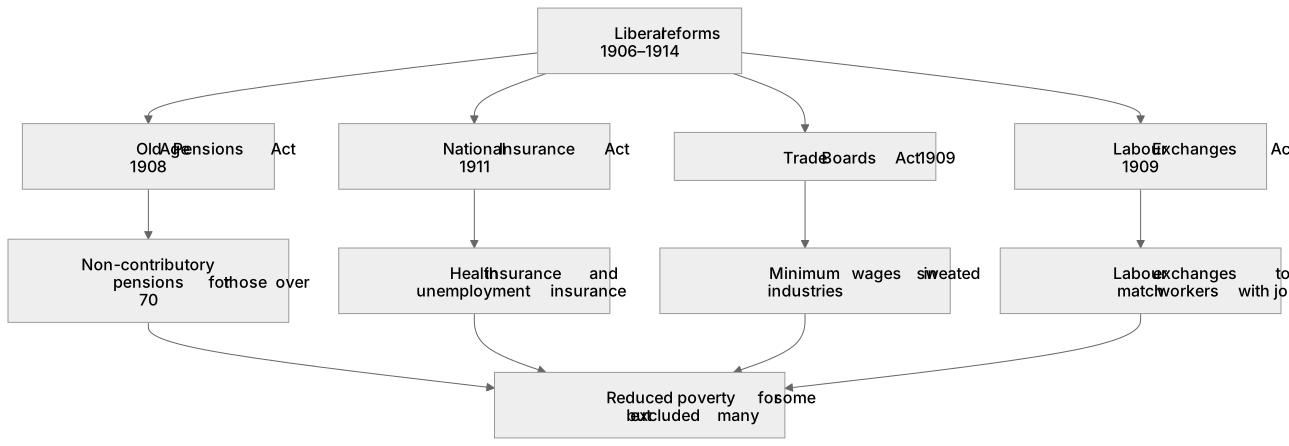
The Liberal reforms of 1906–1914 marked a shift from laissez-faire to state intervention. The Old Age Pensions Act 1908 provided non-contributory pensions of 5s per week for those over 70 with incomes under £21 per year, rising to 10s for couples, but excluded those who had received poor relief. National Insurance Act 1911 introduced health insurance (sick pay, maternity benefit, free medical treatment) for workers earning under £160 per year, and unemployment insurance for trades like building and shipbuilding. The Trade Boards Act 1909 set minimum wages in sweated industries such as chain-making and tailoring. The Labour Exchanges Act 1909 created labour exchanges to match workers with jobs. These reforms had mixed impact: they reduced poverty for some but excluded many, and were not universal.
What earns the marks
- Old Age Pensions Act 1908: non-contributory, 5s per week for single person over 70, 10s for married couple, income limit £21 per year, excluded those who had received poor relief.
- Trade Boards Act 1909: established minimum wages in sweated industries such as chain-making, tailoring, and lace-making, with boards to enforce rates.
- Labour Exchanges Act 1909: set up labour exchanges to help unemployed workers find jobs, improving labour mobility but criticised for not creating jobs.
- Impact: reforms reduced poverty for some but excluded many (e.g., women, casual workers), and did not solve poverty; they marked a shift in state responsibility.
Common mistakes and how to put them right
Stating that old age pensions were contributory.
Put it right: They were non-contributory, funded by taxation.
Claiming National Insurance covered all workers.
Put it right: It covered only those earning under £160 per year and certain trades for unemployment.
Confusing the Trade Boards Act with the Labour Exchanges Act.
Put it right: Trade Boards set minimum wages; Labour Exchanges helped find work.
Exam tips
- Use specific figures (5s, £21, £160) to show precise knowledge.
- Link each reform to its impact on poverty, noting limitations.
- Compare the reforms to earlier Poor Law provision to highlight change.
Try the lesson
The start of the Paper 3, Option 34.2: Poverty, public health and the state in Britain, c1780–1939 - 4 Social and welfare reforms: pressure and action, 1880–1914: The impact of the Liberal government’s reforms: old age pensions and National Insurance; the Trade Boards Act 1909 and the Labour Exchanges Act 1909. lesson, made from checked teaching notes for this specification point.
Have a go first
Under the Old Age Pensions Act of 1908, from what age could a person in Britain first receive a state pension?
Listen
The Liberal reforms of 1906–1914 marked a shift from laissez-faire to state intervention. The Old Age Pensions Act 1908 provided non-contributory pensions of 5s per week for those over 70 with incomes under £21 per year, rising to 10s for couples, but excluded those who had received poor relief. National Insurance Act 1911 introduced health insurance (sick pay, maternity benefit, free medical treatment) for workers earning under £160 per year, and unemployment insurance for trades like building and shipbuilding. The Trade Boards Act 1909 set minimum wages in sweated industries such as chain-making and tailoring. The Labour Exchanges Act 1909 created labour exchanges to match workers with jobs. These reforms had mixed impact: they reduced poverty for some but excluded many, and were not universal. A strong answer earns marks for these points. Old Age Pensions Act 1908: non-contributory, 5s per week for single person over 70, 10s for married couple, income limit £21 per year, excluded those who had received poor relief. National Insurance Act 1911: contributory health insurance for workers earning under £160 per year, providing sick pay, maternity benefit, and medical treatment; unemployment insurance for cyclical trades like building and shipbuilding. Trade Boards Act 1909: established minimum wages in sweated industries such as chain-making, tailoring, and lace-making, with boards to enforce rates. Labour Exchanges Act 1909: set up labour exchanges to help unemployed workers find jobs, improving labour mobility but criticised for not creating jobs. A common slip: stating that old age pensions were contributory. Instead, they were non-contributory, funded by taxation. Exam tip: Use specific figures (5s, £21, £160) to show precise knowledge.
See it
Put the events in order
Put these events in the order they happened, earliest first.
- 1. Old Age Pensions Act provided non-contributory pensions
- 2. National Insurance Act introduced health and unemployment insurance
- 3. Trade Boards Act set minimum wages in sweated industries
Key words
Say what each word means before you turn the card.
State intervention vs. laissez-faire
Try answering aloud or in your head before turning the card.
Poverty and social welfare
Try answering aloud or in your head before turning the card.
The role of government in providing security
Try answering aloud or in your head before turning the card.
Impact on different groups (workers, elderly, women)
Try answering aloud or in your head before turning the card.
See every definition
- State intervention vs. laissez-faire
- The Liberal reforms of 1906–1914 marked a shift from laissez-faire to state intervention.
- Poverty and social welfare
- The reforms reduced poverty for some but excluded many, and were not universal.
- The role of government in providing security
- The reforms marked a shift in state responsibility.
- Impact on different groups (workers, elderly, women)
- The reforms reduced poverty for some but excluded many, such as women and casual workers, and did not solve poverty.
Label the diagram
Some boxes have lost their names. Pick the right name for each number.
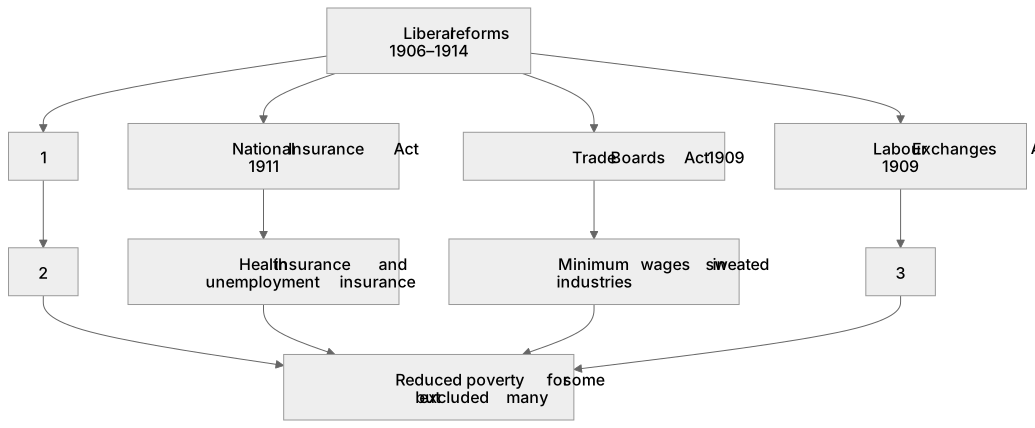
1Box 1
2Box 2
3Box 3
There is more to this lesson
The full lesson goes on to check your understanding and help you earn the marks. Create a free account to carry on, with your progress saved.
A week of Premium from your first lesson · Then the free plan continues · No card, no charge
Test your understanding of Paper 3, Option 34.2: Poverty, public health and the state in Britain, c1780–1939 - 4 Social and welfare reforms: pressure and action, 1880–1914: The impact of the Liberal government’s reforms: old age pensions and National Insurance; the Trade Boards Act 1909 and the Labour Exchanges Act 1909.
Active recall beats re-reading. Take an instant quiz now to test what you’ve learned and lock it into long-term memory.
A week of Premium from your first lesson · Then the free plan continues · No card, no charge