Pearson Edexcel · A-Level · History
Course version: 9HI0 · Version from Sept 2015
Poverty, public health and the state in Britain, c1780–1939 - 4 Social and…
Full specification wording
Paper 3, Option 34.2: Poverty, public health and the state in Britain, c1780–1939 - 4 Social and welfare reforms: pressure and action, 1880–1914: The significance of the Royal Commission on the Poor Laws, 1905–09 and of the majority and minority reports; the establishment of principles for welfare reform.
The Royal Commission on the Poor Laws (1905–09) reviewed the poor law system and produced two reports.
Checked against the Pearson Edexcel 9HI0 specification (opens in a new tab) on .
- Point 2 of 3
- 4 key terms
Study notes
From the checked teaching notes for this specification point.
The idea
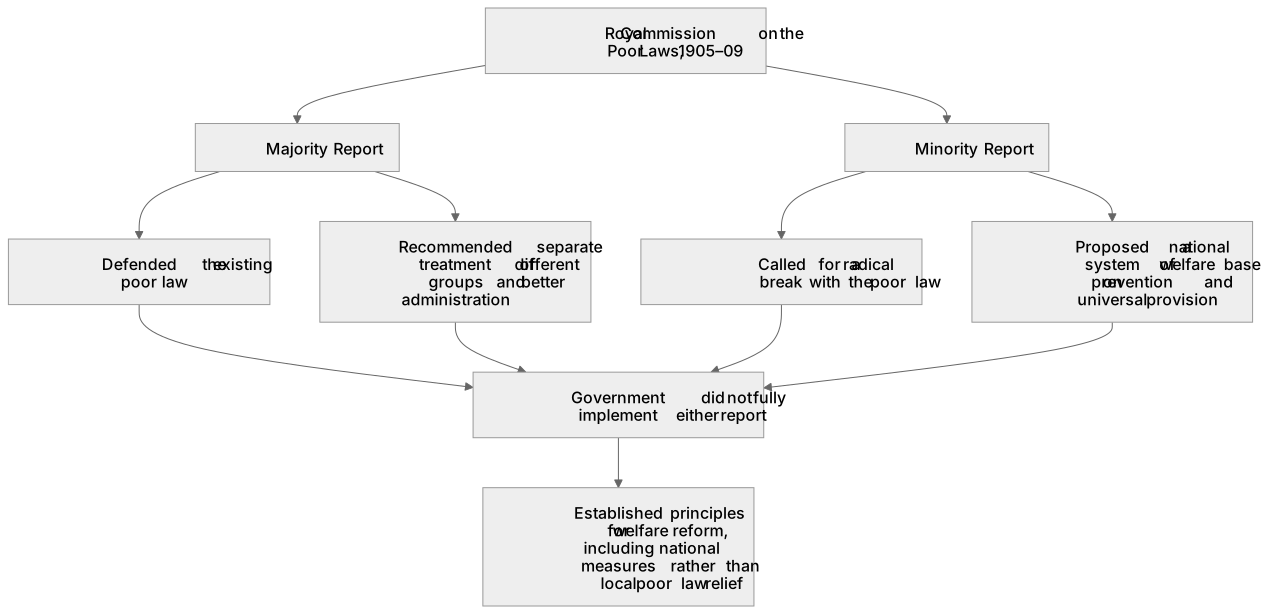
The Royal Commission on the Poor Laws (1905–09) reviewed the poor law system and produced two reports. The Majority Report, influenced by poor law administrators, defended the existing poor law but recommended improvements such as separate treatment of different groups and better administration. The Minority Report, signed by Beatrice Webb and others, called for a radical break with the poor law, proposing a national system of welfare based on prevention and universal provision. Although the government did not fully implement either report, the commission's work established key principles for future welfare reform, including the idea that poverty should be addressed through national measures rather than local poor law relief. These debates influenced the Liberal reforms and later welfare state thinking.
What earns the marks
- The Royal Commission on the Poor Laws (1905–09) was set up to investigate the poor law and its effectiveness.
- The Majority Report upheld the poor law but recommended administrative improvements and specialised treatment for different groups.
- The Minority Report, associated with Beatrice Webb, advocated abolishing the poor law and creating a national welfare system based on prevention.
- The split between the reports highlighted divisions over whether poverty was an individual or structural problem.
- The commission's work established principles such as national responsibility for welfare and prevention rather than mere relief, influencing later reforms.
Common mistakes and how to put them right
Stating that the Majority Report supported the Minority Report's proposals.
Put it right: The Majority Report defended the poor law, while the Minority Report called for its abolition.
Claiming the commission's recommendations were immediately enacted.
Put it right: The government implemented only some measures, and the reports mainly influenced future policy.
Attributing the Minority Report solely to Beatrice Webb.
Put it right: It was signed by a minority of members, including Webb, but was a collective document.
Exam tips
- Contrast the Majority and Minority Reports clearly, using specific proposals to illustrate differences.
- Explain how the reports contributed to the establishment of welfare principles, even if not fully implemented.
- Link the commission's work to the broader context of Liberal reforms and changing attitudes to poverty.
Try the lesson
The start of the Paper 3, Option 34.2: Poverty, public health and the state in Britain, c1780–1939 - 4 Social and welfare reforms: pressure and action, 1880–1914: The significance of the Royal Commission on the Poor Laws, 1905–09 and of the majority and minority reports; the establishment of principles for welfare reform. lesson, made from checked teaching notes for this specification point.
Have a go first
In which years did the Royal Commission on the Poor Laws sit and report?
Listen
The Royal Commission on the Poor Laws (1905–09) reviewed the poor law system and produced two reports. The Majority Report, influenced by poor law administrators, defended the existing poor law but recommended improvements such as separate treatment of different groups and better administration. The Minority Report, signed by Beatrice Webb and others, called for a radical break with the poor law, proposing a national system of welfare based on prevention and universal provision. Although the government did not fully implement either report, the commission's work established key principles for future welfare reform, including the idea that poverty should be addressed through national measures rather than local poor law relief. These debates influenced the Liberal reforms and later welfare state thinking. A strong answer earns marks for these points. The Royal Commission on the Poor Laws (1905–09) was set up to investigate the poor law and its effectiveness. The Majority Report upheld the poor law but recommended administrative improvements and specialised treatment for different groups. The Minority Report, associated with Beatrice Webb, advocated abolishing the poor law and creating a national welfare system based on prevention. The split between the reports highlighted divisions over whether poverty was an individual or structural problem. A common slip: stating that the Majority Report supported the Minority Report's proposals. Instead, the Majority Report defended the poor law, while the Minority Report called for its abolition. Exam tip: Contrast the Majority and Minority Reports clearly, using specific proposals to illustrate differences.
See it
Key words
Say what each word means before you turn the card.
Poor law reform
Try answering aloud or in your head before turning the card.
Welfare principles
Try answering aloud or in your head before turning the card.
Social investigation and policy
Try answering aloud or in your head before turning the card.
State responsibility for poverty
Try answering aloud or in your head before turning the card.
See every definition
- Poor law reform
- The Royal Commission on the Poor Laws reviewed the poor law system, and its Majority Report defended the existing poor law while recommending improvements such as better administration.
- Welfare principles
- The commission's work established key principles for future welfare reform, including the idea that poverty should be addressed through national measures rather than local poor law relief.
- Social investigation and policy
- The Royal Commission on the Poor Laws was set up to investigate the poor law and its effectiveness, producing majority and minority reports.
- State responsibility for poverty
- The commission's work established principles such as national responsibility for welfare and prevention rather than mere relief, influencing later reforms.
Label the diagram
Some boxes have lost their names. Pick the right name for each number.
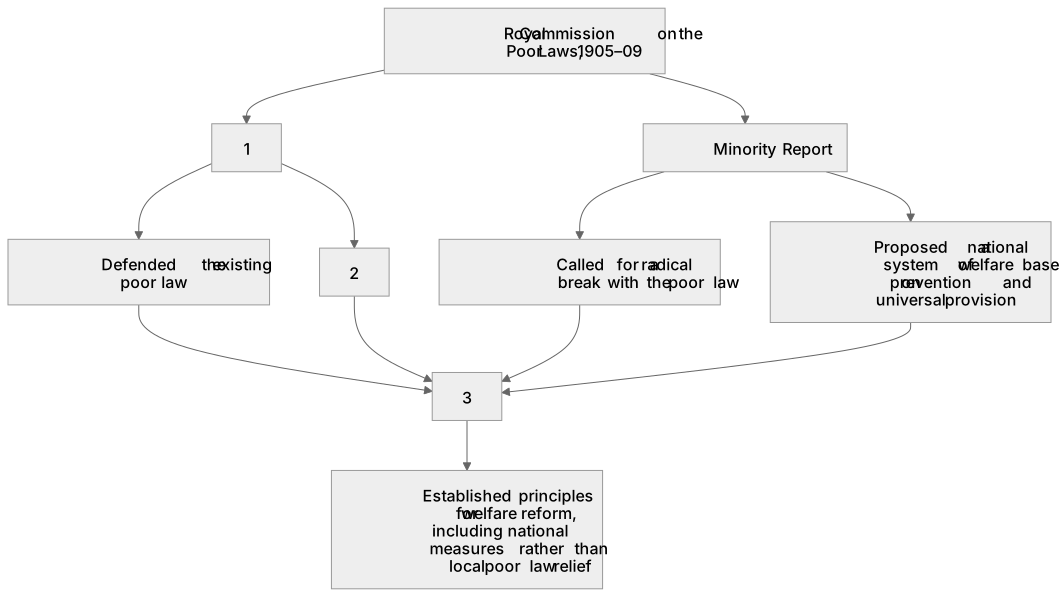
1Box 1
2Box 2
3Box 3
There is more to this lesson
The full lesson goes on to check your understanding and help you earn the marks. Create a free account to carry on, with your progress saved.
A week of Premium from your first lesson · Then the free plan continues · No card, no charge
Test your understanding of Paper 3, Option 34.2: Poverty, public health and the state in Britain, c1780–1939 - 4 Social and welfare reforms: pressure and action, 1880–1914: The significance of the Royal Commission on the Poor Laws, 1905–09 and of the majority and minority reports; the establishment of principles for welfare reform.
Active recall beats re-reading. Take an instant quiz now to test what you’ve learned and lock it into long-term memory.
A week of Premium from your first lesson · Then the free plan continues · No card, no charge