Pearson Edexcel · A-Level · History
Course version: 9HI0 · Version from Sept 2015
Britain: losing and gaining an empire, 1763–1914 - 1 The changing nature…
Full specification wording
Paper 3, Option 35.1: Britain: losing and gaining an empire, 1763–1914 - 1 The changing nature and extent of trade: Reasons for, and nature of, the changing patterns of trade, 1763-1914, including the slave trade, trade in coal and textiles, new trading patterns with the Americas, India and the Far East, the impact of industrialisation on trade and the importance of government policy (key developments: the abolition of the slave trade 1807, the adoption of free trade 1842–46, the repeal of the Navigation Acts 1849).
Between 1763 and 1914 Britain's trade shifted from protected Atlantic commerce to global free trade.
Checked against the Pearson Edexcel 9HI0 specification (opens in a new tab) on .
- Point 1 of 2
- 4 key terms
Study notes
From the checked teaching notes for this specification point.
The idea
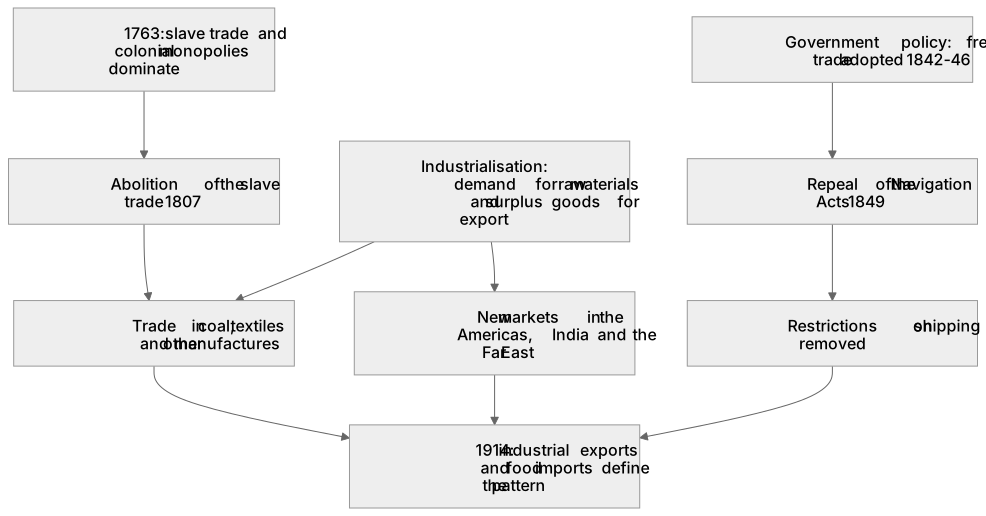
Between 1763 and 1914 Britain's trade shifted from protected Atlantic commerce to global free trade. In 1763 the slave trade and colonial monopolies dominated; by 1914 industrial exports and food imports defined the pattern. The slave trade declined after abolition in 1807, replaced by trade in coal, textiles and other manufactures. Industrialisation increased demand for raw materials and created surplus goods for export, while new markets opened in the Americas, India and the Far East. Government policy changed from protection to free trade through the 1842–46 reforms and the repeal of the Navigation Acts in 1849, which removed restrictions on shipping. These changes altered the reasons for trade, its nature and its direction, making Britain the world's leading trading nation.
What earns the marks
- Explains reasons for changing trade patterns: industrial demand for raw materials, surplus manufactures for export, and the search for new markets.
- Describes the nature of the slave trade and its decline after abolition in 1807, including its replacement by other commodities.
- Analyses the growth of coal and textile trades as key exports during industrialisation.
- Explains new trading patterns with the Americas, India and the Far East, including the exchange of manufactured goods for raw materials and food.
- Assesses the impact of industrialisation on trade: increased production, transport improvements and urban demand.
- Evaluates the importance of government policy: adoption of free trade 1842–46 and repeal of the Navigation Acts 1849 in removing barriers.
Common mistakes and how to put them right
Treating the abolition of the slave trade in 1807 as the immediate end of slavery itself.
Put it right: The 1807 Act abolished the British slave trade, but slavery in British colonies continued until emancipation in 1833.
Assuming free trade was adopted in a single year.
Put it right: The adoption of free trade occurred through a series of measures between 1842 and 1846, including the 1842 tariff reductions and the 1846 repeal of the Corn Laws.
Claiming the Navigation Acts were repealed before 1849.
Put it right: The Navigation Acts were repealed in 1849, removing restrictions on foreign shipping and further opening trade.
Exam tips
- Use specific key developments (1807, 1842–46, 1849) to anchor your argument about changing government policy.
- Link each trade pattern to a reason, such as industrial demand or government action, to show causation.
- Compare the nature of trade in 1763 with 1914 to highlight change over time.
Try the lesson
The start of the Paper 3, Option 35.1: Britain: losing and gaining an empire, 1763–1914 - 1 The changing nature and extent of trade: Reasons for, and nature of, the changing patterns of trade, 1763-1914, including the slave trade, trade in coal and textiles, new trading patterns with the Americas, India and the Far East, the impact of industrialisation on trade and the importance of government policy (key developments: the abolition of the slave trade 1807, the adoption of free trade 1842–46, the repeal of the Navigation Acts 1849). lesson, made from checked teaching notes for this specification point.
Have a go first
How did the key development in British trade policy in 1807 alter the nature of Britain's Atlantic commerce?
Listen
Between 1763 and 1914 Britain's trade shifted from protected Atlantic commerce to global free trade. In 1763 the slave trade and colonial monopolies dominated; by 1914 industrial exports and food imports defined the pattern. The slave trade declined after abolition in 1807, replaced by trade in coal, textiles and other manufactures. Industrialisation increased demand for raw materials and created surplus goods for export, while new markets opened in the Americas, India and the Far East. Government policy changed from protection to free trade through the 1842–46 reforms and the repeal of the Navigation Acts in 1849, which removed restrictions on shipping. These changes altered the reasons for trade, its nature and its direction, making Britain the world's leading trading nation. A strong answer earns marks for these points. Explains reasons for changing trade patterns: industrial demand for raw materials, surplus manufactures for export, and the search for new markets. Describes the nature of the slave trade and its decline after abolition in 1807, including its replacement by other commodities. Analyses the growth of coal and textile trades as key exports during industrialisation. Explains new trading patterns with the Americas, India and the Far East, including the exchange of manufactured goods for raw materials and food. A common slip: treating the abolition of the slave trade in 1807 as the immediate end of slavery itself. Instead, the 1807 Act abolished the British slave trade, but slavery in British colonies continued until emancipation in 1833. Exam tip: Use specific key developments (1807, 1842–46, 1849) to anchor your argument about changing government policy.
See it
Watch it explained
What is the one idea the video explains? Say it in a sentence.
Read the described scene instead
Between 1763 and 1914, Britain's trade changed from protected Atlantic commerce to global free trade. In 1763 the slave trade and colonial monopolies dominated. By 1914, industrial exports and food imports defined the pattern. This lesson traces the reasons for that change, its nature, and its direction. Why did trade patterns change? Industrialisation created demand for raw materials and surplus manufactures for export. Manufacturers and merchants also searched for new markets. Those three pressures — raw-material demand, surplus goods, and new markets — pushed British trade beyond its old Atlantic routes. In 1763, the slave trade and colonial monopolies dominated British commerce. The slave trade declined after abolition in 1807, when the British trade in enslaved people was abolished. It was replaced by trade in coal, textiles and other manufactures. Remember, the 1807 Act ended the trade, not slavery itself. Industrialisation changed the nature of trade. Increased production created surplus goods, while transport improvements moved them faster. Growing urban demand required imported raw materials and food. Britain exported coal and textiles and imported raw materials and food. New trading patterns developed with the Americas, India and the Far East, exchanging manufactured goods for raw materials and food. Government policy shifted from protection to free trade. The 1842 tariff reductions and the 1846 repeal of the Corn Laws formed the adoption of free trade between 1842 and 1846. Then the repeal of the Navigation Acts in 1849 removed restrictions on foreign shipping. Together these measures lowered barriers and further opened trade. Avoid three common errors. First, 1807 abolished the British slave trade, but slavery in British colonies continued until emancipation in 1833. Second, free trade was not adopted in a single year; it came through measures between 1842 and 1846. Third, the Navigation Acts were repealed in 1849, not earlier, removing restrictions on foreign shipping. So, between 1763 and 1914, trade shifted from protected Atlantic commerce to global free trade. Industrial demand, surplus manufactures and new markets changed what Britain traded and where. Government policy moved from protection to free trade. By 1914, Britain was the world's leading trading nation. Pause here and compare the nature of trade in 1763 with 1914.
Key words
Say what each word means before you turn the card.
Change and continuity in trade patterns
Try answering aloud or in your head before turning the card.
Causes and consequences of industrialisation
Try answering aloud or in your head before turning the card.
Government intervention and free trade
Try answering aloud or in your head before turning the card.
Empire and global trade networks
Try answering aloud or in your head before turning the card.
See every definition
- Change and continuity in trade patterns
- Between 1763 and 1914 trade shifted from protected Atlantic commerce to global free trade, altering the reasons for trade, its nature and its direction.
- Causes and consequences of industrialisation
- Industrialisation increased demand for raw materials and created surplus goods for export, while new markets opened in the Americas, India and the Far East.
- Government intervention and free trade
- Policy changed from protection to free trade through the 1842–46 reforms and the repeal of the Navigation Acts in 1849, which removed restrictions on shipping.
- Empire and global trade networks
- New trading patterns with the Americas, India and the Far East involved the exchange of manufactured goods for raw materials and food.
Label the diagram
Some boxes have lost their names. Pick the right name for each number.
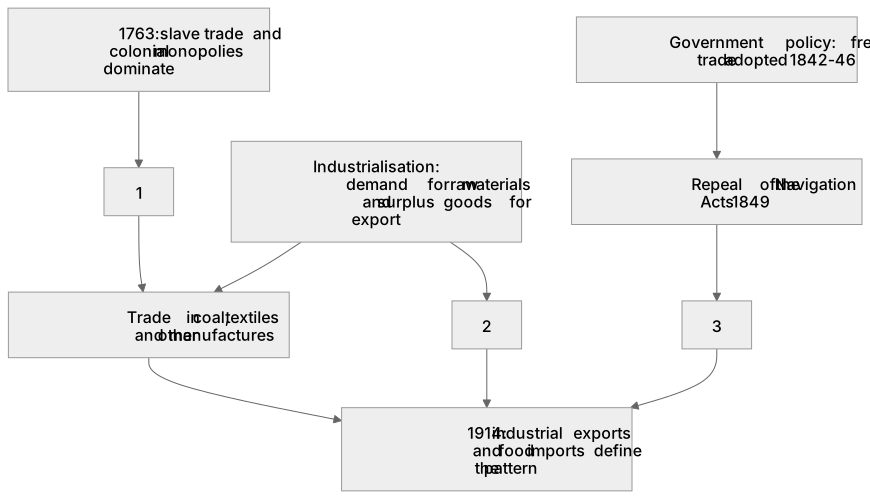
1Box 1
2Box 2
3Box 3
There is more to this lesson
The full lesson goes on to check your understanding and help you earn the marks. Create a free account to carry on, with your progress saved.
A week of Premium from your first lesson · Then the free plan continues · No card, no charge
Test your understanding of Paper 3, Option 35.1: Britain: losing and gaining an empire, 1763–1914 - 1 The changing nature and extent of trade: Reasons for, and nature of, the changing patterns of trade, 1763-1914, including the slave trade, trade in coal and textiles, new trading patterns with the Americas, India and the Far East, the impact of industrialisation on trade and the importance of government policy (key developments: the abolition of the slave trade 1807, the adoption of free trade 1842–46, the repeal of the Navigation Acts 1849).
Active recall beats re-reading. Take an instant quiz now to test what you’ve learned and lock it into long-term memory.
A week of Premium from your first lesson · Then the free plan continues · No card, no charge