Pearson Edexcel · A-Level · History
Course version: 9HI0 · Version from Sept 2015
Britain: losing and gaining an empire, 1763–1914 - 1 The changing nature…
Full specification wording
Paper 3, Option 35.1: Britain: losing and gaining an empire, 1763–1914 - 1 The changing nature and extent of trade: The changing importance of ports, entrepôts and trade routes within the UK and throughout the Empire, 1763-1914 (key developments: the acquisition of Singapore 1819 and Hong Kong 1842, the opening up of Shanghai to trade 1842, the purchase of the Suez Canal shares 1875, the acquisition of Zanzibar 1890, the lease of Wei hai-wei 1898).
Between 1763 and 1914, the importance of ports, entrepôts and trade routes shifted as Britain expanded its empire.
Checked against the Pearson Edexcel 9HI0 specification (opens in a new tab) on .
- Point 2 of 2
- 3 key terms
Study notes
From the checked teaching notes for this specification point.
The idea
Between 1763 and 1914, the importance of ports, entrepôts and trade routes shifted as Britain expanded its empire. In the UK, London, Liverpool and Glasgow grew as ports handling imperial trade. Entrepôts such as Singapore (acquired 1819) and Hong Kong (acquired 1842) became vital for re-exporting goods in Asia. The opening of Shanghai to trade in 1842 gave Britain access to Chinese markets. The purchase of Suez Canal shares in 1875 secured a shorter route to India and the Far East. The acquisition of Zanzibar in 1890 and the lease of Wei hai-wei in 1898 extended British strategic influence and control over trade routes. These developments changed the geography of trade, linking the UK to global networks.
What earns the marks
- Explains the changing importance of UK ports such as London, Liverpool and Glasgow in handling imperial trade.
- Describes the role of entrepôts like Singapore (1819) and Hong Kong (1842) in re-exporting goods and facilitating free trade.
- Analyses the significance of the opening of Shanghai to trade in 1842 for British access to Chinese markets.
- Assesses the impact of the purchase of Suez Canal shares in 1875 on trade routes to India and the Far East.
- Evaluates the acquisition of Zanzibar in 1890 and the lease of Wei hai-wei in 1898 in extending British trade influence.
- Explains how these developments changed trade routes within the UK and throughout the Empire.
Common mistakes and how to put them right
Assuming Singapore was acquired by military conquest.
Put it right by noting Stamford Raffles acquired it through a treaty with local rulers in 1819 to establish a trading post.
Confusing the acquisition of Hong Kong Island in 1842 with the later lease of the New Territories.
Put it right by specifying Hong Kong Island was ceded in 1842 under the Treaty of Nanking.
Claiming the Suez Canal shares were purchased in 1875 by the British government alone.
Put it right by noting the British government purchased the Khedive's shares, but the canal was jointly owned with French investors.
Exam tips
- Use the key developments as evidence to show how ports and routes changed in importance over time.
- Link each port or entrepôt to its specific role in trade, such as re-exporting or securing routes.
Try the lesson
The start of the Paper 3, Option 35.1: Britain: losing and gaining an empire, 1763–1914 - 1 The changing nature and extent of trade: The changing importance of ports, entrepôts and trade routes within the UK and throughout the Empire, 1763-1914 (key developments: the acquisition of Singapore 1819 and Hong Kong 1842, the opening up of Shanghai to trade 1842, the purchase of the Suez Canal shares 1875, the acquisition of Zanzibar 1890, the lease of Wei hai-wei 1898). lesson, made from checked teaching notes for this specification point.
Have a go first
Which port did Britain acquire in 1819 as an entrepôt for trade in the Far East?
Listen
Between 1763 and 1914, the importance of ports, entrepôts and trade routes shifted as Britain expanded its empire. In the UK, London, Liverpool and Glasgow grew as ports handling imperial trade. Entrepôts such as Singapore (acquired 1819) and Hong Kong (acquired 1842) became vital for re-exporting goods in Asia. The opening of Shanghai to trade in 1842 gave Britain access to Chinese markets. The purchase of Suez Canal shares in 1875 secured a shorter route to India and the Far East. The acquisition of Zanzibar in 1890 and the lease of Wei hai-wei in 1898 extended British strategic influence and control over trade routes. These developments changed the geography of trade, linking the UK to global networks. A strong answer earns marks for these points. Explains the changing importance of UK ports such as London, Liverpool and Glasgow in handling imperial trade. Describes the role of entrepôts like Singapore (1819) and Hong Kong (1842) in re-exporting goods and facilitating free trade. Analyses the significance of the opening of Shanghai to trade in 1842 for British access to Chinese markets. Assesses the impact of the purchase of Suez Canal shares in 1875 on trade routes to India and the Far East. A common slip: Assuming Singapore was acquired by military conquest. Instead, noting Stamford Raffles acquired it through a treaty with local rulers in 1819 to establish a trading post. Exam tip: Use the key developments as evidence to show how ports and routes changed in importance over time.
See it
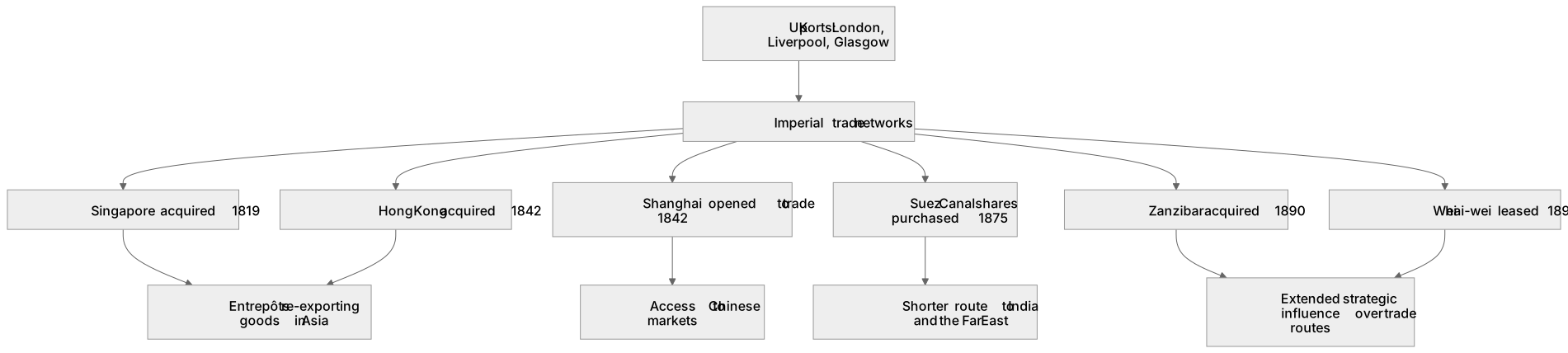
Put the events in order
Put these events in the order they happened, earliest first.
- 1. Acquisition of Hong Kong Island
- 2. Acquisition of Singapore as a trading post
- 3. Lease of Wei hai-wei
- 4. Purchase of Suez Canal shares
- 5. Acquisition of Zanzibar
Key words
Say what each word means before you turn the card.
Empire and trade networks
Try answering aloud or in your head before turning the card.
Strategic control of trade routes
Try answering aloud or in your head before turning the card.
Urban and port development
Try answering aloud or in your head before turning the card.
See every definition
- Empire and trade networks
- The geography of trade changed as developments linked the UK to global networks throughout the Empire between 1763 and 1914.
- Strategic control of trade routes
- The acquisition of Zanzibar in 1890 and the lease of Wei hai-wei in 1898 extended British strategic influence and control over trade routes.
- Urban and port development
- In the UK, London, Liverpool and Glasgow grew as ports handling imperial trade.
Label the diagram
Some boxes have lost their names. Pick the right name for each number.
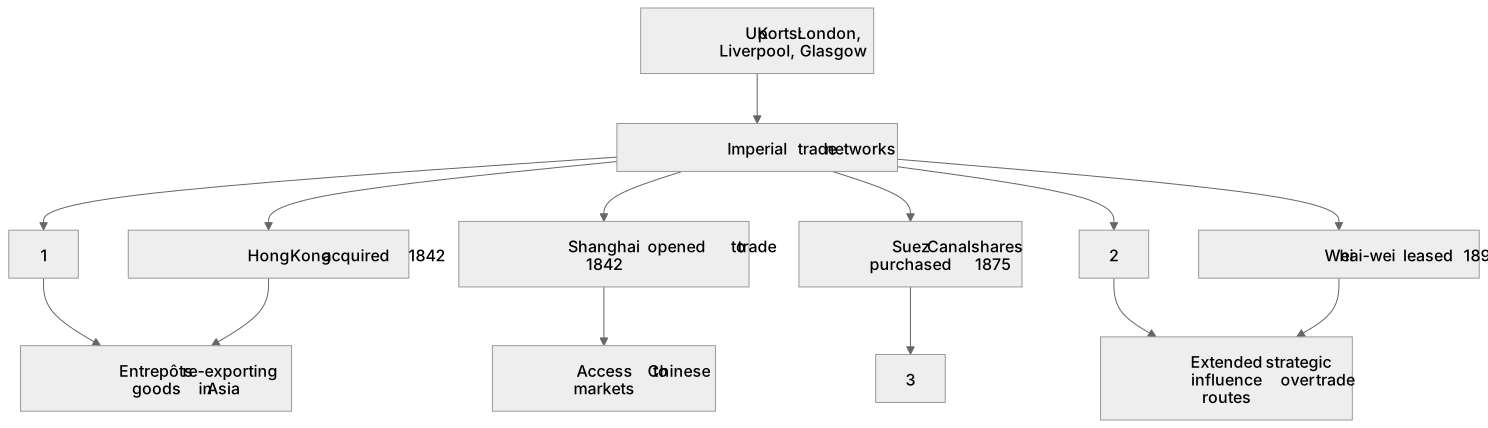
1Box 1
2Box 2
3Box 3
There is more to this lesson
The full lesson goes on to check your understanding and help you earn the marks. Create a free account to carry on, with your progress saved.
A week of Premium from your first lesson · Then the free plan continues · No card, no charge
Test your understanding of Paper 3, Option 35.1: Britain: losing and gaining an empire, 1763–1914 - 1 The changing nature and extent of trade: The changing importance of ports, entrepôts and trade routes within the UK and throughout the Empire, 1763-1914 (key developments: the acquisition of Singapore 1819 and Hong Kong 1842, the opening up of Shanghai to trade 1842, the purchase of the Suez Canal shares 1875, the acquisition of Zanzibar 1890, the lease of Wei hai-wei 1898).
Active recall beats re-reading. Take an instant quiz now to test what you’ve learned and lock it into long-term memory.
A week of Premium from your first lesson · Then the free plan continues · No card, no charge