Pearson Edexcel · A-Level · History
Course version: 9HI0 · Version from Sept 2015
The British experience of warfare, c1790–1918 - 2 Changes in weaponry and…
Full specification wording
Paper 3, Option 35.2: The British experience of warfare, c1790–1918 - 2 Changes in weaponry and the role of the people: Changing weaponry 1790-1918: the role of science and technology in improving weaponry (key developments: carronades and the navy in the 1790s, Congreve's rockets 1806, William Armstrong's new artillery 1859-60, the Vickers machine gun 1914-18, development of the tank 1915-18).
From 1790 to 1918, science and technology transformed weaponry.
Checked against the Pearson Edexcel 9HI0 specification (opens in a new tab) on .
- Point 1 of 2
- 4 key terms
Study notes
From the checked teaching notes for this specification point.
The idea
From 1790 to 1918, science and technology transformed weaponry. In the 1790s, the carronade gave the Royal Navy a powerful short-range gun. Congreve's rockets (1806) introduced early rocket artillery. William Armstrong's new artillery (1859–60) brought rifled breech-loading guns. The Vickers machine gun (1914–18) provided sustained automatic fire. The tank (1915–18) combined armour, mobility and firepower to break trench deadlock. These developments show how scientific advances, industrial capacity and military needs drove innovation, with mixed effectiveness and significant impact on tactics and outcomes.
What earns the marks
- Explain the carronade: its design, advantages (lighter, shorter, faster loading) and limitations (short range).
- Describe Congreve's rockets: their design, use in the Napoleonic Wars, and limitations such as inaccuracy.
- Analyse Armstrong's artillery: rifling, breech-loading, and its impact on range and accuracy.
- Evaluate the Vickers machine gun: reliability, rate of fire, and its effect on trench warfare.
- Assess the tank's development: early designs, first use at Flers-Courcelette (1916), and its role in breaking the stalemate.
Common mistakes and how to put them right
Attributing the carronade to the army rather than the Royal Navy.
Put it right: It was a naval gun.
Overstating the effectiveness of Congreve's rockets.
Put it right: They were often inaccurate and had limited impact.
Assuming the tank was immediately decisive.
Put it right: Early tanks were mechanically unreliable and used in small numbers.
Exam tips
- Use specific dates and names, such as Congreve's rockets 1806, to show precise knowledge.
- Link each weapon to the broader theme of science and technology in warfare.
- Assess both strengths and weaknesses of each development to demonstrate balanced analysis.
Try the lesson
The start of the Paper 3, Option 35.2: The British experience of warfare, c1790–1918 - 2 Changes in weaponry and the role of the people: Changing weaponry 1790-1918: the role of science and technology in improving weaponry (key developments: carronades and the navy in the 1790s, Congreve's rockets 1806, William Armstrong's new artillery 1859-60, the Vickers machine gun 1914-18, development of the tank 1915-18). lesson, made from checked teaching notes for this specification point.
Have a go first
Which new type of naval gun, introduced in the 1790s, was shorter and lighter than existing cannon and could fire a heavy shot?
Listen
From 1790 to 1918, science and technology transformed weaponry. In the 1790s, the carronade gave the Royal Navy a powerful short-range gun. Congreve's rockets (1806) introduced early rocket artillery. William Armstrong's new artillery (1859–60) brought rifled breech-loading guns. The Vickers machine gun (1914–18) provided sustained automatic fire. The tank (1915–18) combined armour, mobility and firepower to break trench deadlock. These developments show how scientific advances, industrial capacity and military needs drove innovation, with mixed effectiveness and significant impact on tactics and outcomes. A strong answer earns marks for these points. Explain the carronade: its design, advantages (lighter, shorter, faster loading) and limitations (short range). Describe Congreve's rockets: their design, use in the Napoleonic Wars, and limitations such as inaccuracy. Analyse Armstrong's artillery: rifling, breech-loading, and its impact on range and accuracy. Evaluate the Vickers machine gun: reliability, rate of fire, and its effect on trench warfare. Exam tip: Use specific dates and names, such as Congreve's rockets 1806, to show precise knowledge.
See it
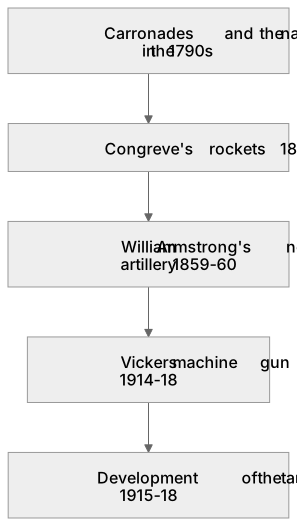
Put it in order
Put these steps in the order they happen.
- 1. Congreve's rockets 1806
- 2. William Armstrong's new artillery 1859-60
- 3. Carronades and the navy in the 1790s
- 4. Development of the tank 1915-18
- 5. Vickers machine gun 1914-18
Key words
Say what each word means before you turn the card.
Role of science and technology in warfare
Try answering aloud or in your head before turning the card.
Industrialisation and weapon production
Try answering aloud or in your head before turning the card.
Impact of new weapons on tactics
Try answering aloud or in your head before turning the card.
Effectiveness and limitations of innovations
Try answering aloud or in your head before turning the card.
See every definition
- Role of science and technology in warfare
- Scientific advances, industrial capacity and military needs drove innovation in weaponry, with mixed effectiveness and significant impact on tactics and outcomes.
- Industrialisation and weapon production
- Industrial capacity, alongside scientific advances and military needs, drove innovation in weaponry from 1790 to 1918.
- Impact of new weapons on tactics
- Developments such as the tank, which combined armour, mobility and firepower to break trench deadlock, had a significant impact on tactics and outcomes.
- Effectiveness and limitations of innovations
- These developments had mixed effectiveness, and each weapon's strengths and weaknesses must both be assessed.
Label the diagram
Some boxes have lost their names. Pick the right name for each number.
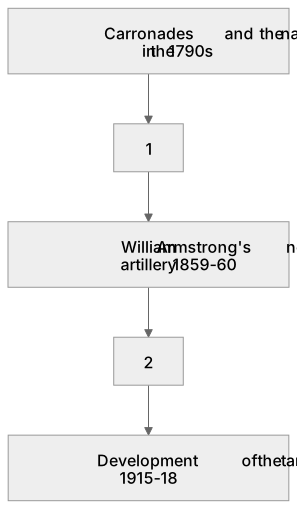
1Box 1
2Box 2
There is more to this lesson
The full lesson goes on to check your understanding and help you earn the marks. Create a free account to carry on, with your progress saved.
A week of Premium from your first lesson · Then the free plan continues · No card, no charge
Test your understanding of Paper 3, Option 35.2: The British experience of warfare, c1790–1918 - 2 Changes in weaponry and the role of the people: Changing weaponry 1790-1918: the role of science and technology in improving weaponry (key developments: carronades and the navy in the 1790s, Congreve's rockets 1806, William Armstrong's new artillery 1859-60, the Vickers machine gun 1914-18, development of the tank 1915-18).
Active recall beats re-reading. Take an instant quiz now to test what you’ve learned and lock it into long-term memory.
A week of Premium from your first lesson · Then the free plan continues · No card, no charge