Pearson Edexcel · A-Level · History
Course version: 9HI0 · Version from Sept 2015
The British experience of warfare, c1790–1918 - 2 Changes in weaponry and…
Full specification wording
Paper 3, Option 35.2: The British experience of warfare, c1790–1918 - 2 Changes in weaponry and the role of the people: The populace and the war effort 1790-1918: providing finance – taxation, bonds, consols and war loans; changing civilian roles, from camp followers to an organised home front.
This theme examines how Britain financed warfare and how civilians contributed between 1790 and 1918.
Checked against the Pearson Edexcel 9HI0 specification (opens in a new tab) on .
- Point 2 of 2
- 3 key terms
Study notes
From the checked teaching notes for this specification point.
The idea
This theme examines how Britain financed warfare and how civilians contributed between 1790 and 1918. Finance involved taxation, bonds, consols and war loans. Taxation included duties on goods and income tax, introduced during the French Wars and expanded in the First World War. Bonds and consols were government securities: investors lent money in return for interest, and consols paid interest indefinitely. War loans were large-scale borrowing, often through public campaigns. Civilian roles changed from camp followers, who accompanied armies and provided cooking, laundry and nursing, to an organised home front, with government direction of labour, munitions work, voluntary aid and propaganda.
What earns the marks
- Explains how taxation provided finance, including duties and income tax, and how the tax base expanded during major wars.
- Explains how bonds, consols and war loans raised money by borrowing from investors and the public, and how interest and repayment worked.
- Describes the changing role of camp followers, including support tasks such as cooking, laundry and nursing, and their gradual replacement by more formal arrangements.
- Explains how the home front became organised, with government direction of labour, munitions production, voluntary organisations and propaganda.
- Compares finance and civilian roles across the period, identifying continuity and change between the French Wars and the First World War.
Common mistakes and how to put them right
Treating consols as a form of taxation rather than as government bonds that pay interest.
Put it right by classifying consols as long-term borrowing.
Assuming camp followers were only soldiers' families.
Put it right by recognising their essential support roles, including cooking, laundry and nursing.
Describing the home front as entirely voluntary.
Put it right by noting increasing government direction of labour and production, especially after 1915.
Exam tips
- Use specific examples such as income tax, consols and the Ministry of Munitions to support each point.
- Link finance and civilian roles to the wider war effort, showing how money and people sustained fighting.
- Compare the French Wars and the First World War to show change over time, rather than describing each period separately.
Try the lesson
The start of the Paper 3, Option 35.2: The British experience of warfare, c1790–1918 - 2 Changes in weaponry and the role of the people: The populace and the war effort 1790-1918: providing finance – taxation, bonds, consols and war loans; changing civilian roles, from camp followers to an organised home front. lesson, made from checked teaching notes for this specification point.
Have a go first
What was the specific role of 'consols' in providing finance for the British war effort during the French Wars (1793–1815)?
Listen
This theme examines how Britain financed warfare and how civilians contributed between 1790 and 1918. Finance involved taxation, bonds, consols and war loans. Taxation included duties on goods and income tax, introduced during the French Wars and expanded in the First World War. Bonds and consols were government securities: investors lent money in return for interest, and consols paid interest indefinitely. War loans were large-scale borrowing, often through public campaigns. Civilian roles changed from camp followers, who accompanied armies and provided cooking, laundry and nursing, to an organised home front, with government direction of labour, munitions work, voluntary aid and propaganda. A strong answer earns marks for these points. Explains how taxation provided finance, including duties and income tax, and how the tax base expanded during major wars. Explains how bonds, consols and war loans raised money by borrowing from investors and the public, and how interest and repayment worked. Describes the changing role of camp followers, including support tasks such as cooking, laundry and nursing, and their gradual replacement by more formal arrangements. Explains how the home front became organised, with government direction of labour, munitions production, voluntary organisations and propaganda. A common slip: Treating consols as a form of taxation rather than as government bonds that pay interest. Instead, classifying consols as long-term borrowing. Exam tip: Use specific examples such as income tax, consols and the Ministry of Munitions to support each point.
See it
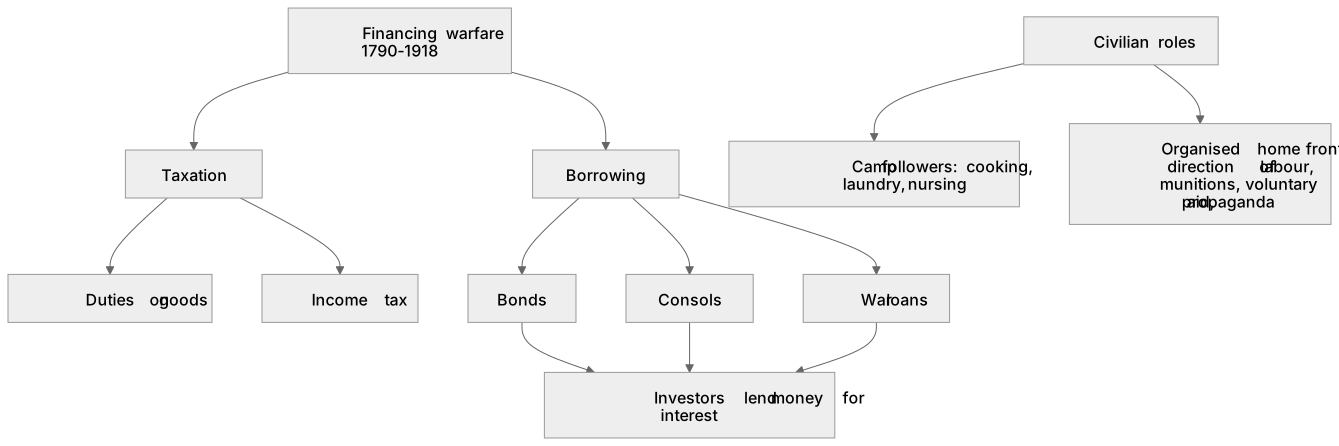
Key words
Say what each word means before you turn the card.
Finance
Try answering aloud or in your head before turning the card.
Civilian roles
Try answering aloud or in your head before turning the card.
Home front
Try answering aloud or in your head before turning the card.
See every definition
- Finance
- Involved taxation, bonds, consols and war loans, which together provided the money for warfare between 1790 and 1918.
- Civilian roles
- Changed from camp followers, who accompanied armies and provided cooking, laundry and nursing, to an organised home front.
- Home front
- Became organised, with government direction of labour, munitions work, voluntary aid and propaganda.
Label the diagram
Some boxes have lost their names. Pick the right name for each number.
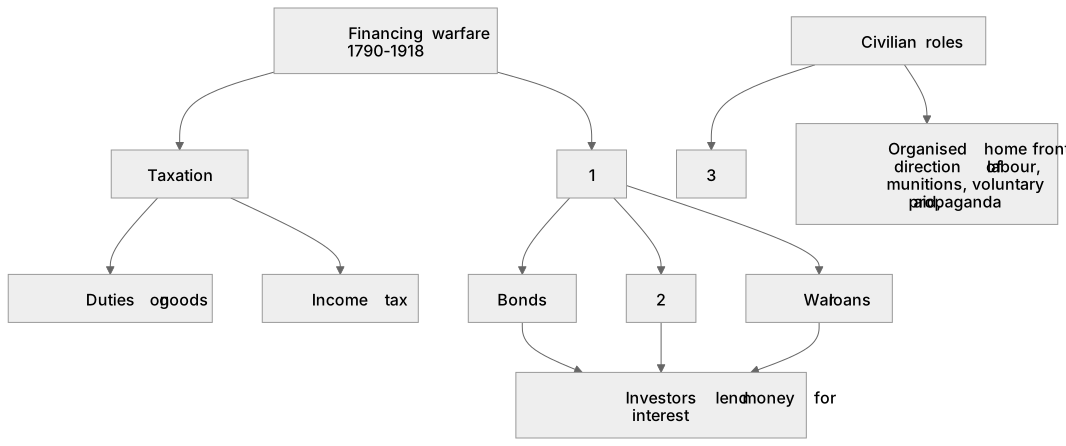
1Box 1
2Box 2
3Box 3
There is more to this lesson
The full lesson goes on to check your understanding and help you earn the marks. Create a free account to carry on, with your progress saved.
A week of Premium from your first lesson · Then the free plan continues · No card, no charge
Test your understanding of Paper 3, Option 35.2: The British experience of warfare, c1790–1918 - 2 Changes in weaponry and the role of the people: The populace and the war effort 1790-1918: providing finance – taxation, bonds, consols and war loans; changing civilian roles, from camp followers to an organised home front.
Active recall beats re-reading. Take an instant quiz now to test what you’ve learned and lock it into long-term memory.
A week of Premium from your first lesson · Then the free plan continues · No card, no charge