Pearson Edexcel · A-Level · History
Course version: 9HI0 · Version from Sept 2015
The British experience of warfare, c1790–1918 - 5 The war in the air,…
Full specification wording
Paper 3, Option 35.2: The British experience of warfare, c1790–1918 - 5 The war in the air, 1914–18: The development of the Royal Flying Corps as a fighting force; the importance of technology in the development of air combat; the importance of air power in achieving victory in 1918.
The Royal Flying Corps (RFC) began in 1912 as a small reconnaissance arm, but rapidly developed into a structured fighting force.
Checked against the Pearson Edexcel 9HI0 specification (opens in a new tab) on .
- Point 2 of 3
- 4 key terms
Study notes
From the checked teaching notes for this specification point.
The idea
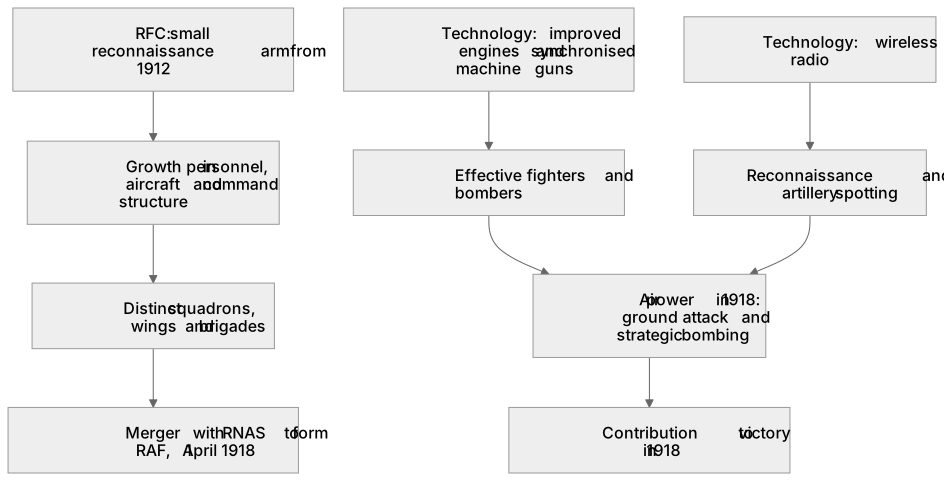
The Royal Flying Corps (RFC) began in 1912 as a small reconnaissance arm, but rapidly developed into a structured fighting force. Its growth involved massive increases in personnel, aircraft and command structure, culminating in its merger with the RNAS to form the Royal Air Force (RAF) on 1 April 1918. Technology drove air combat: advances in engine power and synchronised machine guns transformed aircraft into effective fighters and bombers, while wireless radio revolutionised reconnaissance and artillery spotting. By 1918, air power contributed to victory through ground attack and strategic bombing. The scale of this expansion is evident in the RAF possessing over 20,000 aircraft and approximately 291,000 personnel by the Armistice.
What earns the marks
- Explains how the RFC grew from a small pre-war force into a large, structured fighting force with distinct squadrons, wings and brigades, leading to the creation of the Royal Air Force in April 1918.
- Analyses the importance of technology such as improved engines and synchronised machine guns in enabling fighting and bombing, and wireless radio for reconnaissance and artillery spotting.
- Assesses the importance of air power in achieving victory in 1918 through roles such as artillery spotting, contact patrols, ground attack and strategic bombing, and evaluates the extent of its contribution.
- Uses specific examples, such as the Battle of Amiens in August 1918, to illustrate how air power supported ground operations and contributed to Allied advances.
- Evaluates different interpretations of the significance of air power, considering factors like German air resistance, weather, and the continued primacy of ground forces.
Common mistakes and how to put them right
Attributing end-of-war personnel and aircraft figures to the RFC.
Put it right: The RFC ceased to exist on 1 April 1918; the figures of over 20,000 aircraft and approximately 291,000 personnel by the Armistice belong to the newly formed RAF.
Overstating the decisiveness of strategic bombing by 1918.
Put it right: Acknowledge that while bombing had some effect, its impact on victory was limited compared to tactical air support and ground operations.
Assuming the RFC was a large, modern force from the start of the war.
Put it right: Recognise that in 1914 it had fewer than 100 aircraft and grew gradually in response to wartime demands.
Exam tips
- When discussing technology, link specific innovations to their effects on combat roles, such as how synchronised guns made fighters more effective.
- Use precise dates and names, such as the formation of the RAF on 1 April 1918, to demonstrate secure knowledge and avoid conflating the RFC with the RAF.
Try the lesson
The start of the Paper 3, Option 35.2: The British experience of warfare, c1790–1918 - 5 The war in the air, 1914–18: The development of the Royal Flying Corps as a fighting force; the importance of technology in the development of air combat; the importance of air power in achieving victory in 1918. lesson, made from checked teaching notes for this specification point.
Have a go first
In which year was the Royal Flying Corps formed, before it went on to serve as a fighting force in the First World War?
Listen
The Royal Flying Corps (RFC) began in 1912 as a small reconnaissance arm, but rapidly developed into a structured fighting force. Its growth involved massive increases in personnel, aircraft and command structure, culminating in its merger with the RNAS to form the Royal Air Force (RAF) on 1 April 1918. Technology drove air combat: advances in engine power and synchronised machine guns transformed aircraft into effective fighters and bombers, while wireless radio revolutionised reconnaissance and artillery spotting. By 1918, air power contributed to victory through ground attack and strategic bombing. The scale of this expansion is evident in the RAF possessing over 20,000 aircraft and approximately 291,000 personnel by the Armistice. A strong answer earns marks for these points. Explains how the RFC grew from a small pre-war force into a large, structured fighting force with distinct squadrons, wings and brigades, leading to the creation of the Royal Air Force in April 1918. Analyses the importance of technology such as improved engines and synchronised machine guns in enabling fighting and bombing, and wireless radio for reconnaissance and artillery spotting. Assesses the importance of air power in achieving victory in 1918 through roles such as artillery spotting, contact patrols, ground attack and strategic bombing, and evaluates the extent of its contribution. Uses specific examples, such as the Battle of Amiens in August 1918, to illustrate how air power supported ground operations and contributed to Allied advances. A common slip: Attributing end-of-war personnel and aircraft figures to the RFC. Instead, the RFC ceased to exist on 1 April 1918; the figures of over 20,000 aircraft and approximately 291,000 personnel by the Armistice belong to the newly formed RAF. Exam tip: When discussing technology, link specific innovations to their effects on combat roles, such as how synchronised guns made fighters more effective.
See it
Key words
Say what each word means before you turn the card.
Royal Flying Corps
Try answering aloud or in your head before turning the card.
Royal Air Force
Try answering aloud or in your head before turning the card.
synchronised machine guns
Try answering aloud or in your head before turning the card.
wireless radio
Try answering aloud or in your head before turning the card.
See every definition
- Royal Flying Corps
- A fighting force that began in 1912 as a small reconnaissance arm and rapidly developed into a structured force with distinct squadrons, wings and brigades.
- Royal Air Force
- Formed on 1 April 1918 through the merger of the Royal Flying Corps with the RNAS.
- synchronised machine guns
- A technological advance that, alongside improved engine power, transformed aircraft into effective fighters and bombers.
- wireless radio
- A technological development that revolutionised reconnaissance and artillery spotting.
Label the diagram
Some boxes have lost their names. Pick the right name for each number.
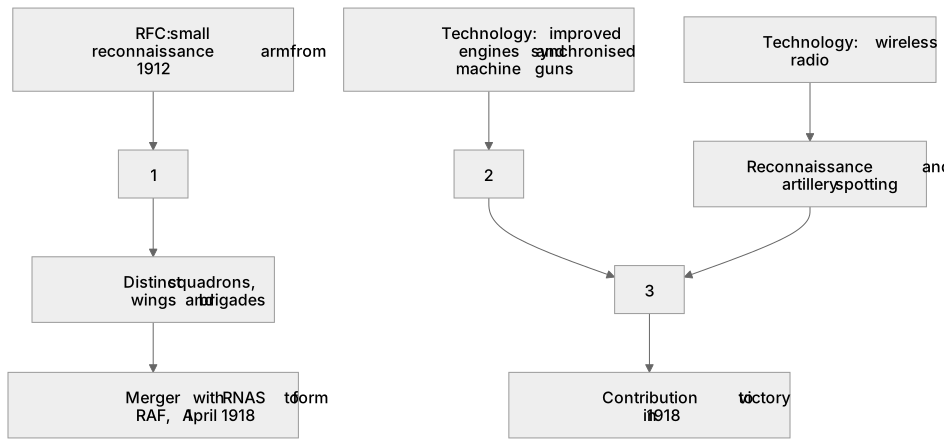
1Box 1
2Box 2
3Box 3
There is more to this lesson
The full lesson goes on to check your understanding and help you earn the marks. Create a free account to carry on, with your progress saved.
A week of Premium from your first lesson · Then the free plan continues · No card, no charge
Test your understanding of Paper 3, Option 35.2: The British experience of warfare, c1790–1918 - 5 The war in the air, 1914–18: The development of the Royal Flying Corps as a fighting force; the importance of technology in the development of air combat; the importance of air power in achieving victory in 1918.
Active recall beats re-reading. Take an instant quiz now to test what you’ve learned and lock it into long-term memory.
A week of Premium from your first lesson · Then the free plan continues · No card, no charge