Pearson Edexcel · A-Level · History
Course version: 9HI0 · Version from Sept 2015
The British experience of warfare, c1790–1918 - 5 The war in the air,…
Full specification wording
Paper 3, Option 35.2: The British experience of warfare, c1790–1918 - 5 The war in the air, 1914–18: The impact of aerial reconnaissance: photographic, observation and communication.
Aerial reconnaissance transformed military intelligence.
Checked against the Pearson Edexcel 9HI0 specification (opens in a new tab) on .
- Point 1 of 3
- 4 key terms
Study notes
From the checked teaching notes for this specification point.
The idea
Aerial reconnaissance transformed military intelligence. Photographic reconnaissance used cameras to map trenches, artillery positions and troop movements, providing detailed images for planning. Observation involved aircrew visually spotting enemy activity, directing artillery fire and reporting changes. Communication relied on wireless, signal lamps and message drops to relay information quickly. Together, these methods improved targeting, reduced surprise and shaped tactics, though weather, enemy aircraft and limited technology posed challenges. The impact was a more informed and coordinated war on the ground.
What earns the marks
- Explains how photographic reconnaissance provided permanent, detailed records for mapping and artillery targeting.
- Describes the role of visual observation in spotting enemy movements and adjusting artillery fire in real time.
- Analyses how communication methods (wireless, lamps, message drops) linked aircraft to ground commanders and enabled rapid response.
- Assesses the overall impact: improved intelligence, more effective artillery, and changes in tactics, despite limitations such as weather and enemy opposition.
- Evaluates the significance for the conduct of war: reconnaissance as a force multiplier and a step towards modern surveillance.
Common mistakes and how to put them right
Assuming all reconnaissance was photographic.
Put it right: Recognise that visual observation and communication were equally important and often used together.
Overstating the reliability of early wireless.
Put it right: Note that wireless was bulky, unreliable and often supplemented by other methods.
Ignoring the dangers and limitations.
Put it right: Include the effects of weather, enemy fighters and anti-aircraft fire on reconnaissance effectiveness.
Exam tips
- Use specific examples, such as the role of reconnaissance at the Somme or Passchendaele, to illustrate impact.
- Distinguish between the three types of reconnaissance and explain how they complemented each other.
- Link reconnaissance to outcomes like improved artillery accuracy or tactical surprise to show significance.
Try the lesson
The start of the Paper 3, Option 35.2: The British experience of warfare, c1790–1918 - 5 The war in the air, 1914–18: The impact of aerial reconnaissance: photographic, observation and communication. lesson, made from checked teaching notes for this specification point.
Have a go first
How did the development of aerial reconnaissance most significantly impact the conduct of trench warfare on the Western Front?
Listen
Aerial reconnaissance transformed military intelligence. Photographic reconnaissance used cameras to map trenches, artillery positions and troop movements, providing detailed images for planning. Observation involved aircrew visually spotting enemy activity, directing artillery fire and reporting changes. Communication relied on wireless, signal lamps and message drops to relay information quickly. Together, these methods improved targeting, reduced surprise and shaped tactics, though weather, enemy aircraft and limited technology posed challenges. The impact was a more informed and coordinated war on the ground. A strong answer earns marks for these points. Explains how photographic reconnaissance provided permanent, detailed records for mapping and artillery targeting. Describes the role of visual observation in spotting enemy movements and adjusting artillery fire in real time. Analyses how communication methods (wireless, lamps, message drops) linked aircraft to ground commanders and enabled rapid response. Assesses the overall impact: improved intelligence, more effective artillery, and changes in tactics, despite limitations such as weather and enemy opposition. A common slip: Assuming all reconnaissance was photographic. Instead, Recognise that visual observation and communication were equally important and often used together. Exam tip: Use specific examples, such as the role of reconnaissance at the Somme or Passchendaele, to illustrate impact.
See it
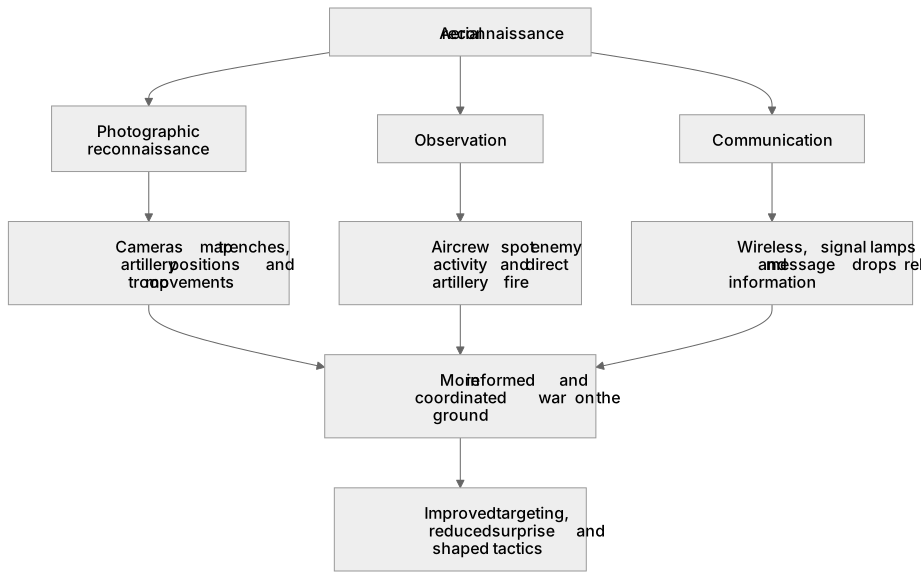
Key words
Say what each word means before you turn the card.
Photographic reconnaissance
Try answering aloud or in your head before turning the card.
Observation
Try answering aloud or in your head before turning the card.
Communication
Try answering aloud or in your head before turning the card.
Aerial reconnaissance
Try answering aloud or in your head before turning the card.
See every definition
- Photographic reconnaissance
- Used cameras to map trenches, artillery positions and troop movements, providing detailed images for planning.
- Observation
- Involved aircrew visually spotting enemy activity, directing artillery fire and reporting changes.
- Communication
- Relied on wireless, signal lamps and message drops to relay information quickly.
- Aerial reconnaissance
- Transformed military intelligence and produced a more informed and coordinated war on the ground.
Label the diagram
Some boxes have lost their names. Pick the right name for each number.
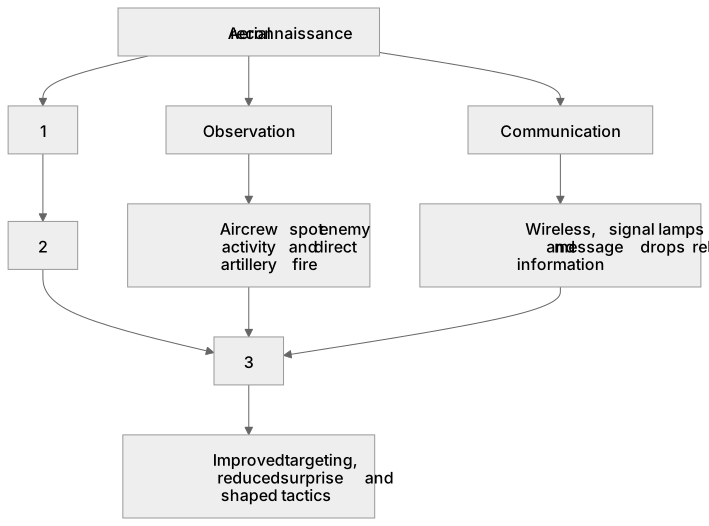
1Box 1
2Box 2
3Box 3
There is more to this lesson
The full lesson goes on to check your understanding and help you earn the marks. Create a free account to carry on, with your progress saved.
A week of Premium from your first lesson · Then the free plan continues · No card, no charge
Test your understanding of Paper 3, Option 35.2: The British experience of warfare, c1790–1918 - 5 The war in the air, 1914–18: The impact of aerial reconnaissance: photographic, observation and communication.
Active recall beats re-reading. Take an instant quiz now to test what you’ve learned and lock it into long-term memory.
A week of Premium from your first lesson · Then the free plan continues · No card, no charge