Pearson Edexcel · A-Level · History
Course version: 9HI0 · Version from Sept 2015
Protest, agitation and parliamentary reform in Britain, c1780–1928 - 1…
Full specification wording
Paper 3, Option 36.1: Protest, agitation and parliamentary reform in Britain, c1780–1928 - 1 Radical reformers, c1790–1819: Government responses: the trial of the leaders of the London Corresponding Society and suspension of Habeas Corpus, 1794, the Treason Act and Seditious Meetings Act 1795, the Gagging Acts 1817 and the Six Acts 1819.
This topic examines government responses to radical protest.
Checked against the Pearson Edexcel 9HI0 specification (opens in a new tab) on .
- Point 2 of 3
- 4 key terms
Study notes
From the checked teaching notes for this specification point.
The idea
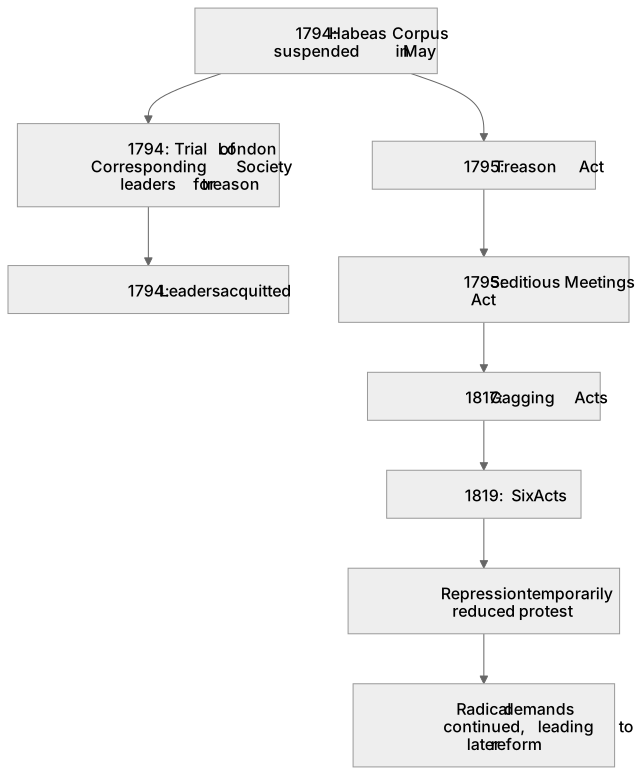
This topic examines government responses to radical protest. In May 1794, the government suspended Habeas Corpus, allowing detention without trial, and later that year tried leaders of the London Corresponding Society for treason; they were acquitted. In 1795, the Treason Act made it easier to convict for treason, and the Seditious Meetings Act restricted public meetings. In 1817, following Spa Fields, the Gagging Acts suspended Habeas Corpus again and banned seditious meetings. In 1819, the Six Acts suppressed radical publications, restricted public meetings, and increased penalties for sedition. These measures aimed to crush radicalism but often increased resentment and failed to stop reform demands.
What earns the marks
- 1794: Habeas Corpus suspended in May, allowing imprisonment without trial; trial of LCS leaders for treason later that year ended in acquittal.
- 1795: Treason Act defined treason more broadly; Seditious Meetings Act limited meetings and required licences for debating societies.
- 1817: Gagging Acts suspended Habeas Corpus and banned seditious meetings; aimed to suppress unrest after Spa Fields and the attack on the Prince Regent.
- 1819: Six Acts restricted public meetings, increased stamp duty on newspapers, and allowed magistrates to seize arms.
- Overall impact: repression temporarily reduced protest but radical demands continued, leading to later reform.
Common mistakes and how to put them right
Saying the LCS leaders were convicted of treason.
Put it right: They were acquitted.
Confusing the 1795 Treason Act with the 1817 Gagging Acts.
Put it right: The 1795 Act broadened treason; the 1817 Acts suspended Habeas Corpus and banned meetings.
Claiming the Six Acts ended radical protest.
Put it right: They suppressed some activities but radicalism persisted.
Exam tips
- Link each government response to the protest it aimed to suppress, such as the 1817 Gagging Acts following Spa Fields.
- Assess the effectiveness of each measure in reducing radical activity.
- Use specific terms of the Acts to show precise knowledge.
Try the lesson
The start of the Paper 3, Option 36.1: Protest, agitation and parliamentary reform in Britain, c1780–1928 - 1 Radical reformers, c1790–1819: Government responses: the trial of the leaders of the London Corresponding Society and suspension of Habeas Corpus, 1794, the Treason Act and Seditious Meetings Act 1795, the Gagging Acts 1817 and the Six Acts 1819. lesson, made from checked teaching notes for this specification point.
Have a go first
What was the main purpose of the suspension of Habeas Corpus in 1794?
Listen
This topic examines government responses to radical protest. In May 1794, the government suspended Habeas Corpus, allowing detention without trial, and later that year tried leaders of the London Corresponding Society for treason; they were acquitted. In 1795, the Treason Act made it easier to convict for treason, and the Seditious Meetings Act restricted public meetings. In 1817, following Spa Fields, the Gagging Acts suspended Habeas Corpus again and banned seditious meetings. In 1819, the Six Acts suppressed radical publications, restricted public meetings, and increased penalties for sedition. These measures aimed to crush radicalism but often increased resentment and failed to stop reform demands. A strong answer earns marks for these points. 1794: Habeas Corpus suspended in May, allowing imprisonment without trial; trial of LCS leaders for treason later that year ended in acquittal. 1795: Treason Act defined treason more broadly; Seditious Meetings Act limited meetings and required licences for debating societies. 1817: Gagging Acts suspended Habeas Corpus and banned seditious meetings; aimed to suppress unrest after Spa Fields and the attack on the Prince Regent. 1819: Six Acts restricted public meetings, increased stamp duty on newspapers, and allowed magistrates to seize arms. A common slip: saying the LCS leaders were convicted of treason. Instead, they were acquitted. Exam tip: Link each government response to the protest it aimed to suppress, such as the 1817 Gagging Acts following Spa Fields.
See it
Put the events in order
Put these events in the order they happened, earliest first.
- 1. Six Acts restricted public meetings and increased newspaper stamp duty
- 2. Trial of the leaders of the London Corresponding Society
- 3. Gagging Acts suspended Habeas Corpus and banned seditious meetings
- 4. Treason Act and Seditious Meetings Act passed
Key words
Say what each word means before you turn the card.
Repression and civil liberties
Try answering aloud or in your head before turning the card.
Government fear of revolution
Try answering aloud or in your head before turning the card.
The rule of law and treason trials
Try answering aloud or in your head before turning the card.
The balance between order and reform
Try answering aloud or in your head before turning the card.
See every definition
- Repression and civil liberties
- Measures such as suspending Habeas Corpus, banning seditious meetings and restricting publications aimed to crush radicalism but often increased resentment.
- Government fear of revolution
- Responses to radical protest included suspending Habeas Corpus, treason trials, the Treason Act and the Seditious Meetings Act.
- The rule of law and treason trials
- Leaders of the London Corresponding Society were tried for treason in 1794 and were acquitted.
- The balance between order and reform
- Repression temporarily reduced protest but failed to stop reform demands, leading to later reform.
Label the diagram
Some boxes have lost their names. Pick the right name for each number.
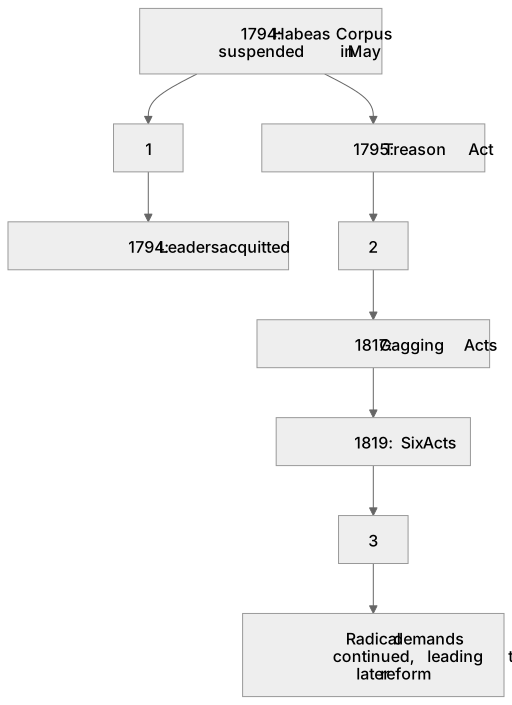
1Box 1
2Box 2
3Box 3
There is more to this lesson
The full lesson goes on to check your understanding and help you earn the marks. Create a free account to carry on, with your progress saved.
A week of Premium from your first lesson · Then the free plan continues · No card, no charge
Test your understanding of Paper 3, Option 36.1: Protest, agitation and parliamentary reform in Britain, c1780–1928 - 1 Radical reformers, c1790–1819: Government responses: the trial of the leaders of the London Corresponding Society and suspension of Habeas Corpus, 1794, the Treason Act and Seditious Meetings Act 1795, the Gagging Acts 1817 and the Six Acts 1819.
Active recall beats re-reading. Take an instant quiz now to test what you’ve learned and lock it into long-term memory.
A week of Premium from your first lesson · Then the free plan continues · No card, no charge