Pearson Edexcel · A-Level · History
Course version: 9HI0 · Version from Sept 2015
Ireland and the Union, c1774–1923 - 1 Towards emancipation, 1774–1830:…
Full specification wording
Paper 3, Option 36.2: Ireland and the Union, c1774–1923 - 1 Towards emancipation, 1774–1830: Daniel O’Connell and impact of the Catholic Board 1811 and the Catholic Association 1823; the County Clare elections, 1828 and 1829; the passage of the Roman Catholic Relief Act 1829 through parliament and its impact.
Daniel O’Connell transformed Irish Catholic politics by founding the Catholic Board in 1811 and the Catholic Association in 1823.
Checked against the Pearson Edexcel 9HI0 specification (opens in a new tab) on .
- Point 2 of 3
- 4 key terms
Study notes
From the checked teaching notes for this specification point.
The idea
Daniel O’Connell transformed Irish Catholic politics by founding the Catholic Board in 1811 and the Catholic Association in 1823. The Board gave educated Catholics a platform but faced suppression. The Association, funded by the ‘Catholic rent’, mobilised priests and tenant farmers. O’Connell’s decision to stand in County Clare in 1828 produced a decisive by-election victory. Fearing civil war, the government passed the Roman Catholic Relief Act in April 1829, allowing Catholics to sit in parliament while raising the county franchise. A second County Clare by-election followed in July 1829 as O'Connell refused the old oath. The Act's impact was profound: it split the Tory party and set a precedent for mass agitation.
What earns the marks
- Explains how the Catholic Board of 1811 provided a national platform for Catholic grievances but lacked mass support and was weakened by government suppression.
- Analyses how the Catholic Association of 1823, through the Catholic rent and the involvement of parish priests, created a disciplined mass movement.
- Assesses the significance of O’Connell’s victory in the County Clare by-election of 1828 as a direct challenge to the exclusion of Catholics from parliament, pressuring the government.
- Evaluates the passage of the Roman Catholic Relief Act 1829 (April) and its political consequences, such as the disintegration of the Tory party.
- Discusses the 1829 County Clare by-election (July), necessitated by O'Connell's refusal of the old oath, and the overall impact of the Act on the Irish franchise.
Common mistakes and how to put them right
Implying the 1829 County Clare by-election pressured the passage of the 1829 Act.
Put it right: The Act passed in April 1829; the second by-election occurred in July 1829 because O'Connell refused to take the old oath required for his 1828 election.
Confusing the Catholic Board (1811) with the Catholic Association (1823).
Put it right: The Board was an elite body, while the Association was a mass movement.
Assuming the 1829 Act gave Catholics full political equality.
Put it right: It allowed them to sit in parliament, but it also raised the county franchise, reducing the number of Catholic voters.
Exam tips
- Use precise dates and terms: Catholic Board 1811, Catholic Association 1823, Catholic rent, County Clare 1828 and 1829, Roman Catholic Relief Act 1829.
- Link O’Connell’s tactics to the wider political context, such as the fear of civil war and the divisions within the Tory party.
Try the lesson
The start of the Paper 3, Option 36.2: Ireland and the Union, c1774–1923 - 1 Towards emancipation, 1774–1830: Daniel O’Connell and impact of the Catholic Board 1811 and the Catholic Association 1823; the County Clare elections, 1828 and 1829; the passage of the Roman Catholic Relief Act 1829 through parliament and its impact. lesson, made from checked teaching notes for this specification point.
Have a go first
Which body did Daniel O’Connell help to establish in 1823 to campaign for Catholic emancipation?
Listen
Daniel O’Connell transformed Irish Catholic politics by founding the Catholic Board in 1811 and the Catholic Association in 1823. The Board gave educated Catholics a platform but faced suppression. The Association, funded by the ‘Catholic rent’, mobilised priests and tenant farmers. O’Connell’s decision to stand in County Clare in 1828 produced a decisive by-election victory. Fearing civil war, the government passed the Roman Catholic Relief Act in April 1829, allowing Catholics to sit in parliament while raising the county franchise. A second County Clare by-election followed in July 1829 as O'Connell refused the old oath. The Act's impact was profound: it split the Tory party and set a precedent for mass agitation. A strong answer earns marks for these points. Explains how the Catholic Board of 1811 provided a national platform for Catholic grievances but lacked mass support and was weakened by government suppression. Analyses how the Catholic Association of 1823, through the Catholic rent and the involvement of parish priests, created a disciplined mass movement. Assesses the significance of O’Connell’s victory in the County Clare by-election of 1828 as a direct challenge to the exclusion of Catholics from parliament, pressuring the government. Evaluates the passage of the Roman Catholic Relief Act 1829 (April) and its political consequences, such as the disintegration of the Tory party. A common slip: implying the 1829 County Clare by-election pressured the passage of the 1829 Act. Instead, the Act passed in April 1829; the second by-election occurred in July 1829 because O'Connell refused to take the old oath required for his 1828 election. Exam tip: Use precise dates and terms: Catholic Board 1811, Catholic Association 1823, Catholic rent, County Clare 1828 and 1829, Roman Catholic Relief Act 1829.
See it
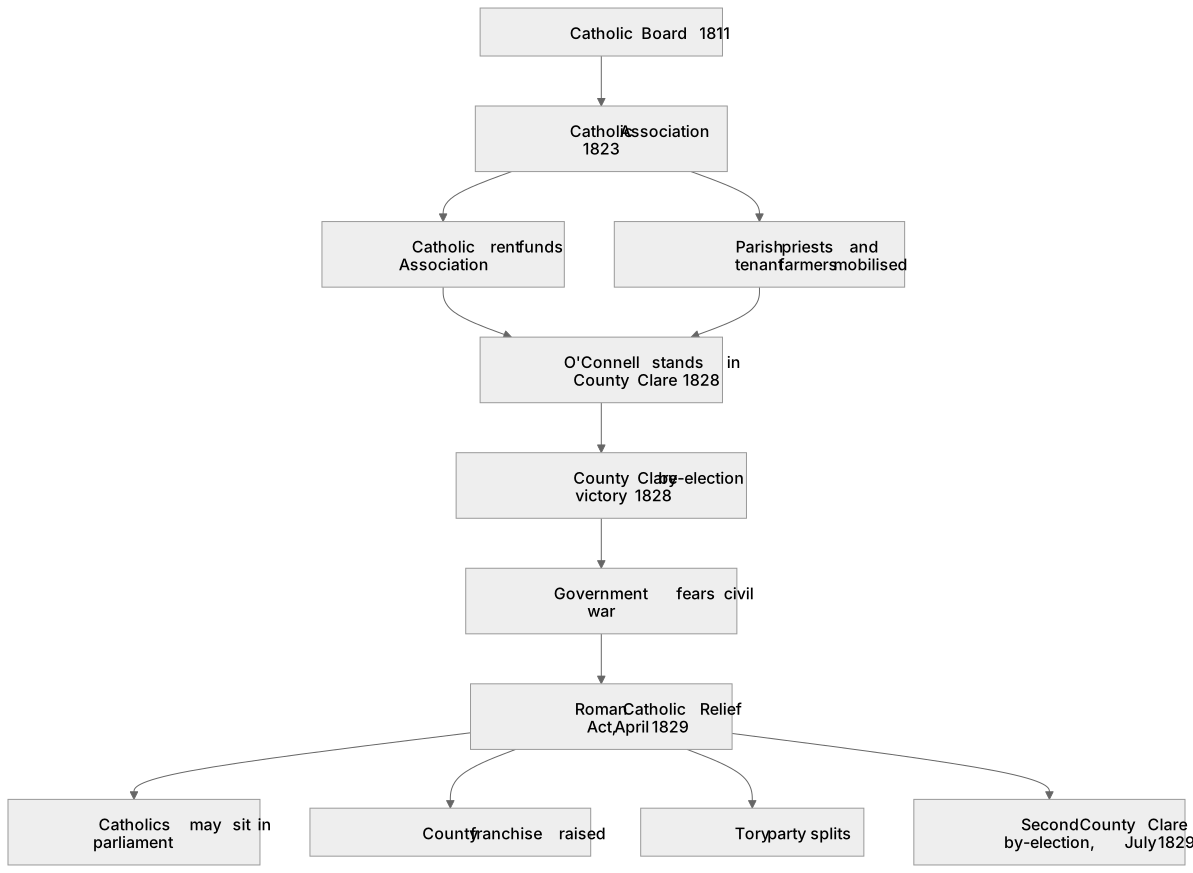
Put the events in order
Put these events in the order they happened, earliest first.
- 1. Roman Catholic Relief Act passed through parliament
- 2. Catholic Board founded, giving educated Catholics a platform
- 3. O'Connell's decisive victory in the County Clare by-election
- 4. Catholic Association founded, funded by the Catholic rent
Key words
Say what each word means before you turn the card.
Catholic Board
Try answering aloud or in your head before turning the card.
Catholic Association
Try answering aloud or in your head before turning the card.
Catholic rent
Try answering aloud or in your head before turning the card.
Roman Catholic Relief Act 1829
Try answering aloud or in your head before turning the card.
See every definition
- Catholic Board
- A body founded in 1811 that gave educated Catholics a platform for Catholic grievances but lacked mass support and was weakened by government suppression.
- Catholic Association
- A body founded in 1823 which, through the Catholic rent and the involvement of parish priests, created a disciplined mass movement.
- Catholic rent
- The funding that allowed the Catholic Association to mobilise priests and tenant farmers.
- Roman Catholic Relief Act 1829
- Passed in April 1829, it allowed Catholics to sit in parliament while raising the county franchise, and it split the Tory party.
Label the diagram
Some boxes have lost their names. Pick the right name for each number.
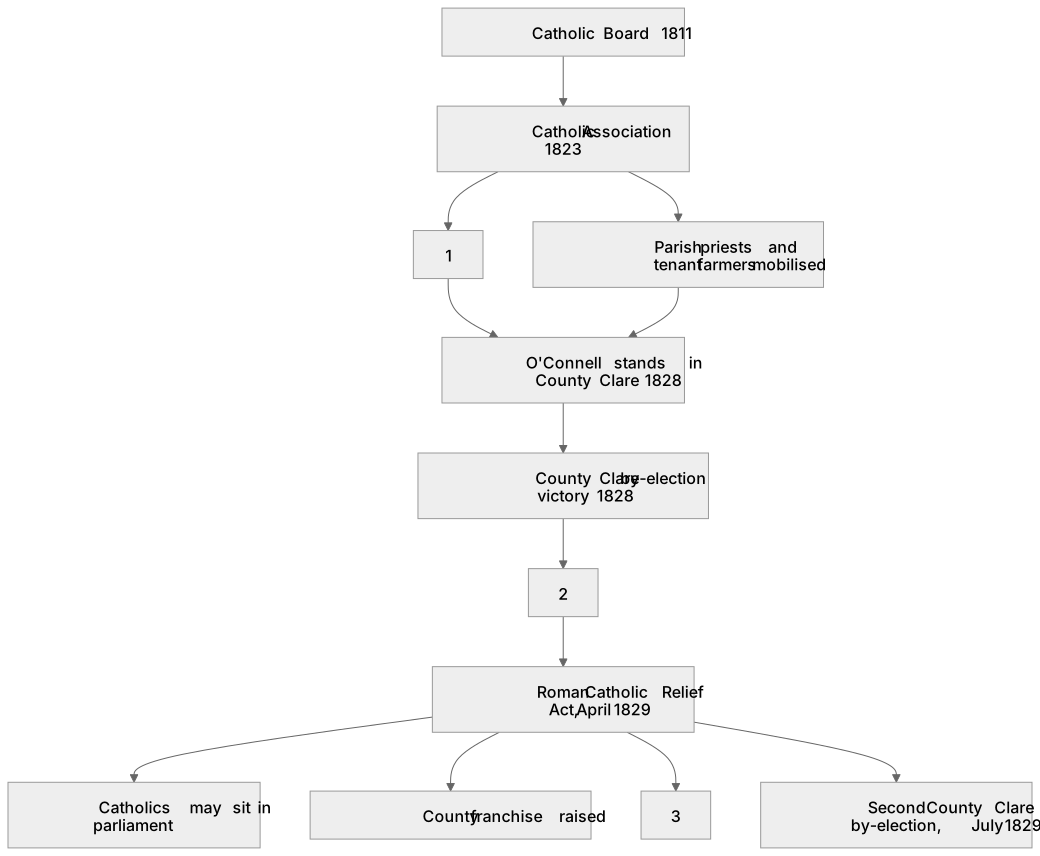
1Box 1
2Box 2
3Box 3
There is more to this lesson
The full lesson goes on to check your understanding and help you earn the marks. Create a free account to carry on, with your progress saved.
A week of Premium from your first lesson · Then the free plan continues · No card, no charge
Test your understanding of Paper 3, Option 36.2: Ireland and the Union, c1774–1923 - 1 Towards emancipation, 1774–1830: Daniel O’Connell and impact of the Catholic Board 1811 and the Catholic Association 1823; the County Clare elections, 1828 and 1829; the passage of the Roman Catholic Relief Act 1829 through parliament and its impact.
Active recall beats re-reading. Take an instant quiz now to test what you’ve learned and lock it into long-term memory.
A week of Premium from your first lesson · Then the free plan continues · No card, no charge