Pearson Edexcel · A-Level · History
Course version: 9HI0 · Version from Sept 2015
Ireland and the Union, c1774–1923 - 1 Towards emancipation, 1774–1830: The…
Full specification wording
Paper 3, Option 36.2: Ireland and the Union, c1774–1923 - 1 Towards emancipation, 1774–1830: The significance of the campaign in the Irish parliament to remove restrictions on Irish trade, 1778–82; the impact of the removal of the restrictions on the Irish economy.
Between 1778 and 1782, Irish Patriot politicians campaigned in the Irish parliament to remove restrictions on Irish trade imposed by British navigation laws.
Checked against the Pearson Edexcel 9HI0 specification (opens in a new tab) on .
- Point 3 of 3
- 4 key terms
Study notes
From the checked teaching notes for this specification point.
The idea
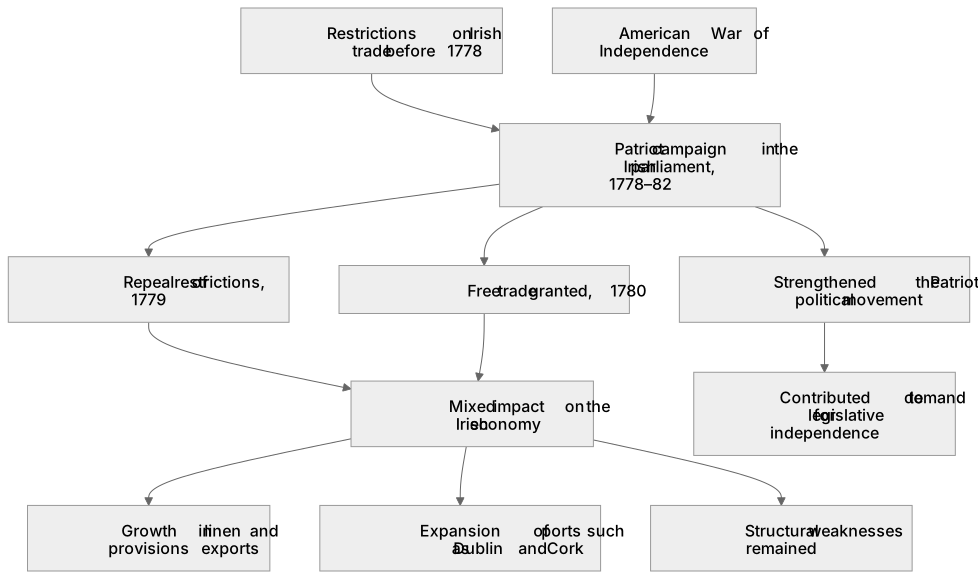
Between 1778 and 1782, Irish Patriot politicians campaigned in the Irish parliament to remove restrictions on Irish trade imposed by British navigation laws. They argued that Ireland suffered from commercial disadvantages, especially in colonial trade. The campaign gained momentum from the American War of Independence, which threatened British trade and made concessions prudent. Key measures included the repeal of restrictions in 1779 and the granting of free trade in 1780. The impact on the Irish economy was mixed: exports of linen and provisions grew, and ports such as Dublin and Cork expanded, but structural weaknesses remained, including dependence on British markets and limited industrial development. The campaign also strengthened the Patriot political movement, contributing to the wider demand for legislative independence.
What earns the marks
- Explains the nature of the restrictions on Irish trade before 1778, including the navigation acts and prohibitions on exporting certain goods to the colonies.
- Analyses the arguments and methods used by the Irish parliament in the campaign, such as Patriot speeches, petitions and the use of the American crisis as leverage.
- Assesses the significance of the concessions granted between 1778 and 1782, including the repeal of restrictions and the granting of free trade.
- Evaluates the economic impact of the removal of restrictions, considering sectors such as linen, provisions, shipping and the overall balance of trade.
- Discusses the political consequences of the campaign, including the strengthening of the Patriot party and the link to the broader movement for legislative independence.
Common mistakes and how to put them right
Assuming that the removal of restrictions immediately transformed the Irish economy.
Put it right: Present a balanced assessment of economic change.
Confusing the trade campaign with the later campaign for legislative independence.
Put it right: Distinguish the aims and outcomes of each.
Overstating the role of the British parliament.
Put it right: Clarify the roles of both parliaments.
Exam tips
- Use specific examples of restricted goods and the measures that removed restrictions, such as the 1779 and 1780 acts.
- Support economic impact with evidence of export growth or port development, but also note continuing weaknesses.
- Connect the trade campaign to the wider political context, including the American war and the rise of the Patriots.
Try the lesson
The start of the Paper 3, Option 36.2: Ireland and the Union, c1774–1923 - 1 Towards emancipation, 1774–1830: The significance of the campaign in the Irish parliament to remove restrictions on Irish trade, 1778–82; the impact of the removal of the restrictions on the Irish economy. lesson, made from checked teaching notes for this specification point.
Have a go first
How did the Irish Patriot opposition significantly escalate their campaign to force the British government to remove restrictions on Irish trade in 1779?
Listen
Between 1778 and 1782, Irish Patriot politicians campaigned in the Irish parliament to remove restrictions on Irish trade imposed by British navigation laws. They argued that Ireland suffered from commercial disadvantages, especially in colonial trade. The campaign gained momentum from the American War of Independence, which threatened British trade and made concessions prudent. Key measures included the repeal of restrictions in 1779 and the granting of free trade in 1780. The impact on the Irish economy was mixed: exports of linen and provisions grew, and ports such as Dublin and Cork expanded, but structural weaknesses remained, including dependence on British markets and limited industrial development. The campaign also strengthened the Patriot political movement, contributing to the wider demand for legislative independence. A strong answer earns marks for these points. Explains the nature of the restrictions on Irish trade before 1778, including the navigation acts and prohibitions on exporting certain goods to the colonies. Analyses the arguments and methods used by the Irish parliament in the campaign, such as Patriot speeches, petitions and the use of the American crisis as leverage. Assesses the significance of the concessions granted between 1778 and 1782, including the repeal of restrictions and the granting of free trade. Evaluates the economic impact of the removal of restrictions, considering sectors such as linen, provisions, shipping and the overall balance of trade. A common slip: Assuming that the removal of restrictions immediately transformed the Irish economy: growth occurred but was uneven and limited by other factors. Instead, present a balanced assessment of economic change. Exam tip: Use specific examples of restricted goods and the measures that removed restrictions, such as the 1779 and 1780 acts.
See it
Put the events in order
Put these events in the order they happened, earliest first.
- 1. Campaign began in Irish parliament to remove trade restrictions
- 2. Granting of free trade to Ireland
- 3. Repeal of restrictions on Irish trade
Key words
Say what each word means before you turn the card.
Colonial trade
Try answering aloud or in your head before turning the card.
Free trade
Try answering aloud or in your head before turning the card.
Patriot political movement
Try answering aloud or in your head before turning the card.
Legislative independence
Try answering aloud or in your head before turning the card.
See every definition
- Colonial trade
- Trade that was subject to restrictions imposed by British navigation laws, which Irish Patriot politicians argued left Ireland with commercial disadvantages.
- Free trade
- What was granted in 1780, following the repeal of restrictions in 1779, as a concession made prudent by the American War of Independence.
- Patriot political movement
- A movement strengthened by the campaign in the Irish parliament, contributing to the wider demand for legislative independence.
- Legislative independence
- The wider demand to which the campaign contributed after strengthening the Patriot political movement.
Label the diagram
Some boxes have lost their names. Pick the right name for each number.
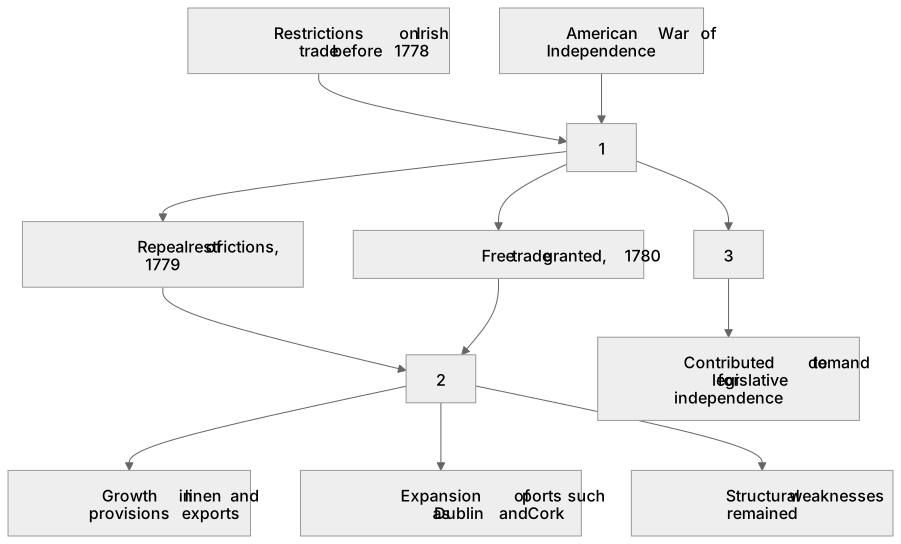
1Box 1
2Box 2
3Box 3
There is more to this lesson
The full lesson goes on to check your understanding and help you earn the marks. Create a free account to carry on, with your progress saved.
A week of Premium from your first lesson · Then the free plan continues · No card, no charge
Test your understanding of Paper 3, Option 36.2: Ireland and the Union, c1774–1923 - 1 Towards emancipation, 1774–1830: The significance of the campaign in the Irish parliament to remove restrictions on Irish trade, 1778–82; the impact of the removal of the restrictions on the Irish economy.
Active recall beats re-reading. Take an instant quiz now to test what you’ve learned and lock it into long-term memory.
A week of Premium from your first lesson · Then the free plan continues · No card, no charge